Welcome

Welcome to my blog

This is where I post various musings about wildlife and ecology, observations of interesting species (often invertebrates)
and bits of research that grab my attention. As well as blogging, I undertake professional ecological & wildlife surveys
covering invertebrates, plants, birds, reptiles, amphibians and some mammals, plus habitat assessment and management
advice
. I don't work on planning applications/for developers. The pages on the right will tell you more about my work,
main interests and key projects, and you can follow my academic work here.
Showing posts with label Hymenoptera. Show all posts

Thursday, 30 July 2015

Bioblitz 2 - The Hatching

Earlier in the summer I helped out with identification at a bioblitz, and one of the things I was given to look at was a cluster of pupae attached to an oak leaf. It didn't take long to work out that they were a species of small parasitic wasps in the genus Eulophus, but they needed to be reared to adulthood to be identified to species. So, that's what I did...

Now empty, the ring of pupae that surround the host caterpillar (removed), giving this stage of Eulophus the name 'tombstone pupae'.
Side view of Eulophus - note the metallic green colour, much reduced wing venation and long pale legs. The body, excluding legs, wings and antennae is around 2mm long.
Note the bulges on the mesoscutum just in front of the wing bases. The line around the bottom of a bulge is called the notaulix (pl. notaulices) and is only sharp in the front half. This is diagnostic of the subfamily Eulophinae.
The antennae are inserted level with the base of the eyes, not halfway up. This is one characteristic of the genus Eulophus.
The scutellum (the upper surface between the wing bases here) is only slightly convex, not strongly bulging. This is another characteristic of Eulophus.
More characteristics - the front coxae (basal segments) are pale and the mid coxae are metallic.
These (and some other hard-to-photograph) features mean that this species is Eulophus larvarum. It is common in the UK and has two forms - the spring form (April-June) and the summer form (June-August). The summer form has a pale spot near the front of the gaster (the broad or 'main' part of the abdomen) which is seen here.

The pale/yellow spot on the gaster showing this to be the summer form of E. larvarum.
This species is a parasite of the exposed caterpillars of moths in several families in the UK. Being so tiny they are often overlooked, but careful searxching may produce specimens and they were easy to both raise (in a  ventilated lidded pot) and (to my surprise) identify, using Askew (1968) which is now available as a free download - see below.


Reference

Askew, R.R. (1968). Handbooks for the Identification of British Insects 8(2b). Hymenoptera: Chalcidoidea Section b. RES, London. [free download here]

Monday, 8 June 2015

Bioblitz bits AKA things in other things

I've done a couple of bioblitzes as entomological geek-in-residence for the day, identifying things that are a little tricky, and the most recent was just a couple of days ago in Southampton, around the Southampton University campus. This involves me looking for specimens myself, but during busy periods such as when groups come back from recording sessions, I'm at a table with a microscope and a pile of books. A lot of different species passed through my hands that day, but here are a couple of less familiar one that are both endoparasites...

The species of interest here isn't the aphid, but the disc-shaped structure below it. The aphid is a mummified husk at this stage because it has been parasitised by the small wasp Discritulus planiceps. This lives inside the aphid, then exits through the body wall and develops into an adult inside the disc-like cocoon it builds beneath the host skin. Wasps of the genus Praon do something similar but their cocoons are tent-shaped.
This cluster of pupae was attached to the underside of an oak leaf. They are each a few millimetres long and have small blobs of what I assume are dried faeces at one end. A bit of research indicated that they are probably wasps of the genus Eulophus. They are now in my hatchery to see if I can confirm the species once they emerge. They will have emerged from a caterpillar host before pupating and the fragments to the left of the cluster are probably where it was attached before falling off the leaf. A more familar species is the braconid wasp Apanteles glomeratus that has a similar lifestyle, parasitising the caterpillars of white butterflies like Pieris.

A close-up of a Eulophus pupa - various structures are quite clearly visible such as eyes and mouthparts.
At the end of the day, Lizzy from HBIC announced the total number of species recorded on the day - 257, an increase of about 30 on last year's event, although more records will trickle in a specimens like the Eulophus above are identified.

Monday, 28 July 2014

Nest of tiny delights

Wow - a month since my last post - there has been no shortage of wildlife to write about, just no 'spare' time to do the writing. However, the paid stuff is quiet for a few days at least, so I thought I'd share some observations of the small and hidden, to be precise what I found lurking within a used-and-the-young-fledged robin's nest.

The robin's nest before dismantling.
You never know what'll be hiding in a nest (whether bird or mammal) - there's always the possibility of some under-recorded parasites, plus the array of small invertebrates that simply use the structure as their own. So, a white tray, various tweezers and pins and some time later, this is what I found, along with quite a few Collembola (springtails) and Psocoptera (barklice) which I didn't collect on this occasion as I knew I would have time to work through the identification.

One of three similar pupae a few mm long, currently in my hatchery.
Another pupa, also a few mm long.
A very young spiderling, highly active and I think one of the wolf spiders (Lycosidae)
A tiny dead wasp, probably one of the Pteromalidae, possibly predated by a spider.
The exuvia (skin) of, well, I'm not sure...

Alive and active, the larva of what is probably a 'carpet beetle' (Dermestidae).
So, not much in the way of definite identifications - with juvenile stages, that tends to be difficult, though if any are successfully raised to adulthood, I will as ever update the post. Also, no parasites, but there was good evidence of a thriving community of small invertebrates potentially living out their whole life cycle in the structure of the nest with larvae, pupae, evidence of emergence, predators and prey.

Thursday, 15 May 2014

The moth-mummy returns

I've written about parasitic braconid wasps before, and you know, I probably will again - because they are fascinating. This one hatched recently from the mummified remains of what I think is a small noctuid moth larva that I found in our garden, possibly one of the Xestia or Noctua species.

Mummified remains of an unfortunate moth larva, showing the legs
Mummified moth larva showing the wasp's exit hole at the rear. The material sticking the mummy to its substrate can be seen beneath the head.
As you've gathered, this is an internal parasite (parasitoid) - in this case probably Aleoides borealis or something taxonomically close to it (written as "Aleiodes sp. near borealis"). This kills the host before it is fully grown - it then changes the host behaviour to ensure it adopts a parasite-frindly position, after which the parasitoid makes a slit in the host on the underside near the head. Through this slit, it produces a sticky fluid which glues the host in place. However, I don't only have an empty husk to show you - I collected the mummy before emergence, and this is what appeared in my hatchery.

Aleiodes sp. near borealis
Head (with ocelli) of Aleiodes sp. near borealis
Abdominal pattern of Aleiodes sp. near borealis
Parasitic Hymenoptera are notoriously tricky to identify, but I think this is a reasonable conclusion - as ever, I am happy to hear from anyone who has a better idea what it is!

Wednesday, 12 February 2014

Bum-bursting mummy-wasps

Yes, you know it from the title - it's parasite time. If I ever feel that tiny beetles are too easy to identify and I fancy a challenge, the parasitic Hymenoptera are the group of choice - huge numbers of species, tiny differences between them, and few accessible keys. Yay. To make sure I don't get lazy, I have a hatchery where pupae (for example those I dislodge cutting firewood, mending the garden fence etc) are kept to see what they turn out to be as adults, identified and maybe even released. Sometimes other things turn up, for example this mummified larva of the knot-grass moth Acronicta rumicis on a bramble stem.

Mummified larva of Acronicta rumicis
It's worth noting that this is not a pupa - it is the moth larva's empty skin stuck to the stem by the dark brown sticky substance you can see just behind the head. This 'glue' is released by the fully grown wasp larva by cutting a slit in the underside of its host. I have had the 'mummy' in a hatchery for several weeks, but this morning I found an exit hole at the rear of the dead moth larva, and a lively adult wasp scuttling and flying inside the container.

Acronicta rumicis 'mummy' showing the parasite's emergence hole
The parasitic wasp cooled down and quiet. 1 square = 5mm.
So, time for identification. It's a wasp of some sort within the superfamily Ichneumonoidea. However, the abdomen isn't on a thin stalk and the wing venation indicates it is of the family Braconidae rather than Ichneumonidae.

Braconid wasp showing wing venation
For comparison, the wing venation of the braconid Aleiodes praetor, from Huddleston & Gauld (1988)
Now, it's worth noting that there is no guide to British braconid genera or species. Shaw & Huddleston (1991) gives a key to the subfamilies, but beyond that, identification requires a variety of more-or-less obscure journal articles in most cases, and the taxonomy has undergone a lot of revision. Fortunately however, this is (for a braconid) a relatively straightforward specimen. Firstly, the subfamily key takes it to Rogadinae and secondly, the wing diagram above matches the specimen closely because (handily) they are the same - Aleiodes. In the most recent checklist (Broad et al. 2012) there are 37 species of this genus in Britain and all are believed to be solitary (unlike many braconids where many parasites develop in a single host, the best known probably being Cotesia glomerata AKA Apanteles glomeratus). Although species identification is challenging, there are some clues. For example, the first two abdominal segments (blue arrows in the photo below) have longitudinal ridges running along the middle of their upper surfaces and this is typical of the common species A. praetor.

Aleiodes sp. showing ridges on the first two abdominal segments (blue arrows)
I couldn't check this tentative ID myself - at least not without accumulating some articles I don't have ready access to and/or visiting a museum collection (even online there is very little in the way of images, keys and so on). So, I passed this onto some braconid specialists who have confirmed it isn't A. praetor (not orange enough, though there are more technical ID features required too!) and I hope I'll get a definite species ID soon. Until then, I await whatever else appears in the hatchery...

Ventral view of Aleiodes showing orange legs with some black areas, and orange mouthparts.
References

Broad, G. R., Shaw, M.R. & Godfray, H.C.J. (2012). Checklist of British and Irish Braconidae (Hymenoptera) [30th April 2012 version]. Free download here.
Huddleston, T. & Gauld, I. (1988). Parasitic wasps (Ichneumonoidea) in British light-traps. The Entomologist 107(2): 134-154.
Shaw, M.R. & Huddleston, T. (1991). Classification and Biology of braconid wasps (Hymenoptera: Braconidae). RES Handbooks for the Identification of British Insects 7(11): 1-126. Free download here.

Tuesday, 10 December 2013

A tiny clue that looks like poo

Sometimes a seemingly innocuous observation can lead onto an interesting ecological story... A couple of days ago while collecting bramble and raspberry leaves for my stick-insects, I noticed a small black-and-white cocoon attached to the underside of one of the leaves.

Black-and-white cocoon, 6mm long
Although the occupant has clearly emerged as an adult, I wondered if the distinctive black-and-white cocoon might be identifiable, at least to family level or similar. A quick web search made it clear that this was the pupal cocoon of an ichneumon and it didn't take long to find out that the pattern (which maybe camouflage it as bird-dropping or piece of mould?) is characteristic of the genus Hyposoter (subfamily Camploplaginae).

At least 15 species of this genus can be found in the UK and they parasitise the caterpillars of various butterflies and moths such as the Lymantriidae (tussock-moths), Pieridae (butterflies - whites and yellows) and Lycaenidae (butterflies - coppers, hairstreaks and blues). They do so by the female wasp laying an egg in the host caterpillar, piercing it with her ovipositor. Once hatched, the wasp larva develops inside its host which shrinks, becoming a hard,  brittle shell - effectively mummified. When ready to pupate, the wasp larva spins a cocoon inside the larval skin (or in some cases the host skin splits and the wasp pupates outside) and this creates the black-and-white patchwork pattern - it takes about a month from the egg being laid to a new adult emerging.

I don't know which Hyposoter this is and I doubt that it's possible to tell from just a cocoon. However, one of the British species (H. ebeninus) has been filmed going through its life cycle, and this is certainly a candidate for the species here as the adults match ichneumons I have seen but not identified (though that isn't a reliable indiactor - they are a diverse and tricky group to ID), and parasitises the cabbage white butterfly (Pieris brassicae) which is common here. Again, this is not enough for an identification, but it is something I can look out for next season. In any case, I hope that's an interesting little ecological tale from a passing observation.

Close-up of the Hyposoter cocoon showing silk threads attached to the host's mummified skin.

Monday, 18 November 2013

Multiple cocoon of many mysteries

I'm not often stuck for an identification, at least not for long but while dismantling an old fence panel a few days ago, I did find some things I really couldn't identify, at least maybe not...

Cocoons found attached to an old fence panel
The left-hand one is in some ways the easiest - it's probably a moth, maybe the knot grass (Acronicta rumicis) which I have seen in our garden and which makes long grass-covered cocoons (this one is around 55-60mm long including the grass) - hopefully I'll find out for sure when it emerges as it's now in one of my hatcheries.

The other one is less straightforward. As there's a cigar-shaped cocoon inside it, it is more of a nest than a cocoon as such, and appears to have two concentric 'walls', the inner one thicker and covered in tiny wood fragments.

The 'inner' nest around 18mm long, the cocoon inside is around 8mm long.
The cocoon within the inner nest - whatever was inside has clearly emerged, leaving an open end with a small 'lid'
Next to the cocoon, there's clearly a small black shape, plus in the very top photo, there's material between the two nest walls.

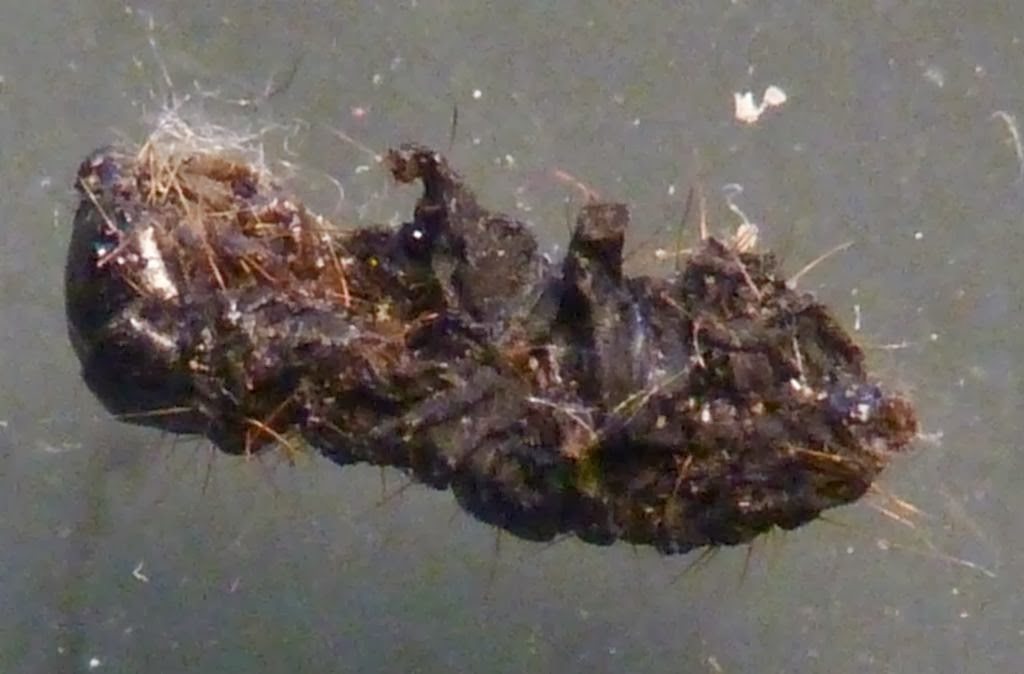
The small black shape turns out to be a dead and shrivelled caterpillar - whatever it was, it bore long hairs/bristles which can still be seen. Length approx. 6mm
From this angle, the true legs can be seen towards the head end (left) curled under the thorax, while the larger, stubby prolegs are more clearly visible in the middle/rear
The relatively simple lens/eye arrangment of the caterpillar
I can't tell what this caterpillar is as it is dry and shrivelled, but the form of the inner nest suggests a puss moth (Cerura vinula) or other member of the family Notodontidae. Mature puss moth larvae are large and spectacular, but the first instar is small and black. However, it doesn't have long bristles, so can't be this species, though other members of the family may be plausible candidates. A different question does arise though - cocoons give rise to adults, not larvae, so what is it doing here? If there were wasp eggs, then one plausible explanation would be that it was brought in immobilised by a solitary wasp as a food source for its own young. However, this is a nest with a cocoon in it, not eggs. Also, there is no evidence of a wasp in the cocoon, but there is the material between the inner and outer nest walls. I am unaware of any wasps where a host caterpillar is entombed by a pupating larva to await its adult emergence, but they are a diverse group  often with complex (and often poorly understood) life-cycles, so I imagine it is possible. Alternatively, the caterpillar was simply caught inside a nest construction and starved.

Spider exuviae (moulted skins) within the outer nest
As seen in the photo above, the material consists mainly of moulted spider skins (exuviae) of differing sizes, sugessting an individual spider grew and moulted several times using the thin outer nest (the red structure top-left is a set of mouthparts, almost as large as the whole skin bottom-right). It seems plausible that the hiding place was a good one and a spider simply used it, building its nest around the tougher one already there. Looking even closer there is more to see.

The thin outer wall and the thck inner wall with wood shavings. Just below where they meet, a small white structure is visible in partial shadow.
Hidden behind the larger structures, what appears to be another, much smaller cocoon. This is now also in a hatchery awaiting whatever emerges.
This looks like an opportunistic cocoon-builder that has just used a handy crevice, but it may be related to the larger nests. I don't know which species are involved, but I hope that the two remaining cocoons remain viable and I'll see which species emerge. You never know, it might shed some light on the mystery nest/larva - and if it does, I will, as ever, post it here.

Thursday, 10 October 2013

The ladybird and the cocoon of doom

About 10 days ago, while cleaning one of my stick-insect cages, I noticed an adult 7-spot ladybird Coccinella 7-punctata with a silky cocoon stuck between its legs. Ladybirds don't make cocoons like that - what could it be? Some small invertebrates can be truly difficult to identify, but this one was, for once, straightforward as it is a common parasite of several ladybird species, Perilitus coccinellae, a wasp in the family Braconidae. But, to be sure I put the cocoon in a hatchery and waited...

Perilitus coccinellae cocoon, approx 6mm long
An adult P. coccinellae (a female - males are unknown) did indeed emerge and provides a good opportunity to look at a common, but often overlooked parasite.
 
Adult P. coccinellae - note the wing venation and the needle-like ovipositor with the abdomen curled under the body
Adult P. coccinellae - a closer look at the ovipositor
Adult P. coccinellae - see how the abdomen is curled under the body
The wasp has an interesting life history (as parasites often do). Although ladybird pupae are sometimes targeted, adults are usually parasitised. The wasp taps the ladybird with her antennae then curls the ovipositor forward and begins to tap and probe for weak points, laying a single egg into the ladybird along with trophic ('nutritional') cells which absorb food from the host so the wasp larva can feed on them once it hatches. It does not feed on the ladybird directly, although the diversion of nutrients to the parasite ipacts on the host's reproductive development and fat storage. After reaching its 4th instar, the larva chews its way out from the underside of the ladybird's abdomen, having immobilised it, possibly by affecting the host's motor neurones. It then forms the cocoon which is attached to the ladybird's legs. The ladybird is alive at this point which means that the wasp is protected by its warning colouration and reflex bleeding defence. The wasp then pupates, emerges as an adult and seeks a new host as soon as its wings are dry. The ladybird usually dies within about a week, either of starvation or fungal disease. Some host ladybirds do regain the use of their limbs although most are greatly weakened and die soon after. In winter the cycle stops for a while as the wasp larva hibernates within a host ladybird.

So, a bad end for the ladybird, but an interesting tale - if you'd like to read it in more detail, try Majerus (1994) which contains plenty more interesting ladybird info.

Reference

Majerus, M.E.N. (1994). Ladybirds. HarperCollins, London. [New Naturalist series]

Tuesday, 10 September 2013

Grubs within grubs within grubs

Back in the 17th century, Jonathan Swift (he of Gulliver's Travels fame) wrote:

"So nat'ralists observe, a flea
Hath smaller fleas that on him prey;
And these have smaller fleas to bite 'em.
And so proceeds Ad infinitum."

Then, in the 19th century, mathematician Augustus De Morgan updated this to the more familiar

"Great fleas have little fleas upon their backs to bite 'em,
And little fleas have lesser fleas, and so ad infinitum."

Well, this might not proceed quite ad infinitum, but there certainly can be several tiers of parasitism. One common example involves the small wasp Apanteles glomeratus (family Braconidae) which parasitises larvae of the 'cabbage' white butterflies Pieris brassicae and P. rapae. Eggs are laid into the butterfly larvae, where they hatch and develop - after about 15 to 20 days the wasp larvae emerge and the host dies. The wasps then pupate in silken cocoons next to the dead host, creating the arrangement that can be seen attached to a wide range of substrates, sometimes in very exposed situations (such as the middle of a glass patio door...), with the whole cluster attached by silk threads.

A typical arrangement of Apanteles glomeratus cocoons by the dead host larva of Pieris brassicae.
Apanteles glomeratus cocoons showing the tangle of silk threads.
I have seen  numerous examples of this arrangement over recent days, largely because following several very poor summers in the UK, Pieris spp. are some of the few butterfly species to have done well, and consequently there are many of their larvae for parasites to target. Also, as Pieris spp. are ravenous eaters of brassicas in farms and gardens, A. glomeratus is a vegetable-grower's friend. However, if I look more closely, I might find 'hyperparasites' (parasites of parasites) such as the tiny ichneumon wasp Lysibia nana which targets braconids such as A. glomeratus. Closer still and - well, I don't think anyone has investigated - but I'd expect to find microscopic protozoan, fungal or nematode parasites. Maybe I need to capture some L. nana and have a look.

If you would like more technical detail about parasitic wasps, Ronquist (1999) gives details of their phylogeny, classification and evolution (including, in Table 1, some examples of who parasitises who). In contrast, if you fancy an excellent (and silly) photo of a braconid larva, try here instead (or, as well - I like both, and Myrmecos is a fine blog looking at entomology, often ants, from a more photographic viewpoint).

Reference

Ronquist, F. (1999). Phylogeny, classification and evolution of the Cynipoidea. Zoologica Scripta 28(1-2): 139-164.

Wednesday, 26 June 2013

It's June, and wasps are busting out all over

Bees are good. We like bees. They pollinate and are pleasant to watch. They are of course also wild creatures subject to the stresses that any other organism has to deal with, and one of these is parasitism. With our garden bee logs, new and old, almost completely occupied by the red mason bee Osmia rufa, it is not surprising that other nesting sites are sought out. Sometimes the chosen spot is not a good one, as in this case where a nest had been attached between a hoe and the inside of our tool shed - we'd noticed the nest, but the hoe fell down anyway, taking some of the cells and cocoons with it.

Osmia rufa nest - the open sides of the cells were pressed against the handle of a hoe until it fell down. Note the larva in the bottom centre cell (now taken away to be raised indoors)
The inside of an O. rufa cell - note the plug made of numerous small pieces of mud tamped into place by the prongs on the female's head.
A cocoon and pollen ball (larval food supply which includes a small amount of nectar) from an O. rufa cell.
Being a fan of bees (well, wildlife in general really) and ever-curious, I collected the cocoons that had been displaced (about a third of the whole nest) and brought them indoors to be put into a hatchery. I was of course hoping to see the bees emerge and release them, but a few days later something else happened entirely; the hatchery was full of small parasitic wasps - Monodontomerus obscurus (Hymenoptera, family Torymidae) - 21 in total.

Some of the Monodontomerus obscurus hatched from O. rufa cocoons
A female (note the ovipositor) M. obscurus apparently feeding on an O. rufa larval pollen store.
Although the larger parasites of O. rufa are listed in Baldock (2008), there seems to be relatively little mention of this aspect of the bee's natural history even though it is a familiar and popular species. However, Krunic et al. (2005) provide more detail and note that M. obscurus can suppress O. rufa populations in some nesting situations such as paper tubes and hollow reeds.

This is a normal part of bee ecology of course - and the wasps are interesting little jewels in their own right, so (as ever) I took the opportunity to have a look at one of them (a female) more closely. Males are present but smaller (approx. 4mm long without appendages, females approx. 5mm) and lack the ovipositor that female use to lay eggs into the bee cocoons.

Female M. obscurus - approx 5mm long plus 2-3mm of ovipositor
Close-up of the head of a female M. obscurus - note the red eye with short white bristles, plus the sculpturing on the head and thorax.
Close-up of the hind femur of a female M. obscurus - note the sculpturing on the leg and the 'finger-print' pattern of sculpturing on the abdomen behind it. Also, the edges of the thoracic plates bear fringes of short white bristles, presumably to protect the membranous joints.

O. rufa cocoon with M. obscurus exit hole.
With the cocoon having disgorged its parasites, there was only one thing left to do - open it up to what was left inside.

The content of an O. rufa cocoon after emergence of M. obscurus.
I did wonder of there would be much evidence of the juvenile bee, but very little was left, having presumably been consumed by the wasp larvae - there are a few fragments (e.g. bottom right) but nothing more. Most of the invertebrate material consists of pupal skins of M. obscurus - unsurprising given the number that emerged. There is some frass (faeces) and bits of dried mud from the nest which must have fallen in before the cocoon was spun. Top left is a dead female wasp who didn't emerge fully from pupation. She is of course also in a hatchery just in case she releases smaller parasites of her own...


References

Baldock, D.W. (2008). Bees of Surrey. SWT, Woking.
Krunic, M., Stanisavljevic, L., Pinzauti, M. & Felicioli, A. (2005). The accompanying fauna of Osmia cornuta and Osmia rufa and effective measures of protection. Bulletin of Insectology 58(2): 141-152.