If you are a regular here, you'll know I spend a lot of time peering closely at small invertebrates in order to identify them, like here. For those interested in taxonomy and morphology (like me), that can be an end in itself - I find small creatures fascinating and I like to know what they are. I geek them, and do so proudly - plus I'm a professional entomologist/ecologist so there's the academic-kudos and getting-paid aspects. However, there is more to it than that.
I have been asked more than once why we need to identify species - and it's a fair question; after all, the beetles don't care whether we can name them, and individual ones would probably prefer not to be fatally sampled for the greater good. However, without identification (which often requires a dead specimen), there can be no survey, monitoring or collection of distribution data; and without these, we don't know what needs conservation effort. In an ideal world, their habitats would be fine, biodiversity would not be threatened, and conservation (if needed given the previous points!) would have limitless funding. Sadly these things are very very much not the case. So, samples are taken, species are identified (along with date, location etc) and data sent to recording schemes/centres, or now added to online systems such as iRecord to be validated by hard-working volunteers such as myself...
Once the data has made its way to the recording scheme database, it can be downloaded, interrogated - in short, used. This could be for any number of purposes - planning, research, amatuer interest, and so on. However, during the winter of 2013/14 I was lucky enough to be contracted to use this data to write a status review of the Chrysomelidae (leaf beetles), the group I specialise in. This meant looking at the change in distribution of all the British species and allocating them to categories such as 'Least Concern', 'Endangered' and 'Vulnerable'. Thus, scarce and threatened species could be identified and highlighted with extra information focusing on these, such as summaries of habitats, distribution, threats and conservation measures. This is important as it will inform conservation efforts, survey work, policy decisions and other activities. It's also part of a wider project with different specialists covering their groups of choice such as Carabidae (ground beetles) and is a major update to status review work published in the 1990s (e.g. Hyman & Parsons, 1992) some of which is now considerably out of date.
I won't go into any more detail here, but if you want to look at the report, it's called A review of the scarce and threatened beetles of Great Britain: The leaf beetles and their allies and is free to download here along with data covering the key species.
Reference
Hyman, P.S. & Parsons, M.S. (1992). A review of the scarce and threatened Coleoptera of Great Britain 1. JNCC, Peterborough.
Showing posts with label conservation. Show all posts
Showing posts with label conservation. Show all posts
Monday, 27 October 2014


Monday, 24 February 2014
The beetle is dead, long live the beetle
The decline of the leaf beetle (Chrysomelidae) Chrysomela tremula is well known (e.g. Cox, 2007; Hubble, 2012), even though the causes of its probable extinction in the UK are not understood - possibly the decline of coppicing and/or a side-effect of insecticidal spraying. The last known record was from Warwickshire in 1958, so when its rediscovery was reported relatively recently from purple willow Salix purpurea in Cambridgeshire (Mendel & Hatton, 2012), there was much rejoicing. Then, shortly afterwards, the authors realised that this had been a misidentification and they had actually found C. saliceti, a species never before found in Britain (Mendel & Hatton, 2013). So, C. tremula remains probably extinct but we do have a new species. This doesn't mean C. saliceti is non-native - it is very similar to C. tremula and may simply have been overlooked - after all, their separation was tricky enough to briefly trick some very experienced entomologists until another one noticed and the error was rectified - which is how science works...
Then after a discussion at the recent Coleopterists' Day in Oxford, Howard Mendel was kind enough to post me a couple of specimens of the new species as I had never seen one.
The trick is to separate the two species - especially in case C. tremula is still hiding somewhere (or re-appears from the Continent). A paper about this is planned, but until then, there are two key features:
References
Cox, M.L. (2007). Atlas of the Seed and Leaf Beetles of Britain and Ireland. Pisces, Newbury.
Hubble, D. (2012). Keys to the Adults of Seed and Leaf Beetles of Britain and Ireland. FSC, Telford.
Mendel, H. & Hatton, J. (2012). Chrysomela tremula Fabricius (Chrysomelidae) rediscovered in Britain. The Coleopterist 21(3): 132-135.
Mendel, H. & Hatton, J. (2013). Correction: Chrysomela saliceti Suffrian (new to Britain) not Chrysomela tremula Fabricius (Chrysomelidae) in the cambridgeshire fens. The Coleopterist 22(1): 19.
Warchałowski, A. (2003). The Leaf-beetles (Chrysomelidae) of Europe and the Mediterranean Area. Natura Optima Dux Foundation, Warsaw.
Then after a discussion at the recent Coleopterists' Day in Oxford, Howard Mendel was kind enough to post me a couple of specimens of the new species as I had never seen one.
 |
| Chrysomela saliceti approx 9.5mm long. |
 |
| Chrysomela saliceti under different lighting to more clearly show the punctures on the pronotum and elytra. |
- The claw-bearing tarsal segment (two apical teeth on the underside in tremula, absent in saliceti).
- Dissection of males to check the tip of the aedeagus (equivalent of a penis).
 |
| Tarsus ('foot') of C. saliceti - the claws are visible but no teeth on the underside. |
 |
| The aedeagi of the two species for comparison. |
References
Cox, M.L. (2007). Atlas of the Seed and Leaf Beetles of Britain and Ireland. Pisces, Newbury.
Hubble, D. (2012). Keys to the Adults of Seed and Leaf Beetles of Britain and Ireland. FSC, Telford.
Mendel, H. & Hatton, J. (2012). Chrysomela tremula Fabricius (Chrysomelidae) rediscovered in Britain. The Coleopterist 21(3): 132-135.
Mendel, H. & Hatton, J. (2013). Correction: Chrysomela saliceti Suffrian (new to Britain) not Chrysomela tremula Fabricius (Chrysomelidae) in the cambridgeshire fens. The Coleopterist 22(1): 19.
Warchałowski, A. (2003). The Leaf-beetles (Chrysomelidae) of Europe and the Mediterranean Area. Natura Optima Dux Foundation, Warsaw.
Monday, 6 January 2014
Looking after Spiny Norman
OK, in case you've not heard of him, Spiny Norman is a giant hedgehog from the Monty Python 'Piranha Brothers' sketch. I'm not going to write about offbeat-comedic imaginary hedgehogs, just the real ones you might see in your garden - more precisely the European hedgehog Erinaceus europaeus (there are seventeen species worldwide but only this one is found in Britain and last summer it was voted Britain's national species).
Traditionally a common and familiar species, hedgehogs have undergone a serious decline in Britain - this is difficult to measure but has been achieved with work such as the PTES Mammals on Roads Survey and the BHPS 2011 State of Britain's Hedgehogs report. The national population is estimated at around 30 million in 1950 but only 1.5 million by1995, and a further halving by 2001 in some areas. The reasons for this major decline are not entirely clear. However, some likely causes include:
I could go on, but there are plenty of online resources like this leaflet about 'Gardening with Hedgehogs', as well as opportunities to get more involved such as the Hedgehog Street project where you can become a Hedgehog Champion, and a variety of voluntary PTES surveys.
 |
| Months before I saw a hedgehog in our garden, I knew there was at least one around because of its droppings - black with invertebrate remains in it. |
- Agricultural intensification, in particular larger field sizes and losses of hedgerows and permanent grassland – also pesticide use which reduces prey availability.
- In urban areas (even small ones such as villages), smaller and tidier gardens with impassable fencing is likely to have reduced the amount of suitable urban habitat.
- (Over)development, not only direct habitat loss, but fragmentation by buildings and roads which leads to local populations becoming isolated and vulnerable to local extinction.
- Increased road use - tens of thousands of hedgehogs are killed by vehicles each year and may be an importance cause of local decline in some areas.
- Competition with badgers (Meles meles) - where habitat provides effective cover and foraging opportunities, badgers and hedgehogs can coexist. However, badgers are a natural predator of (and competitor for food with) hedgehogs which therefore avoid sites with large numbers of badgers. The badger cull is still a stupid, unethical and politically motivated idea though.
- Increased disease levels.
- If you have a garden, don't be too tidy - allow leaves to accumulate, have a scruffy wildlife area and put in a hedgehog house. I made one out of scrap wood last autumn and it's already got a hedgehog in it (oh yes). I wouldn't have known except that the current bad weather damaged the roof and I found the hedgehog during (subsequently very careful and quiet) repairs earlier today. It really is important to resist the temptation to lift the lid for a peek...
- Also, if you have a pond (as we do), make sure the sides are not steep all the way around as hedgehog will drown if they fall in and can't climb out - flatten/shallow out at least some of the edge and/or install slipways if you need to.
- If possible, avoid using plastic mesh/netting or leaving plastic bottles, pots etc lying around as hedgehogs can get tangled, or get their heads stuck in them (their foraging behaviour means they are naturally inquisitive). Also, don't burn piles of grass mowings or other cut vegetation without checking first for hedgehogs (the same goes for bonfires). Similarly check compost heaps before turning them with a fork to avoid stabbing hedgehogs.
- Also avoid using garden chemicals, including slug pellets, especially the more toxic versions (some are more mammal-friendly).
- Leave some gaps/holes in fencing so hedgehogs can move between and in/out of gardens.
- Don't feed hedgehogs with bread-and-milk - they can't digest it and it makes them ill. If you want to feed them, cat-food is fine. In dry conditions, shallow dishes of water are important too.
 |
| Our garden hedgehog house (note the staggered entrance-way and pile of dry leaves) with the waterproof roof removed. |
I could go on, but there are plenty of online resources like this leaflet about 'Gardening with Hedgehogs', as well as opportunities to get more involved such as the Hedgehog Street project where you can become a Hedgehog Champion, and a variety of voluntary PTES surveys.
 |
| Garden hedgehog enjoying cat food and a dish of clean water. Nom. |
Monday, 17 December 2012
Into the Tomb of Zootoca
The title of a lost H.P. Lovecraft tale? Nope, though it isn't every Christmas party that you get handed a box containing a mummified corpse...
Actually, this isn't as odd as it sounds - the lizard was found by friends while taking up an old carpet, and might be a casualty of one of their cats that subsequently dried out. As you'll see later, it isn't perfectly preserved... Anyhow, the first thing I did was measure it - at approximately 40mm in length including tail, it was newly born as the common (or viviparous) lizard (Zootoca vivipara, previously Lacerta) is 37-44mm long at birth with the tail no more than about half the overall length (Beebee & Griffiths 2000, Inns 2009). Then, as ever, I took a closer look...
As you can see, the skin/scales of the head is largely intact and the scale pattern remains clearly visible, a feature that can be useful for identification, especially in areas (unlike the UK) with a wide range of superficially similar species. As is typical for young common lizards, the colour is dark, though this could be an artefact of death and drying, and zooming in on the abdominal scales gives a hint of the colour that develops after a few weeks. The dense, overlapping arrangement of dorsal scales (with 'keels') is typical of lacertids.
Turning the specimen over, further structures can be seen. As well as skeletal features such as the ribs, some of the ventral scales (or 'plates') are intact (though not the collar area beneath the neck, nor the femoral pores beneath the thigh), and show the development of an iridescent greenish colour. The scales are not simple plates of keratin like the 'scutes' of crocodilians, but are outfoldings of the skin itself that are each covered in a tough waterproof layer and contain both an osteoderm (internal bony plate) for structural integrity and a layer of chromatophores - cells that produce colour - just below the outer epidermis.
Turning the specimen on its side then allows the skull to be investigated as the skin is missing. You can immediately see the teeth (more below on this) - as is usual for lizards, they are conical and all approximately the same size - and show that the young common lizard is well equipped to begin feeding (on anything small enough to catch, including aphids!) as soon as it is born. It's also worth taking note of the overall structure as lizard skulls are rarely represented in books on animal signs (unlike mammal skulls, a range of which tend to be illustrated) or other resources such as guides to the contents of owl pellets (presumably owls rarely if ever eat them).
However, I did notice something towards the rear of the skull - you can just see it in the photo above as a pair of little white dots in the left-most of the three main cavities. Time to switch to a higher magnification...
...and another kingdom of organisms as these are clearly Fungi. These structures are around 0.5mm long, with the white 'blob' around 0.1mm in diameter. I can't begin to describe how fiddly it was removing these to make a slide, but I did (tiny tweezers) and decided to see if I could identify the fungus.
This is clearly a spore-mass on a stalk (one cell thick, cell walls indicated by arrows). The white colour of the spore-mass in the first photo is an artefect of lighting and my camera; it is actually a pale yellowish-brown - darker in the second photo where it has been compressed. Consulting Ellis & Ellis (1998) it soon became clear this wasn't a specialised 'bone-eating' fungus but was more likely to be one of the moulds (Ascomycetes) that can be found on a wide range of organic matter. Given the overall form/size and the more-or-less round and transparent spores (some of which appear slightly warty), this is probably Eurotium and/or Aspergillus, although the faint equatorial groove of Eurotium isn't visible in the photos. 'And/or'? you may ask... well...
The taxonomy of some fungal groups is complex because different (asexual 'anamorph' and sexual 'teleomorph') stages have been given different names, and in some cases there are several anamorphs, all with separate names. This is case here with Eurotium being the teleomorph and Aspergillus the anamorph - both of which may be found together, and often are. I could expand on this, but fortunately don't need to - as of January 1st 2013, any one fungus will have a single name covering all stages/'morphs', and details of how this will work are given in Hawksworth (2011). As far as this specimen is concerned, taxonomic considerations aside, it does mean that it is mouldy and therefore not perfectly mummified. I have it in a dry container so it may surrvive, or I might find it turns into a clean skeleton. Certainly this eruption from the scales shows it's still active.
Now, back to the lizard... following a reader's comment, I returned to the specimen and had a better look at the teeth. I also Googled and was surprised to find few images showing lizard teeth in detail - presumably they exist, but not on my bookshelves. As mentioned above, the structure is fairly uniform (unlike us mammals with canines, incisors, molars with varying numbers of cusps and so on), but that is a slight oversimplification.
Ignoring the fungal structures this time, the cheek teeth are clearly more-or-less cylindrical with a conical point; they are also transparent showing what I presume is the pulp cavity as a whitish central mass. However, the front teeth are curved backwards and more 'fang-like' as might be expected in order to catch and hold prey. Although showing little obvious differentiation, a search of the literature online indicates (and I'm way out of my comfort zone here!) that lacertid teeth can be categorised as premaxillary (apparently of taxonomic and palaeontological importance with 7 in Zootoca), maxillary and dentary according to their position and associated jawbones (Arribas 1998). This is where I'll stop on dentition, but if any reader would like to expand on this in the comments (e.g. whether the different tooth groups differ structurally), please feel free!
Lastly, I can't finish this post without mentioning reptile conservation in the UK. The common lizard is widespread but has declined, especially in the south, due largely to development pressure and the loss of brownfield sites. Because of this it is now a UK BAP (Biodiversity Action Plan) species. It seems clear that habitat loss needs to be tackled (although with a government that seems to want to relax, rather than tighten, planning laws it is unclear how this will happen), but there is good advice in Gent & Gibson (2003) and Edgar et al. (2010). Rather than repeating what they have said, or putting my campaigning hat on, I'd just like to highlight the importance of collecting (and sending in to Biological Records Centres) reptile species records, especially as part of systematic surveys though ad hoc records are valuable too, and undertaking practical conservation work to improve habitat quality.
References
Arribas, O.J. (1998). Osteology of the Pyrenean Mountain Lizards and comparison with other species
of the collective genus Archaeolacerta Mertens, 1921 s. l. from Europe and Asia Minor (Squamata: Sauna: Lacertidae). Herpetozoa 11(1/2): 47-70.
Beebee, T. & Griffiths, R. (2000). Amphibians & Reptiles. HarperCollins, London.
Edgar, P., Foster, J. & Baker, J. (eds.) (2010). Reptile Habitat Management Handbook. ARC, Bournemouth.
Ellis, M.B. & Ellis, J.P. (1998). Microfungi on Miscellaneous Substrates (2nd ed.). Richmond, Slough.
Gent, T. & Gibson, S. (eds.) (2003). Herpetofauna Workers' Manual (revised reprint). JNCC, Peterborough.
Hawksworth, D. (2011). A new dawn for the naming of fungi: impacts of decisions made in Melbourne in July 2011 on the future publication and regulation of fungal names. Mycokeys 1: 7-20.
Inns, H. (2009). Britain's Reptiles and Amphibians. WildGuides, Old Basing.
 |
| A mummified common lizard, Zootoca vivipara |
 |
| Dorsal view of the Z. vivipara specimen |
 |
| Dorsal abdominal scales of young Z. vivipara - dark but with a hint of the metallic greenish-brown-bronze colour (including some gold flecks) that typically develops after a few weeks (Beebee & Griffiths 2000) |
 |
| Ventral view of young Z. vivipara |
 |
| Ventral scales/plates of young Z. vivipara |
 |
| Side view of the head of young Z. vivipara. |
 |
| Small Fungi growing on the head of Z. vivipara |
...and another kingdom of organisms as these are clearly Fungi. These structures are around 0.5mm long, with the white 'blob' around 0.1mm in diameter. I can't begin to describe how fiddly it was removing these to make a slide, but I did (tiny tweezers) and decided to see if I could identify the fungus.
 |
| Fungus from Z. vivipara (the arrows indicate the length of one of the stalk cells) |
 |
| Cleistothecium (spore mass) of Eurotium /Aspergillus |
 |
| Warty spores of Eurotium/Aspergillus indicated by arrows. Others are not in focus. |
The taxonomy of some fungal groups is complex because different (asexual 'anamorph' and sexual 'teleomorph') stages have been given different names, and in some cases there are several anamorphs, all with separate names. This is case here with Eurotium being the teleomorph and Aspergillus the anamorph - both of which may be found together, and often are. I could expand on this, but fortunately don't need to - as of January 1st 2013, any one fungus will have a single name covering all stages/'morphs', and details of how this will work are given in Hawksworth (2011). As far as this specimen is concerned, taxonomic considerations aside, it does mean that it is mouldy and therefore not perfectly mummified. I have it in a dry container so it may surrvive, or I might find it turns into a clean skeleton. Certainly this eruption from the scales shows it's still active.
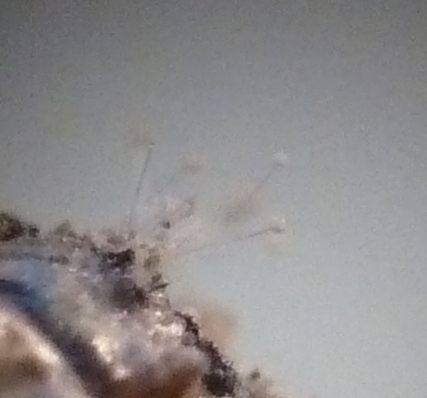 |
| 'Tuft' of Eurotium/Aspergillus growing from the skin of Z. vivipara |
 |
| Cheek teeth of juvenile Z. vivipara |
 |
| Front teeth of juvenile Z. vivipara |
Lastly, I can't finish this post without mentioning reptile conservation in the UK. The common lizard is widespread but has declined, especially in the south, due largely to development pressure and the loss of brownfield sites. Because of this it is now a UK BAP (Biodiversity Action Plan) species. It seems clear that habitat loss needs to be tackled (although with a government that seems to want to relax, rather than tighten, planning laws it is unclear how this will happen), but there is good advice in Gent & Gibson (2003) and Edgar et al. (2010). Rather than repeating what they have said, or putting my campaigning hat on, I'd just like to highlight the importance of collecting (and sending in to Biological Records Centres) reptile species records, especially as part of systematic surveys though ad hoc records are valuable too, and undertaking practical conservation work to improve habitat quality.
References
Arribas, O.J. (1998). Osteology of the Pyrenean Mountain Lizards and comparison with other species
of the collective genus Archaeolacerta Mertens, 1921 s. l. from Europe and Asia Minor (Squamata: Sauna: Lacertidae). Herpetozoa 11(1/2): 47-70.
Beebee, T. & Griffiths, R. (2000). Amphibians & Reptiles. HarperCollins, London.
Edgar, P., Foster, J. & Baker, J. (eds.) (2010). Reptile Habitat Management Handbook. ARC, Bournemouth.
Ellis, M.B. & Ellis, J.P. (1998). Microfungi on Miscellaneous Substrates (2nd ed.). Richmond, Slough.
Gent, T. & Gibson, S. (eds.) (2003). Herpetofauna Workers' Manual (revised reprint). JNCC, Peterborough.
Hawksworth, D. (2011). A new dawn for the naming of fungi: impacts of decisions made in Melbourne in July 2011 on the future publication and regulation of fungal names. Mycokeys 1: 7-20.
Inns, H. (2009). Britain's Reptiles and Amphibians. WildGuides, Old Basing.
Monday, 5 November 2012
Leaf beetle key - write, edit, plug
If you are a regular here, you'll know that I have a considerable interest in invertebrates and that they form a large proportion of the topics I write about (a glance at the 'tag cloud' in the right margin will confirm that). However, you might not know that I specialise a little more than that and that one of my areas of specialism is in the Chrysomelidae - the 'leaf beetles', which include the 'seed', 'reed', 'flea' and 'tortoise' beetles - and the two small closely related families, the Orsodacnidae and Megalopodidae. You may be familiar with these groups having a slightly different taxonomic arrangement, such as the Bruchinae being accorded full family status, but recent cladistic work (e.g. Reid, 1995) suggests otherwise.
References
A few years ago I became interested in this group as a voluntary species recorder for the UK's Biological Records Centre (BRC), and later as organiser of the related UK Recording Scheme. I soon found that, even with the excellent Atlas to British and Irish species having been published (Cox, 2007), I needed to collect a large number of individual journal articles in order to be able to reliably identify adults of the British chrysomelid fauna and that even then there were gaps. The last key covering all species was Joy (1932) which, although excellent, was unavoidably out of date (and hard to find affordably until the CD-ROM version appeared), while the update (Hodge & Jones 1995) was out of print. Grr. Although the BRC were extremely helpful, sending me copies of the articles I needed if they had access to them, it became clear that a lack of readily available user-friendly identification literature was a major barrier to expanding interest in this beetle group. Such a barrier needed to be overcome, especially as the Chrysomelidae includes many charismatic (shiny, colourful and metallic such as the green dock-beetle Gastrophysa viridula) species as well as a number of considerable economic importance (horticultural and agricultural pests) such as the unpopular Lily Beetle (Lilioceris lilii) and the notorious potato pest, the Colorado Beetle (Leptinotarsa decemlineata) although the latter is currently unable to colonise Britain due to low winter temperatures. There is also a conservation component as accurate identification is needed to provide useful distribution and monitoring data. For example, there are a number Biodiversity Action Plan (BAP) and Red Data Book (RDB) species, such as the Pashford Pot Beetle Cryptocephalus exiguus which provides an (unfortunately) excellent
case study of ineffective landscape-scale
conservation, while the flea beetle Psylliodes
luridipennis is a UK endemic known only from Lundy Island where it is
threatened by over-grazing and invasive rhododendron.
Consequently, I made the decision that 'the book' would only appear if I wrote it, and so I began, aiming for an intermediate audience as I wanted to cover all British and Irish species, and many require dissection under a low-power microscope - not something for beginners maybe... I won't go into too much detail other than to say it was difficult - really, really difficult. The initial draft wasn't too bad to write, but - as expected - had many errors and omissions which were discovered during testing. However, many testers provided excellent tips and suggested changes - some extensive - which greatly improved the final version. The difficulty came where species were not covered reliably by existing literature, and this happened a lot while trying to write keys for the notoriously tricky flea beetle genera such as Longitarsus. I was aided in many cases by the excellent images (including genitalia) on the European Chrysomelidae website, but in the end there is no substitute for going to a museum or other institution, and consulting specimens in their reference collections such as those held in Winchester (Hampshire County Council), Oxford (Oxford Uni Museum of Natural History) and at the BENHS HQ near Reading. This is what sampling and collecting is for - it ain't decoration or 'train-spotting'!
 |
| A tray of beetles from the Oxford Uni MNH collections |
So, after editing, re-editing, adding a few species that had been newly found in Britain, and making changes following taxonomic updates, the final version - complete with cover photo - went off to the publisher and then the printer. I was expecting it to be ready in mid to late November, but - much excitement - a courier delivered a box of my author's copies this morning - whoop! I think they are great (obviously) and a bargain at only £8.50 - available here - enjoy! All the many many hours of beetle-scrutiny was worth it - now, I seem to remember there's no general textbook covering this family...
 |
| Woo hoo! A box of brand new copies of my key to British and Irish leaf beetles. |
References
Cox, M.L. (2007). Atlas
of the Seed and Leaf Beetles of Britain and Ireland. Pisces, Newbury.
Hodge, P.J. & Jones, R.A. (1995). New British Beetles: Species not in Joy's Practical Handbook. BENHS, Reading.
Joy, N.H. (1932). A Practical Handbook of British Beetles (2 vols., 1976 reprint). Classey, Faringdon.
Reid, C.A.M. (1995). A cladistic analysis of subfamilial
relationships in the Chrysomelidae sensu
lato (Chrysomeloidea). In: J. Pakaluk & S.A. Ślipiński (eds.) Biology, Phylogeny, and Classification of
Coleoptera: Papers Celebrating the 80th Birthday of Roy A. Crowson. Muzeum
i Instytut Zoologii PAN, Warsaw, pp. 559-631.
Friday, 5 October 2012
The sticky world of sap-runs
It's well known that dead and decaying wood forms essential habitat for a wide range of species invlved in decay processes, plus many more that use such sites to burrow and nest. However, there are some situations which can be looked at individually and seen as providing even more specialised conditions, sometimes relating to living tree tissue, but siimilar in concept to dead-wood habitats. These include coppice stools, old parkland pollards and deadwood (saproxylic) or epiphytic fungi themselves, plus the one I want to look at here - sap-runs.
Sap runs are living areas on the trunk or branches where sap oozes out for all or part of the growing season (Fry & Lonsdale 1991). These occur on (probably) all tree species - some such as elms and horse-chestnuts more than others - and the one I saw recently was on a branch of an oak. At the time I was looking at, and taking photos of, the rarer Wild Service tree in front of it. However, I noticed a flurry of invertebrate activity on a partly dead branch and initially thought it was a hornet (Vespa carbro) nest as I could see these large, and increasingly rare, wasps darting in and out of crevices and crawling on the bark.
There may indeed have been a hornet nest, but what held my attention further was the behaviour of not only the hornets but also a host of other insects including various flies and Red Admiral (Vanessa atalanta) butterflies. The photos below illustrate some of this (apologies for the grainy images - it was the best my zoom could manage!)
The most striking behaviour was the amount of aggression between the different species; initially hornets chasing butterflies and flies away, but also butterflies tussling with each other. In itself, this isn't unusual - male Red Admirals are highly territorial, but this happens in spring - the behaviour seen here occurred in late summer so is clearly something else.
This photo shows the aggression fairly clearly, but more importantly the position of the butterfly below. This is the exact spot occupied by the hornet above and was where any insect that avoided the fighting landed. Clearly there was a valuable resource here - and the only one that seemed plausible was a small sap-run. With sap-runs an important source of nutrient-rich fluid, it is unsurprising that individual insects were competing for it, especially if the run itself was tiny as seems to be the case here. The flies were unidentifiable at a distance and smaller species may well have been present - in fact this is highly likely as sap-runs are known to support specialists such as the gnat-like flies Mycetobia spp. and Sylvicola cinctus, midges Forcipomyia spp., hoverflies Brachyopa spp. (whose males hover near sap-runs and attempt to mate with any females that land on them) and Ferdinandea cuprea, and the beetles Glischrochilus hortensis, Cryptarcha strigata and Epuraea aestiva.
These are only a few examples and there are many others, especially among the hoverflies as the numerous mentions of sap-runs by Rotheray & Gilbert (2011) can testify, including the danger of becoming trapped in sticky fluid that eventually becomes amber. As noted by Kirby (2001), this highlights the importance of sap-runs, along with many other features of trees (rot-holes, dead branches, ivy) that are sometimes removed as signs of 'ill-health', such as by being selectively removed during woodland thinning rather than being selectively retained. In fact, it seems clear that larger and longer-lasting sap-runs support more diverse species assemblages and so trees with large, deep injuries forming sap-runs should be retained just like those with large dead-wood features. It means overturning some of the received (but erroneous) wisdom ingrained in aspects of woodland management, but structural diversity is of key importance and the countryside isn't meant to be neat!
References
Fry, R. & Lonsdale, D. (eds) (1991). Habitat Conservation for Insects - A Neglected Green Issue. AES, Middlesex.
Kirby, P. (2001). Habitat Management for Invertebrates: A Practical Handbook. RSPB, Sandy.
Rotheray, G.E. & Gilbert, F. (2011). The Natural History of Hoverflies. Forrest Text, Tresaith.
 |
| Bracket fungi on standing deadwood |
 |
| Wild Service tree with the oak behind. The red arrow indicates the branch with a sap-run. |
 |
| A hornet on the underside of the branch |
 |
| Three Red Admirals fighting above while one feeds on the underside. Also note the large flies on the upper surface which may be feeding or basking. |
These are only a few examples and there are many others, especially among the hoverflies as the numerous mentions of sap-runs by Rotheray & Gilbert (2011) can testify, including the danger of becoming trapped in sticky fluid that eventually becomes amber. As noted by Kirby (2001), this highlights the importance of sap-runs, along with many other features of trees (rot-holes, dead branches, ivy) that are sometimes removed as signs of 'ill-health', such as by being selectively removed during woodland thinning rather than being selectively retained. In fact, it seems clear that larger and longer-lasting sap-runs support more diverse species assemblages and so trees with large, deep injuries forming sap-runs should be retained just like those with large dead-wood features. It means overturning some of the received (but erroneous) wisdom ingrained in aspects of woodland management, but structural diversity is of key importance and the countryside isn't meant to be neat!
References
Fry, R. & Lonsdale, D. (eds) (1991). Habitat Conservation for Insects - A Neglected Green Issue. AES, Middlesex.
Kirby, P. (2001). Habitat Management for Invertebrates: A Practical Handbook. RSPB, Sandy.
Rotheray, G.E. & Gilbert, F. (2011). The Natural History of Hoverflies. Forrest Text, Tresaith.
Friday, 21 September 2012
Pond bugs - the long and short of it
As you may have noticed if you're a regular, since building my own garden pond, I have been pretty enthusiastic about all things lentic (I like that word) and this post is no exception. During a recent Southampton Natural History Society field trip (hosted by Naomi, an ecologist from Pond Conservation) to look at invertebrates associated with New Forest ponds, numerous fine creatures were found, including a couple of spindly beasts that are probably unfamiliar to most people who don't regularly wade around in the mud and reeds, pond net in hand. The first of these is the Water Stick-insect Ranatra linearis.
The first thing to say is that this isn't a stick-insect, it's a true bug (Hemiptera) in the same family (Nepidae) as water-scorpions, and as such has piercing/sucking mouthparts. The long 'tail' is its breathing tube 15-20mm long at the end of a 30-35mm long body (not including the legs) - quite a striking creature, and though locally common in southern England and wales, rarely seen as it tends to lurk in dense pond vegetation, where it is an ambush predator (like a mantis for example) grasping prey with its raptorial front legs. If caught in a pond net, it tends to look like a bit of twiggy detritus until it moves - the occasional human has been known to jump in surprise at pond-dipping events and the like...
Here you can clearly see how the legs can shoot out mantis-like and grab prey (often small newts and fish) which will then be pierced by the pointed mouthparts (also visible). It is able to fly - useful if a pond dries up, and they also hunt on land - and although I have never seen one doing so, apparently it looks similar to a damselfly when in flight. The eggs are a peculiar sight too - when laid on leaves of water plants such as reedmaces and bur-reeds, breathing tube emerge into the air, and the eggs look like little rows of surgical stitches; there are good photos in Denton (2007).
Moving onto something smaller, at 9-12mm long (excluding legs and antennae), the Water-measurer (Hydrometra stagnorum) is another true bug common in much of lowland England and Wales (less so in Scotland and northern England) and is especially elongate, having the longest length-to-width ratio of any British insect - even the head is elongate, protruding well in front of the eyes which can be seen about half way between the antennae and front legs.
It tends to be found around the edges of ponds and streams, including bankside vegetation as well as the water surface, and are also known from ephemeral waters where they can be found under debris during dry periods. Although they are generally unwinged, individuals with wings do occasionally occur. Attracted by ripples of movement (Savage 1989), they feed on smaller invertebrates such as water-fleas (Cladocera e.g. Daphnia) and mosquito larvae, piercing them through the water surface with their mouthparts, and sometimes pulling them up through it - Fitter & Manuel (1994) includes a photo of prey being consumed. Unlike R. linearis above, the front legs are simply used for walking and are not involved in catching prey - their very regular tip-toe gait gives them their common name as they appear to be pacing out distances. There is a second slightly smaller species, H. gracilenta, but this is very rare in Britain, known only from a handful of locations in southern and eastern England. Back in the 1950s, it was apparently found in the New Forest, but the account was never published and so the alleged location remains a mystery (Huxley 2003) - to find one there would be an entomological highlight!
Although both of these species are fairly common, this is not true of all our aquatic bugs - many (most) ponds in lowland Britain are polluted to some extent, especially by nutrients from our intensive agricultural system, and this has seriously impacted the biodiversity of pond ecosystems. With both point and diffuse sources being a problem, it can be difficult to ensure good ecologicsl water quality, but advice (on managing existing ponds or creating new ones) can be sought from organisations such as Pond Conservation. Garden pond ponds are a little different as few of us have enough room for the metres of shallow muddy margins that a really good pond needs, but some of the same advice applies and they are really important oases - and excellent fun to watch as the wildlife colonises it and does its thing!
References
Denton, J. (2007). Water Bugs and Water Beetles of Surrey. Surrey Wildlife Trust, Woking. [Covers a good range of species; lots of useful info and excellent photos even if you're not in Surrey].
Fitter, R. & Manuel, R. (1994). Lakes, Rivers, Streams & Ponds of Britain & North-West Europe. HarperCollins, London. Also published in 1986 as Field Guide to the Freshwater Life of Britain and North-West Europe. [Both versions are out of print, but worth tracking either down online as they can be quite cheap.]
Huxley, T. (2003). Provisional Atlas of the British Aquatic Bugs (Hemiptera, Heteroptera). BRC, Huntingdon.
Savage, A.A. (1989). Adults of the British Aquatic Hemiptera Heteroptera: A Key with Ecological Notes. FBA, Ambleside. [The standard identification guide].
 |
| Water stick-insect Ranatra linearis |
 |
| The raptorial front legs of Ranatra linearis |
Moving onto something smaller, at 9-12mm long (excluding legs and antennae), the Water-measurer (Hydrometra stagnorum) is another true bug common in much of lowland England and Wales (less so in Scotland and northern England) and is especially elongate, having the longest length-to-width ratio of any British insect - even the head is elongate, protruding well in front of the eyes which can be seen about half way between the antennae and front legs.
 |
| The Water-measurer Hydrometra stagnorum |
Although both of these species are fairly common, this is not true of all our aquatic bugs - many (most) ponds in lowland Britain are polluted to some extent, especially by nutrients from our intensive agricultural system, and this has seriously impacted the biodiversity of pond ecosystems. With both point and diffuse sources being a problem, it can be difficult to ensure good ecologicsl water quality, but advice (on managing existing ponds or creating new ones) can be sought from organisations such as Pond Conservation. Garden pond ponds are a little different as few of us have enough room for the metres of shallow muddy margins that a really good pond needs, but some of the same advice applies and they are really important oases - and excellent fun to watch as the wildlife colonises it and does its thing!
 |
| Naomi from Pond Conservation hard at work looking for aquatic invertebrates in a shallow pond in the New Forest. |
References
Denton, J. (2007). Water Bugs and Water Beetles of Surrey. Surrey Wildlife Trust, Woking. [Covers a good range of species; lots of useful info and excellent photos even if you're not in Surrey].
Fitter, R. & Manuel, R. (1994). Lakes, Rivers, Streams & Ponds of Britain & North-West Europe. HarperCollins, London. Also published in 1986 as Field Guide to the Freshwater Life of Britain and North-West Europe. [Both versions are out of print, but worth tracking either down online as they can be quite cheap.]
Huxley, T. (2003). Provisional Atlas of the British Aquatic Bugs (Hemiptera, Heteroptera). BRC, Huntingdon.
Savage, A.A. (1989). Adults of the British Aquatic Hemiptera Heteroptera: A Key with Ecological Notes. FBA, Ambleside. [The standard identification guide].
Wednesday, 22 August 2012
Rubber-necking the rare Rothschild Giraffe
The giraffe (Giraffa camelopardalis) is of course a familiar and unmistakeable animal - it is however much less common than often imagined. It is split into a number of subspecies (up to nine, depending where taxonomic boundaries are placed) and even the most common, the Maasai giraffe G. c. tippelskirchi numbers no more than around 40,000 individuals in the wild. Several subspecies number no more than a few hundred, one of which, the Rothschild giraffe G. c. rothschildi has an estimated wild population of less than 650 (all in protected areas of East Africa) with almost as many kept in zoos around the world (including Marwell's conservation programme where I took these photos, although I have seen them wild in the Lake Baringo area of Kenya - it is sometimes known as the Baringo giraffe). They are readily identifiable from the coat colour/pattern, especially the pale 'socks' due to a lack of pattern on the lower leg.
Given the small population size, and ongoing threats such as habitat loss (e.g. encroachment by human settlements), widespread poaching, and possibly hybridisation, this subspecies was added as Endangered on the IUCN Red List in 2010. It is also a poorly understood subspecies with no major research being undertaken on it prior to the ongoing Rothschild's Giraffe Project which aims to look at the behaviour and ecology of wild populations, in particular, ecological/habitat requirements, group dynamics, factors affecting behaviour, social structure, herd formation and relatedness, and from all of this, knowledge about how to formulate effective conservation plans (if you'd like to donate to the project, you can do so here).
Like all giraffes, both sexes have short blunt horns called ossicones (formed from ossified cartilage and fused to the skull) - these contain blood vessels and may be involved in temperature regulation. Males compete by engaging in 'necking' behaviour - this starts by rubbing and pushing, and can develop into full-blown contests as males swing their heads at each other and try to land blows with the ossicones. If you ever get the chance to see this, it's amazing - like a huge game of conkers.
Their necks are of course their best-known feature - with just the usual seven cervical vertebrae, each is about 30cm long and they have ball-and-socket articulations for flexibility. Proportionally, newborn young have short necks with most of the elongation happens after birth, otherwise giving birth would be problematic. When upright, the neck is supported by the nuchal ligament and large muscles which create the small hump seen at the base above the shoulders. When bending down to drink or graze (which also means splaying or bending the legs), the network of veins and arteries called the 'rete mirabile', plus valves in the jugular veins, prevent excessive blood flow to the brain. These are just some of the circulatory adaptations that allow the giraffe to function with such as long neck - its heart rate (about 150 beats/minute) is high for a large animal, its heart weighs around 11kg or more generating blood pressure about twice that in humans, and the skin of the lower legs is thick and tight to prevent too much blood pooling there.
I could go on about the bizarre anatony of the giraffe, but I won't - instead, why not have a look at the excellent 'Inside Nature's Giants' TV programme (videos are on Youtube) based on dissections by specialists in their field. It's amazing I can assure you!
 |
| Rothschild giraffes at Marwell - a surreal sight in southern England! |
Like all giraffes, both sexes have short blunt horns called ossicones (formed from ossified cartilage and fused to the skull) - these contain blood vessels and may be involved in temperature regulation. Males compete by engaging in 'necking' behaviour - this starts by rubbing and pushing, and can develop into full-blown contests as males swing their heads at each other and try to land blows with the ossicones. If you ever get the chance to see this, it's amazing - like a huge game of conkers.
Their necks are of course their best-known feature - with just the usual seven cervical vertebrae, each is about 30cm long and they have ball-and-socket articulations for flexibility. Proportionally, newborn young have short necks with most of the elongation happens after birth, otherwise giving birth would be problematic. When upright, the neck is supported by the nuchal ligament and large muscles which create the small hump seen at the base above the shoulders. When bending down to drink or graze (which also means splaying or bending the legs), the network of veins and arteries called the 'rete mirabile', plus valves in the jugular veins, prevent excessive blood flow to the brain. These are just some of the circulatory adaptations that allow the giraffe to function with such as long neck - its heart rate (about 150 beats/minute) is high for a large animal, its heart weighs around 11kg or more generating blood pressure about twice that in humans, and the skin of the lower legs is thick and tight to prevent too much blood pooling there.
 |
| Rothschild giraffe bending down to graze - note the splayed front legs. |
Subscribe to:
Posts (Atom)