Welcome

Welcome to my blog

This is where I post various musings about wildlife and ecology, observations of interesting species (often invertebrates)
and bits of research that grab my attention. As well as blogging, I undertake professional ecological & wildlife surveys
covering invertebrates, plants, birds, reptiles, amphibians and some mammals, plus habitat assessment and management
advice
. I don't work on planning applications/for developers. The pages on the right will tell you more about my work,
main interests and key projects, and you can follow my academic work here.
Showing posts with label non-native species. Show all posts

Sunday, 29 December 2013

Highlights of 2013

December's been a quiet month on the blogging front - a large beetle project is ongoing (status review of the UK Chrysomelidae) and then of course the whole festive-season-thing. However, there was a proper summer this year with an extended period of hot dry weather extending into a mild autumn, and this meant some fine invertebrate (and other) sightings after some truly awful, cool, wet summers. The most spectacular (for me as they were all personal firsts) were probably three Lepidoptera finds between July and September - two butterflies, a monarch (Danaus plexippus) and long-tailed blue (Lampides boeticus) and a moth, the Clifden nonpareil (Catocala fraxini). The monarch is a North American species, and although some have been known to cross the Atlantic, it is more likely that this (and one from a nearby friend's garden) had escaped from a butterfly farm, maybe on the Isle of Wight. Certainly there was a small flurry of records of this species in southern England, aided by the fact that monarchs in the UK often visit gardens to seek their foodplant, milkweed (Asclepias syriaca) which is of course also non-native. The other two are scarce migrants seen in higher-than-usual numbers due to the favourable conditions this year. Being native to NE Europe, the Clifden nonpareil is more often seen on the eastern coasts of Britain, but my sighting was in Hampshire, about 10km inland where one large and unmistakable adult was seen basking on warm brickwork near scrub including its foodplants - aspens and other poplars (Populus spp.). Also a rare migrant, the long-tailed blue can be found on various Fabaceae such as everlasting-peas (Lathyrus spp.) and brooms (Cytisus spp.) - as a Mediterranean resident, it's not often seen in this country. I'll stop there, but if you'd like an affordable and user-friendly guide to European butterflies, one of my favourites is Haahtela et al. (2011). More to come from me in 2014, but until then, here are some pics from 2013...

A flock/mob of jackdaws in spring, as seen from my study window.
Adult female smooth newt in our garden pond.
A leaf beetle larva and its defensive shield of faeces and shed skins.
And finally, just to prove that I do go out and do ecology in the field, here I am taking great created newt eDNA samples at Claylands Nature Reserve, Hampshire.

Reference

Haahtela, T., Saarinen, K., Ojalainen, P. & Aarnio, H. (2011). Butterflies of Britain and Europe: A Photographic Guide. A & C Black, London.

Thursday, 24 October 2013

The (not really) attack of the (not actually) killer spiders!

Over the last few weeks, there has been a flurry of lurid headlines about 'killer spiders' and bites leading to horrible consequences, for example this one which was actually due to a streptococcal infection rather than spider venom - and of course infections can get into any skin puncture, but the tabloid fervour doesn't bother to mention this. In reality the spiders are the false widow Steatoda nobilis which bites few people - the species is not aggressive and there are no confirmed reports of anyone being hospitalised due to the venom. There can be bite symptoms such as chest pains and tingling in the fingers but nothing like the horror-stories in some sections of the media. Sadly, the media frenzy has led to people squashing them on sight and even closing a school where they were found - a major over-reaction in my opinion due to ill-informed health & safety officials being influenced by stories of poisoning and 'infestations'. Yes, it may be Britain's most venomous spider, but there really isn't much competition for that accolade - we have nothing like the Sydney funnel-web here. As it happens, I have one living in my garden storage box, and she's really quite pretty and although she tends her spiderlings carefully is quite timid and curls up behind her web if I point the camera too close. She does not leap at me, fangs clashing and venom dripping. Then again, a headline like 'mostly harmless spider occasionally causes minor irritation' wouldn't sell many papers...

Steatoda nobilis with spiderlings in our garden storage box
Fortunately there are more reasoned sources of information such as the Natural History Museum who get a lot of calls about this spider, and some rather better reporting about why they aren't anything to be scared of after all such as here and here. Yes, they are spreading (probably due to climate change) but have been in Britain since the 19th century and have been expanding their range significantly for 15-20 years - the 'outbreak' over the last few weeks is clearly more to do with awareness with more people noticing them (and panicking) following the 'killer spider' headlines. Still, it was interesting to get an unexpected call from the Guardian yesterday wanting to interview me about the spider - I was happy to do so, and the resulting article is here. The invertebrate conservation charity Buglife has an excellent page about spider bites, including advice about what to do in the unlikely event you are bitten and develop symptoms. So, happy spidering, please don't squash them, or have nightmares about them - they'll eat plenty of your garden and household pests if you let them.

Wednesday, 10 July 2013

It's OK to be takeyai

It's time to look at a family of insects I've not written about before - the Tingidae or 'lacebugs'. These are true bugs (Hemiptera) and, though small, are distinctive due to having a lace-like network of reticulation covering the pronotum and forewings. The function of this isn't immediately obvious, but as they often look like dried seeds or similar, it may be a form of camouflage. They are also flattened dorso-ventrally, with the head, in many species, hidden beneath a hood-like or bulging extension of the pronotum. Although generally unfamiliar to non-entomologists, they can be quite common and there are over 2,000 known species worldwide (25 in the UK, 8 of which are listed as scarce or rare).

All Tingidae are plant-feeders, and being mostly host-specific, some are considered pests. One of these, a Japanese species first recorded in Britain in 1998 (Halstead & Malumphy, 2003) was found in our garden yesterday - the andromeda lacebug Stephanitis takeyai. It feeds on the 'Japanese andromeda' Pieris japonica and has been introduced into the USA and Europe via the ornamental/garden plant trade. It also uses other Pieris species, as well as rhododendrons and azaleas - as such it is sometimes considered a pest in ornamental gardens, though in ours it is welcome to eat what it can find as we don't grow these!

Stephanitis takeyai, approx 4mm long (excluding appendages)
The dark reticulation is clearly visible here and, along with the dark wing markings (which break up the outline) and leaf-coloured legs/antennae I suspect provides effective camouflage. The bulbous hood of the pronotum is visible, almost entirely obscuring the head/eyes, but can been seen more clearly from different angles.

Stephanitis takeyai, side view showing the pronotal hood and, just behind it a thin longitudinal pronotal keel. The flattening of the body is also clear.
Stephanitis takeyai, front view, again showing the pronotal hood.
Although some North American tree-pest species have been well studied, there is a lack of information about the Tingidae in more general sources. There is a short section including keys in Southwood & Leston (1959) and although Ryan (2012) updated the list in this publication, adding S. takeyai and Corythucha ciliata, identification details were not included. However, S. takeyai is a distinctive species, only likely to be confused with another rhododendron-feeding introduction, S. rhododendri which is broadly similar, but has mainly pale wings with a brown band near the base.

S. rhododendri is covered briefly in Becker (1974), Buczacki & Harris (1981) and similar publications, as well as in Southwood & Leston (1959), while Alford (2011) covers the platanus lacebug C. ciliata, a North American pest of various plane trees first found in Britain in 2006, again via the plant trade. However, there is much to learn about these insects, and it seems likely that more will be accidentally imported, so definitely a group worth keeping an eye out for, including on garden/ornamental plants.

References
 
Alford, D.V. (2011). Plant Pests. Collins, London.
Becker, P. (1974). Pests of Ornamental Plants. HMSO, London.
Buczacki, S. & Harris, K. (1981). Guide to the Pests, Diseases and Disorders of Garden Plants. Collins, London.
Halstead, A.J. & Malumphy, C.P. (2003). Outbreak in Britain of Stephanitis takeyai Drake & Mao (Hemiptera: Tingidae), a pest of Pieris japonica. British Journal of Entomology & Natural History 16: 3-6.
Ryan, R. (2012). An addendum to Southwood & Leston's Land and Water Bugs of the British Isles. British Journal of Entomology & Natural History 25: 205-215.
Southwood, T.R.E. & Leston, D. (1959). Land & Water Bugs of the British Isles. Warne, London. [there is a 2005 reprint which is much cheaper, and a CD-ROM version from Pisces Conservation Ltd.]

Tuesday, 30 April 2013

Tree-moth mystery solved

After much musing about whether I had found Stigmella suberivora on the non-native cork oak Quercus suber, a discussion on iSpot followed by a little extra microscope work shows it to be Phyllonorycter messaniella. The identification was finally confirmed by looking at the intersegmental spines which are particularly long in the pupa of this species.

The long intersegmental spines which are diagnostic for the pupa of Phyllonorycter messaniella.

This is a widespread species in the UK on evergreen oak Q. ilex and various deciduous oaks, as well as some other tree genera (Heath & Emmet, 1985). However neither this book nor the excellent leaf-miner websites here and here give Q. suber as a host for the moth in the UK. The next job is to find out whether it really is a new host for the moth in this country... update when I know more.

Reference

Heath, J. & Emmet, A.M. (eds.) (1985). The Moths and Butterflies of Great Britain and Ireland. Volume 2: Cossidae - Heliodinidae. Harley, Colchester.

Monday, 1 April 2013

The Lawn Shrimp cometh

I quite often receive invertebrates in the post, but they are usually leaf beetles (Chrysomelidae) sent to me for identification/verification in my capacity as organiser of the UK's Chrysomelid Recording Scheme - like here for example. However, a couple of days ago I came home to find something quite different awaiting me on the doormat - a crustacean looking like a small shrimp, or to be more precise an amphipod of the family Talitridae (a group usually associated with seashore habitats rather than inland terrestrial ones).

In this case, it had already been identified as Arcitalitrus dorrieni, the 'landhopper', 'woodhopper' or 'lawn shrimp' by the finder/sender, Dennis Trunecka of the Southampton Natural History Society. This is an interesting find as it is Australian in origin (New South Wales & Southern Queensland), with the first UK record being from the Scilly Isles in 1924. Since then, it has been found in a number of sites across southern England, and also in Ireland, the Channel Isles, west Wales and western Scotland (coastal when north of southern England). However, it is not entirely clear how widely it has established itself in the last couple of decades, although individuals can move tens of metres per day as well as being moved over longer distances by the plant trade etc. (Cowling et al. 2004).

Arcitalitrus dorrieni found in woodland leaf litter in Hampshire. The seven segments of the peraeon and the three segments of the pleon are indicated. Length (head to rear of body in this curved position) approx. 6.5mm.
It is most often found under stones and dead wood or among damp material (detritus, debris, leaf litter) in gardens, damp scrub and woodland. It most likely arrived (and to some extent spread) in the UK through the transport of plants/soil to and between plant nurseries and garden centres. It is uncertain whether this non-native species has a significant ecological impact in the UK, although it is possible that it competes with (and maybe replaces) native detritivores in woodlands. In some locations, it can be found in high densities - up to approximately 2,500 per square metre in Dicksonia antartica litter on the Scilly Isles (Richardson 1980). It certainly can be a significant detritivore, consuming 24.7% of annual litter fall in a coniferous woodland in Ireland (O'Hanlon & Bolger 1999) - more than any of the native macrofaunal species.

Identification is fairly straightforward, especially given the small number of possible confusion species. Orchestia cavimana  is an introduced semi-terrestrial Mediterranean amphipod (Konopacka et al. 2009) but much paler in colour - A. dorrieni is variably dark, and orange when dead as here, though pale if preserved). However, there is another introduced terrestrial amphipod, A. sylvaticus, although this is much rarer in the UK. Using the key in Peart & Lowry (2006), the two species can be separated by looking at the epimera (the three segments of the pleon, singular 'epimeron'). In A. dorrieni, the 2nd epimeron is longer than the 3rd while in A. sylvaticus they are more-or-less equal. In the top photo, this is unclear as the rear edge of eipermon 3 is obscured by one of the legs, but with some legs (re)moved, it is clear that this is A. dorrieni. There are other features which might be required to separate further species but these do not (yet) occur in the UK, although it is possible they could be imported with plants.

A. dorrieni - from the green lines, it is clear that epimeron 2 is longer than epimeron 3.
The head bears numerous appendages including two pairs of antennae (typical of crustaceans) and a complex array of mouthparts - I won't go into the details here but there are plenty of resources online and in print providing introductions to crustacean anatomy. The lateral compression is clear (flattened side-to-side) and is generally a good way of separating amphipods from isopods (e.g. woodlice which are flattened top-to-bottom i.e. dorso-ventrally). The antennae are inserted in front of the eye which is black and not especially well developed, being covered by a transparent plate. This is likely to be an adaptation to its life within/under leaf-litter and under damp material where vision is less likely to be useful than senses such as touch - note the long antennae and various bristles.

A. dorrieni showing its lateral compression.
Head of A. dorrieni (side view)
Mouth and mouthparts of A. dorrieni (ventral view)
So, an interesting find and thanks to Dennis for passing it on to me for closer scrutiny. As ever, finds such as this are useful in determining the distribution (and in this case, spread) of species, so it is worth keeping an eye out - especially in case a third Arcitalitrus finds its way here.

References

Cowling, J.E., Spicer, J.I., Weeks, J.M. & Gaston, K.J. (2004). Current status of an amphipod invader, Arcitalitrus dorrieni (Hunt, 1925) in Britain. Journal of Natural History 38: 1665-1675. 
Konopacka, A., Grabowski, M., Bącela-Spychalska, K. & Rewicz, T. (2009). Orchestia cavimana Heller, 1865 (Amphipoda: Talitridae) enters freshwater inland habitats in the Vistula River, Poland. Aquatic Invasions 4(4): 689-691.
O'Hanlon, R.P. & Bolger, T. (1999). The importance of Arcitalitrus dorrieni (Hunt) (Crustacea: Amphipoda: Talitridae) in coniferous litter breakdown. Applied Soil Ecology 11: 29-33.
Peart, R. & Lowry, J.K. (2006). The amphipod genus Arcitalitrus (Crustacea: Amphipoda: Talitridae) of New South Wales forests, with descriptions of six new species. Records of the Australian Museum 58: 97-118.
Richardson, A.M.M. (1980). Notes on the occurrence of Talitrus dorrieni Hunt (Crustacea: Amphipoda: Talitridae) in south-west England. Journal of Natural History 14: 751-757.


Monday, 26 November 2012

What's in a wall?

As you might imagine, I don't mean bricks and mortar - instead I am more interested in the species that can be found growing on walls, particularly old rough stone walls in areas with low levels of air pollution such as might be found in the village of Slapton in south Devon. Yup, where I was one holiday a couple of weeks ago... Old walls are well known to be important for wildlife - for instance, lizards can often be seen basking on them - but for those of us living or working in cities, especially with relatively new and smooth-surfaced buildings (and more air pollution), the opportunities to see such species can be limited.

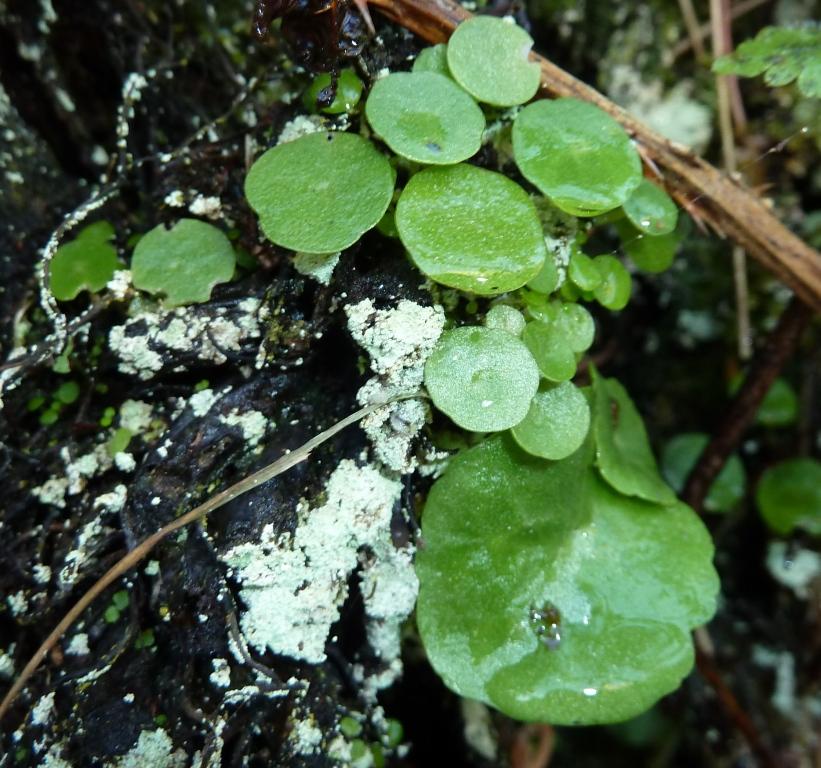
Some are so strongly associated with this type of habitat that their common names reflect it, such as the wall pennywort Umbilicus rupestris (the generic name reflects its other common name, 'navelwort'). Like many wall-dwelling species, they are also found on natural rocks, but man-made rocky surfaces can be just as good.

The round leaves of wall pennywort Umbilicus rupestris.
You can see pale green lichenous growth here, but a closer look around this wall revealed a somewhat more impressive display - the little trumpet-like fruiting bodies of the lichen Cladonia (one of several similar species).
A cluster of Cladonia
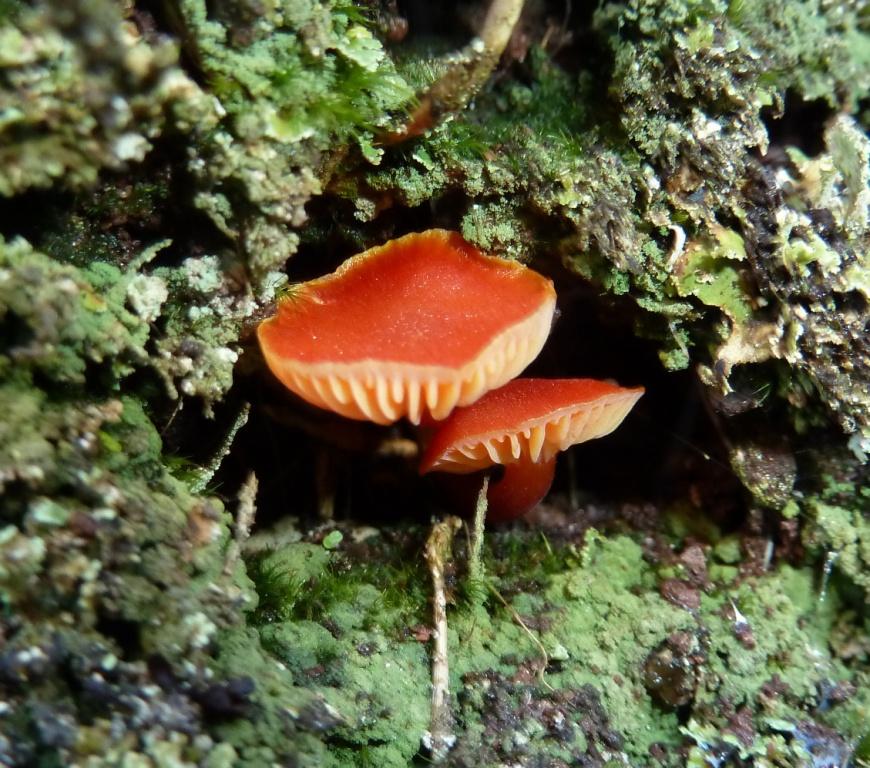
There were also larger growths of non-lichenous fungi among the damp, mossy hollows. One was the branched and spindly Grey Coral Clavulina cinerea. This is a common species but being associated with the ground in woodlands, might not seem a likely wall-colonist. However, the crevices were full of moss and soil, and roots were present from the woody plants on top of the bank the wall retains. So, from the fungus' point of view, just like home! Another was an attractive orange-red waxcap Hygrocybe sp., possibly H. helobia which was only described scientifically in 1974 and is more often associated with grassy woodland clearing or heaths (but again, conditions are suitable in this wall). However, without closer examination (beyond what I'm likely to do on holiday), the species-level ID remains tentative.
Grey Coral fungus Clavulina cinerea

Waxcap Hygrocybe sp.
Moving through the major taxonomic groups, there are also ferns associated with walls. One of these is the rustyback Asplenium ceterach which I initially thought I had found; however, closer examination (yes, sometimes even on holiday, though it took iSpot to confirm it as I don't ID ferns very often...) showed it to be A. adiantum-nigrum, though both are common in SW England. Another (which I can also find growing from crevices in the walls of the church near where I live) is the maidenhair spleenwort A trichomanes.
Asplenium adiantum-nigrum (upper surface of fronds)

Asplenium adiantum-nigrum (lower surface of frond showing red-brown sori)

Maidenhair spleenwort Adiantum trichomanes
Lastly I want to return to the flowering plants, this time a non-native garden escape Nerine bowdenii, also known as the Guernsey Lily. This southern African species is a popular plant in the village of Slapton and can be seen along the narrow lanes outside many of the cottages. However, coming from mountainous areas, it too can adapt to 'mural' life and at least one had managed to escape through a garden fence and grow on top of the old stone wall featured here. I could continue - after all, with all these plants, fungi and lichens, there are of course many invertebrates (my usual topic!) - however, as I promised my wife I would not spend the week rummaging around with collecting pots, these will remain mysterious for now and I'll simply leave you with the big pink lily which, although appearing delicate, was clearly capable of surviving repeated buffeting by passing vehicles...
Guernsey Lily Nerine bowdenii.

Tuesday, 15 May 2012

The Bluebells and the Town-hall Clock

In most of Britain, bluebells (Hyacanthoides non-scripta) are a familiar sight in the spring - a few here and there in hedgerows, grassland and on western sea cliffs, but if you visit ancient woodlands, you have a good chance of seeing carpets of these flowers...
Bluebell Wood in the Holywell Estate in Hampshire
Bluebell flowers are all on one side of the stem forming a 'raceme' of drooping flowers, each a cylindrical bell shape with two blue bracts at the base, the petals (more technically 'perianth segments' as they are fused) curled back strongly at the tips, and the anthers cream-coloured. However, you might see some that aren't quite like this - either the introduced Spanish Bluebell (H.hispanica) or, more commonly, the hybrid between the two, H. x massartiana, both being garden escapes.

H. hispanica looks superficially similar to the native bluebell, but the flowers are not all on the same side of the stem, and are not all drooping, the tips are flared outwards but not tightly curled back, and the anthers are blue. The hybrid is sometimes confused with this species, but has features intermediate between the two such as flowers that curl slightly back at the tips.

If you do visit an ancient bluebell wood, however, don't forget to look around for other species - bluebell carpets are an impressive wildlife spectacle, but this type of habitat supports many other species, some of which may be less familiar, such as Moschatel (Adoxa moschatellina), also known as 'Town-hall Clock'.

The pale green  trifoliate leaves of Moschatel

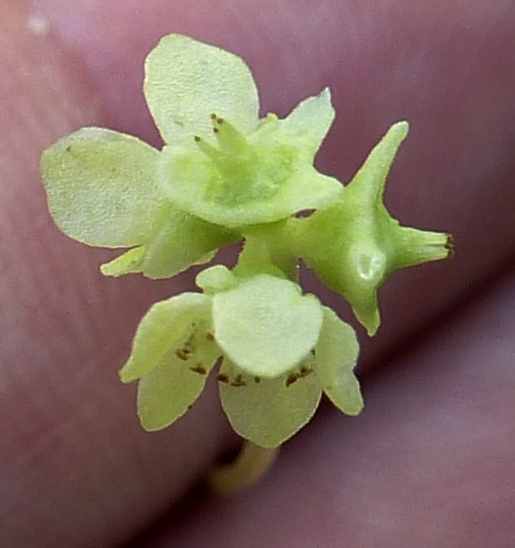
The tiny pale greenish flowers of Moschatel
Moschatel, named after its musky smell, is common in some places, particularly ancient woodlands on damp, fertile soils (and sometimes mountain ledges - in southern Europe, it is a mountain species), but is often overlooked. The trifoliate (three-part, like clovers) leaves are fairly easy to spot, each of the three leaflets further split into three lobes, but the tiny flowers can be elusive. There are five flowers at the end of each long stalk and these are arranged as a cube; four facing sideways at right-angles to each other, the fifth pointing straight up. This gives the plant its alternative 'town-hall clock' name as it recalls the shape of old clock towers with four faces and a roof on top. However, if you want to see it, you have to be quick - it soon dies back and for much of the year there is little evidence of it above ground.


There are many other ancient woodland indicators that can be found by visiting the right sites in spring - as I write, some are still visible, but soon the summer species will take over for another year...

A bluebell wood from ground level

Monday, 16 April 2012

Focusing on the familiar II: ladybirds Part 2

Following on from my introduction to 7-spot and harlequin ladybirds, in part 2 I want to look at some other common British species. The next most familiar is probably the 2-spot ladybird which has two common patterns which look like they could be separate species - either red with 2 black spots or (despite the common name) black with 4 or 6 red spots. The 2-spotted form has large white side-spots on the pronotum (a bit like 7-spots and harlequins and this can look like a black M/W mark) but the others have a more or less black pronotum. In all forms, the legs are black. The 2-spot is found on a wide range of plants in many habitats, and is common as a species that over-winters in buildings.


The two common colour forms of the 2-spot ladybird mating on a reedmace
Another common species is the 24-spot which is a rusty orange-red colour with black spots. The exact number of spots varies (from 0 to 24, with 20 being a common number), and they can be fused - there are also darker forms but they are not as common as in the 2-spot. The elytra also have tiny hairs which are visible with a hand lens (and can just be seen in the photo below). This is found in grasslands where it eats leaves and is commonest in the south of Britain.


24-spot ladybird found in loose soil on an ant-nest
Keeping with the black-on-red species, the 11-spot is widespread and common on various plants on dunes and in other habitats. As is often the case with ladybirds, the number of spots varies (from 7 to 11, although 11 is most common) and the pronotum is black with white sides.


11-spot ladybird escaping digging of soil
Superficially similar to the 11-spot, Adonis' ladybird is less common with a more scattered and localised distribution, although it has been spreading recently. It is red with 3-15 black spots (often around 7) and the pronotum is black with variable, but generally more extensive, white edges and marks than the 11-spot (in the photo below you can see that the front edge of the pronotum is white).


Adonis' ladybird on plastic on a farm
Lastly, the kidney-spot ladybird which is scattered but can be locally common, is black with 2 large orange or red spots. It is associated with various deciduous trees, especially willows, poplars, ash and birch, and is usually found at or near the base rather than higher up. The description may sound similar to the dark form of the 2-spot, but these have 4 or 6 red spots whereas kidney-spots have two red spots - this is why scientific names are so useful - common ones can be misleading. Also, the kidney-spot is much rounder when viewed from above and has splayed edges making it look almost tortoise-shaped. In the photo below you can see a yellow fungus growing on the rear of the elytra - if you want to know more about what this turned out to be, have a look here - it was quite surprising.


Kidney-spot ladybird - note the yellow fungus growing at the rear
So, that is 5 more ladybirds covered - don't forget that there are also the yellow-and-black species (they may form the subject of a separate post), plus some striped ones, some rareties and the micro-ladybirds. If this is a subject that interests you, there is a UK Ladybird Survey for all abilities where you can send in records of your sightings which all helps understanding the dynamics and ecology of one of our most popular groups of insects.

Further reading

Majerus, M. & Kearns, P. (1989). Ladybirds. Richmond, Slough. An excellent little book with detailed keys to species, including the 'micros' - a new edition is being prepared.
Majerus, M., Roy, H., Brown, P. & Ware, R. (2006). Guide to Ladybirds of the British Isles. FSC, Preston Montford. A fold-out laminated sheet perfect for beginners.
Roy, H., Brown, P., Frost, R. & Poland, R. (2011). Ladybirds (Coccinellidae) of Britain and Ireland. FSC, Shrewsbury. Details of all species including maps, identification features, ecology and so on.

Common and scientific names of species mentioned here

7-spot: Coccinella septempunctata
Harlequin: Harmonia axyridis
2-spot: Adalia bipunctata
24-spot: Subcoccinella 24-punctata
11-spot: Coccinella 11-punctata
Adonis: Hippodamia variegata
Kidney-spot: Chilocorus renipustulatus

Friday, 6 April 2012

Focusing on the familiar I: ladybirds Part 1

A few days ago, I asked a question on my Ecology Spot facebook page i.e. whether anyone had any requests for topics they'd like to see. The first one was to cover aspects of identification of more familiar species for non-specialists. This is a slight departure as I often look at the fine 'taxonomic morphology' of more obscure (even if not uncommon) species, but it's a good idea so here goes with the first of what I hope will be an ongoing series, Part 1 of a beginners' guide to ladybirds (or ladybugs if you prefer).

Ladybirds are beetles of the family Coccinellidae, and are often split into the larger and more familar 'macro' ladybirds and the smaller microladybirds or 'inconspicuous' ladybirds. In Britain there are 47 species in total and 26 are the more typical species that I want to look at here (well, a few of them at least). The most familiar is probably the 7-spot ladybird which is large (for a ladybird) and has (on its elytra or 'wing cases') the typical pattern of black spots on a red background. However...


Teneral (recently emerged) specimen of the 7-spot ladybird
This is a 7-spot but is yellowish rather than red as it is a newly emerged adult and its pattern has yet to develop. In fact it you looked even earlier, you'd see this:

A 7-spot ladybird just having emerged from its pupal skin
The reason for showing these pictures, apart from being a reminder that even common things can be tricky, is to show two key features of the 7-spot:
  • Black legs.
  • Black pronotum (the plate between the head and wing cases) with white spots to the sides.
Features like this are important as they help distinguish species from each other even when the spot pattern is abnormal (which does happen - spots can be fused, increased in number or missing). There is a Scarce 7-spot which is very similar but has two pairs of tiny white triangles underneath (by the hind and middle legs) while the 7-spot has a single pair (by the middle legs).More commonly however, the 7-spot needs to be distinguished from the Harlequin ladybird.

Harlequin ladybird
The Harlequin is well-known as an invasive non-native species that has spread rapidly across Britain since its arrival from Asia in 2003. It is often found hibernating in buildings and evidence has started to be found of its impact on native species such as the 2-spot, through competition for food and by direct predation of eggs and larvae. The Harlequin is highly variable (see here for the range of patterns) though the one above is commonly seen. You can see that the legs are paler than those of the 7-spot, and the pronotum is more extensively white with a black M (or W) shaped mark. Easy!

That's all I want to cover for now - more coming soon. If this is a subject that interests you, there is a UK Ladybird Survey for all abilities where you can send in records of your sightings which all helps understanding the dynamics and ecology of one of our most popular groups of insects.

Further reading

Majerus, M. & Kearns, P. (1989). Ladybirds. Richmond, Slough. An excellent little book with detailed keys to species, including the 'micros' - a new edition is being prepared.
Majerus, M., Roy, H., Brown, P. & Ware, R. (2006). Guide to Ladybirds of the British Isles. FSC, Preston Montford. A fold-out laminated sheet perfect for beginners.
Roy, H., Brown, P., Frost, R. & Poland, R. (2011). Ladybirds (Coccinellidae) of Britain and Ireland. FSC, Shrewsbury. Details of all species including maps, identification features, ecology and so on.

Common and scientific names of species mentioned here

7-spot: Coccinella septempunctata
Scarce 7-spot: Coccinella magnifica
Harlequin: Harmonia axyridis
2-spot: Adalia bipunctata