Welcome

Welcome to my blog

This is where I post various musings about wildlife and ecology, observations of interesting species (often invertebrates)
and bits of research that grab my attention. As well as blogging, I undertake professional ecological & wildlife surveys
covering invertebrates, plants, birds, reptiles, amphibians and some mammals, plus habitat assessment and management
advice
. I don't work on planning applications/for developers. The pages on the right will tell you more about my work,
main interests and key projects, and you can follow my academic work here.
Showing posts with label mycology. Show all posts

Thursday, 8 May 2014

Orange agents of decay

While checking a bee-log in our garden, I noticed one of the holes had a dead fly in it. I removed it and was about the throw it away when I saw tiny orange dots on the surface. Because I am a nosy ecologist I put it under the microscope to see if there was anything interesting going on, and saw what looked like a microfungus growing out of the joints and bristle-bases of the fly.

Fly (possibly in the family Muscidae) with orange fungal growths.
There are some very interesting fungi that parasitise insects and I've written about one of them before. However, this looks different - maybe something simply using an already-dead fly as a substrate.

Fungal growths showing the thin threads of hyphae between the orange fruiting bodies.
Fungal fruiting bodies at the bases of the fly's bristles.
The fungal structure is clear - hyphae and fruiting bodies - but with most microfungi, it is necessary to look at the spores, so I made a slide and zoomed in.

Fungal spores x100
The spores are clearly visible as slightly curved spindles, each split into several sections by cross-walls (septae). However, though a mycologist would probably know this fungus by sight, I couldn't find anything that matched it, so sent my pictures to the British Mycological Society's facebook group. It didn't take long for one of the BMS to tell me that this was a species of Fusarium. This at least explained why I hadn't worked out what it was - most Fusarium species are soil fungi involved in decomposition of dead organic matter but I hadn't been looking at soil-dwelling species. If so, the fungus was simply decomposing the fly - which is what it does, and very usefully too; no soil decomposers = dead soil. However, some Fusarium are insect (and plant) pathogens, so it could have killed the fly before decomposing it.

Fusarium are varied, diverse (in terms of both species and strains) and not all well understood or taxonomically clear, though some cause plant diseases and others can infect humans, while one is the main ingredient in Quorn! So, the identification stops at genus on this occasion, but has introduced me to a fungus that, although I'd heard of it, and it may be growing all around us in the ground, I've never stopped to look at before. Thanks BMS!

Monday, 4 November 2013

No clouds, no rain, no cold, November

This title of this post may well be inaccurate by tomorrow, but for now - in this part of Britain at least - it is warm, dry and sunny. More importantly, it has remained warm apart from a couple of cold nights and dry apart from a few days of stormy rain for much of the autumn. This of course affects our wildlife. For example, a 'proper' hot, dry summer after several cool, wet ones has seen butterfly populations bounce back to some extent, and this is likely to be helped by a long warm autumn. Undoubtedly, migratory birds will have done better than in previous years, being able to find more food for there long autumn flight, and hibernating species will have a better chance of storing enough energy for the winter. Personal observations also bear this out - garden birds are not using our feeders so much as they have been (though I have seen plenty of birds around) - presumably there is still plenty of wild food available.

This year our strawberry plants have fruited into November - some wild plants will be doing the same
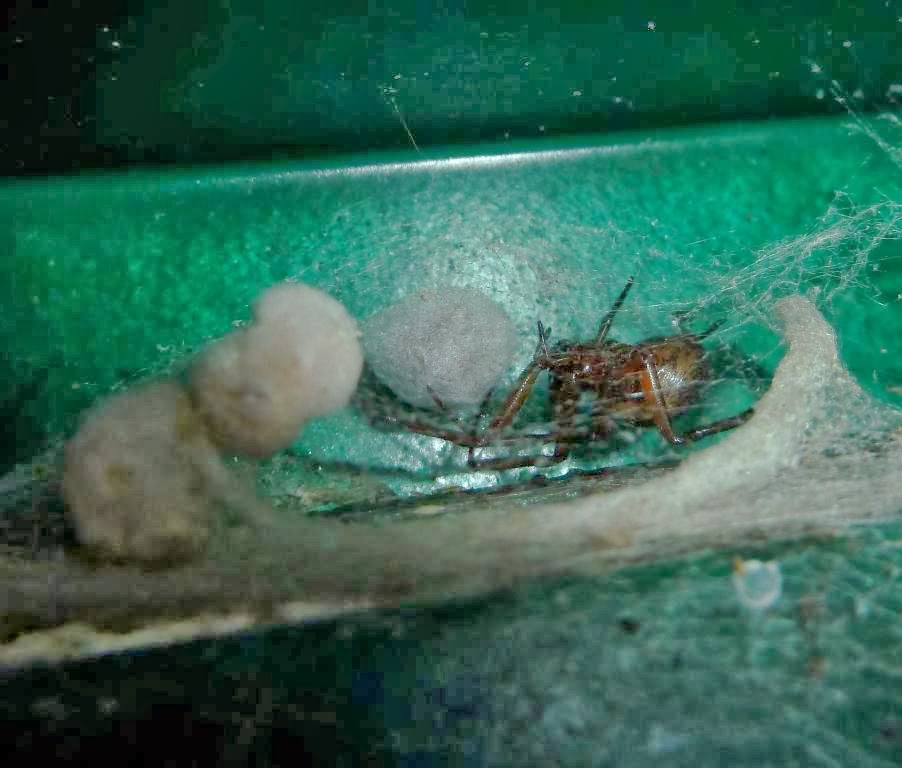
A long season of favourable conditions means that breeding/reproduction can go on for longer with 'extra' broods possibly being squeezed in before winter. I have seen late jackdaw broods in chimney-pots nearby, but on a smaller scale, the female Steatoda nobilis false widow spider (one of the species associated with tabloids' recent scaremongering) that lives in our garden storage box has another brood which she guards closely.

Female Steatoda nobilis guarding her egg-sac - two old sacs remain showing that this is the third brood in this sheltered location.


 Of course, it is autumn - leaves are turning yellow and falling - and it has been damp recently, so Fungi are also appearing to remind us that this is not simply an extension of summer. There are 'toadstool' or mushroom-types of Fungi, but personally I am drawn to the smaller species (as I am with invertebrates), some of which have appeared, almost overnight, on some of our garden woodwork...
 
The common species Coral Spot Nectria cinnabarina - associated with dead wood, here it is on a batten forming part of a garden shed
A small species on hardwood garden shelving - I haven't yet identified it but it look a little like an oysterling (Crepidotus sp.)
So, just a few observations about this autumn, but they do give a flavour of how the current and recent conditions affect the wildlife we see - hope you enjoy whatever you are watching out for!

Sunday, 8 September 2013

Smutty farming

Yup, an obvious pun I know, but hey... as you may know if you read this blog regularly, I am a stakeholder in a community farm - we're chemical-free and pretty wildlife-friendly, and as such use either (a) cunning or (b) many pairs of hands to deal with pests. Of course, we get a few, but they can be interesting in their own right - like yesterday when I found a single fist-sized growth of common smut fungus (Ustilago maydis) at the base of one of our sweetcorn plants.

Common smut Ustilago maydis on sweetcorn
Close-up of U. maydis showing a small growth of the sweetcorn plant.
The fungus can grow on any part of the plant, though, as here, it most commonly affects the cob/seeds which expand and become filled with spores - essentially it causes a gall. It is fairly common, and its presence this year is unsurprising as conditions have been ideal - hot, dry weather while the plants are establishing, followed by rain as they mature - exactly what has occurred. It can cause major crop losses, though our non-intensive 'hands-on' approach means that we'll simply look out for and remove any more if they appear (the standard advice is to burn or bin them, but not compost them as the spores will survive and spread).

Interestingly though, I have found out that the fungus is actually edible, particularly if relatively young (this specimen was very mature and entirely spore-filled), and in Mexico is a delicacy known as 'huitlacoche' which is eaten in a succotash, or in tacos or omelettes. Apparently it's kind of nutty-mushroomy and quite nice but not popular elsewhere as it's seen as a 'disease'/'rot' rather than food - and I must admit it doesn't look that appealing. However, if I find another, less mature one, I'm going to try it - seems a good use of a failed cob! I may report the results here...

Monday, 26 November 2012

What's in a wall?

As you might imagine, I don't mean bricks and mortar - instead I am more interested in the species that can be found growing on walls, particularly old rough stone walls in areas with low levels of air pollution such as might be found in the village of Slapton in south Devon. Yup, where I was one holiday a couple of weeks ago... Old walls are well known to be important for wildlife - for instance, lizards can often be seen basking on them - but for those of us living or working in cities, especially with relatively new and smooth-surfaced buildings (and more air pollution), the opportunities to see such species can be limited.

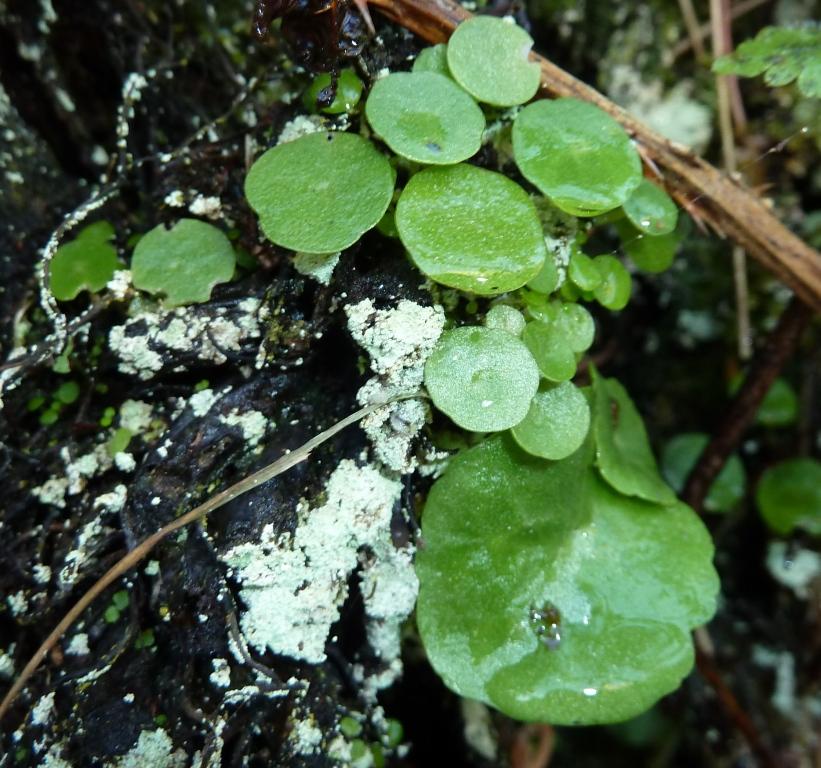
Some are so strongly associated with this type of habitat that their common names reflect it, such as the wall pennywort Umbilicus rupestris (the generic name reflects its other common name, 'navelwort'). Like many wall-dwelling species, they are also found on natural rocks, but man-made rocky surfaces can be just as good.

The round leaves of wall pennywort Umbilicus rupestris.
You can see pale green lichenous growth here, but a closer look around this wall revealed a somewhat more impressive display - the little trumpet-like fruiting bodies of the lichen Cladonia (one of several similar species).
A cluster of Cladonia
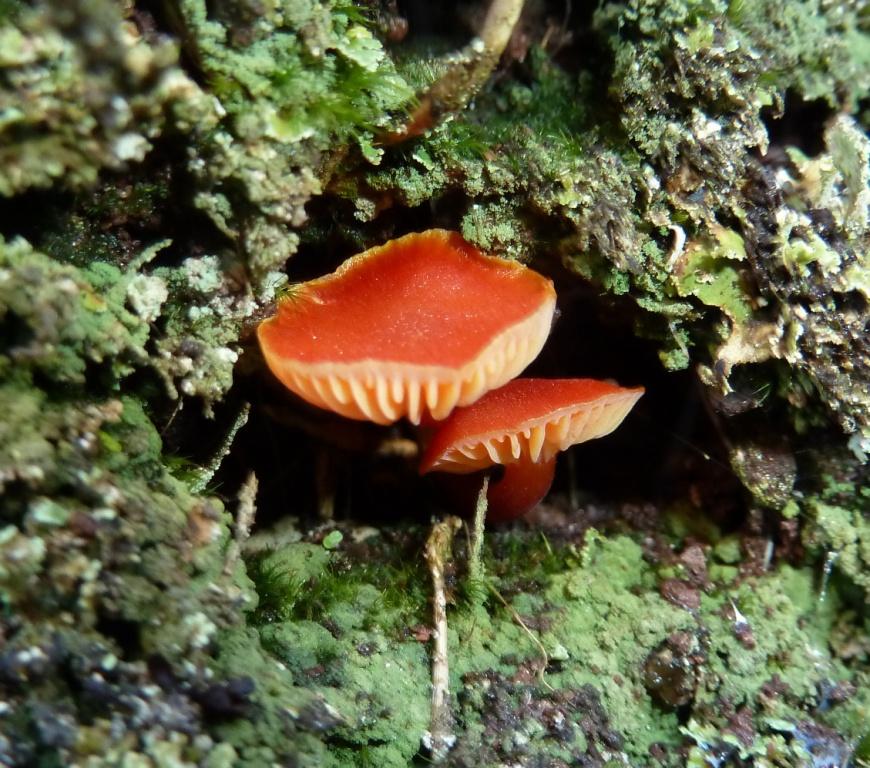
There were also larger growths of non-lichenous fungi among the damp, mossy hollows. One was the branched and spindly Grey Coral Clavulina cinerea. This is a common species but being associated with the ground in woodlands, might not seem a likely wall-colonist. However, the crevices were full of moss and soil, and roots were present from the woody plants on top of the bank the wall retains. So, from the fungus' point of view, just like home! Another was an attractive orange-red waxcap Hygrocybe sp., possibly H. helobia which was only described scientifically in 1974 and is more often associated with grassy woodland clearing or heaths (but again, conditions are suitable in this wall). However, without closer examination (beyond what I'm likely to do on holiday), the species-level ID remains tentative.
Grey Coral fungus Clavulina cinerea

Waxcap Hygrocybe sp.
Moving through the major taxonomic groups, there are also ferns associated with walls. One of these is the rustyback Asplenium ceterach which I initially thought I had found; however, closer examination (yes, sometimes even on holiday, though it took iSpot to confirm it as I don't ID ferns very often...) showed it to be A. adiantum-nigrum, though both are common in SW England. Another (which I can also find growing from crevices in the walls of the church near where I live) is the maidenhair spleenwort A trichomanes.
Asplenium adiantum-nigrum (upper surface of fronds)

Asplenium adiantum-nigrum (lower surface of frond showing red-brown sori)

Maidenhair spleenwort Adiantum trichomanes
Lastly I want to return to the flowering plants, this time a non-native garden escape Nerine bowdenii, also known as the Guernsey Lily. This southern African species is a popular plant in the village of Slapton and can be seen along the narrow lanes outside many of the cottages. However, coming from mountainous areas, it too can adapt to 'mural' life and at least one had managed to escape through a garden fence and grow on top of the old stone wall featured here. I could continue - after all, with all these plants, fungi and lichens, there are of course many invertebrates (my usual topic!) - however, as I promised my wife I would not spend the week rummaging around with collecting pots, these will remain mysterious for now and I'll simply leave you with the big pink lily which, although appearing delicate, was clearly capable of surviving repeated buffeting by passing vehicles...
Guernsey Lily Nerine bowdenii.

Monday, 16 January 2012

Teeny-tiny toadstools - or are they?

Yesterday I was pointed towards a log cut from a fallen tree in my in-laws' garden. On it was a fairly dried-out growth of moss and on the leaves, what looked like some tiny (1mm) fungal caps. Now, I'm no mycologist (or bryologist), but I do find microfungi intriguing and happen to have a copy of Ellis & Ellis (1998) which is the standard (only?) work covering British microfungi on substrates other than vascular plants - for those you need Ellis & Ellis (1997).

The specimen - the caps are about 1mm in diameter.
A slightly closer view showing the wrinkled stalks.
The moss is fairly dry and a bit of a miserable specimen without capsules, but looking at the excellent Atherton et al. (2010), I think that it is the common and widespread species Brachythecium rutabulum (sometimes known as the Rough-stalked Feather-moss). The fungus itself is white with a split cup-like cap and a wrinkled stem that widens towards the base. The cap is granular beneath and bears hairs in the upper/outer surface.
Two of the fruiting bodies showing details of stems and caps.
Side view of a fruiting body showing the split cap and granular spore-bearing structures.
Some moss-epiphytic microfungi have clear fringes of hairs around the edge of the cap. This doesn't appear to be the case here - instead there appears to be an irregular tufting of hairs on the top of the cap with a few at the edge (I wondered if they were the hyphae of another even smaller fungus, but I don't think so).

Side view of the cap showing tufts of hairs.

High-power image of the cap showing branching hairs.

Lastly, spores are an important feature used in the identification of microfungi. I collected some of these on a slide and they are clearly almost spherical and reddish-brown in colour, and each is about 10um in diameter.

Spores (x100 magnification)

So, the overall size, colour, spore colour/shape/size, habitat, hairs and other features lead me to tentatively identify this as Chromocyphella muscicola, a species with caps up to about 3mm diameter which is associated with mosses on bark. However, having consulted with a mycologist from the Hampshire Fungus Recording Group, it appears that C. muscicola doesn't produce stalks like this. Other superficially similar genera such as Leptoglossum also differ from this specimen in one or more ways e.g. spore shape, cap hairs. And so, it was suggested that this might not be a true fungus at all, but instead a myxomycete or 'slime mould' where the globular sporangium had broken open to reveal the network of spore-bearing hairs known as the capillitium.

I have posted about myxomycetes before (e.g. here and here) but it still a group of organisms I know little about, fascinating as they are - taxonomically protozoans but traditionally treated as 'honorary' Fungi. So, swapping books to look at Ing (1999), it soon became clear that this was indeed a 'myxo'. It also happened to be one that was relatively easy to identify from the keys and descriptions - the pale colour, size, stalk, open split 'cap' with the hairs of the capillitium, and spores (shape, size, colour, texture). This process also taught me that an important identification feature can be the shapes, colours and sizes of nodes of the capillitium i.e. structures about the size of a spore where hairs meet and branch.

These features all combined to indicate that this is the myxomycete Physarum nutans - a common and widespread species, though rarely found on mosses (it is usually on dead wood or the bark of live trees). It is very similar in appearance to Didymium squamulosum but they can be separated by features such as the spores (in D. squamulosum they are dark brown in transmitted light whereas in P. nutans, as here, they are pale brown). So, an interesting process for me, looking at an unfamiliar group - the only way to learn more about species identification!

References

Atherton, I., Bosanquet, S. & Lawley, M. (eds.) (2010). Mosses and Liverworts of Britain and Ireland: A Field Guide. British Bryological Society.
Ellis, M.B. & Ellis, J.P. (1997). Microfungi on Land Plants: An Identification Handbook. Richmond, Slough.
Ellis, M.B. & Ellis, J.P. (1998). Microfungi on Miscellaneous Substrates: An Identification Handbook. Richmond, Slough.
Ing, B. (1999). The Myxomycetes of Britain and Ireland: An Identification Handbook. Richmond, Slough.