Welcome

Welcome to my blog

This is where I post various musings about wildlife and ecology, observations of interesting species (often invertebrates)
and bits of research that grab my attention. As well as blogging, I undertake professional ecological & wildlife surveys
covering invertebrates, plants, birds, reptiles, amphibians and some mammals, plus habitat assessment and management
advice
. I don't work on planning applications/for developers. The pages on the right will tell you more about my work,
main interests and key projects, and you can follow my academic work here.
Showing posts with label bees. Show all posts

Wednesday, 26 June 2013

It's June, and wasps are busting out all over

Bees are good. We like bees. They pollinate and are pleasant to watch. They are of course also wild creatures subject to the stresses that any other organism has to deal with, and one of these is parasitism. With our garden bee logs, new and old, almost completely occupied by the red mason bee Osmia rufa, it is not surprising that other nesting sites are sought out. Sometimes the chosen spot is not a good one, as in this case where a nest had been attached between a hoe and the inside of our tool shed - we'd noticed the nest, but the hoe fell down anyway, taking some of the cells and cocoons with it.

Osmia rufa nest - the open sides of the cells were pressed against the handle of a hoe until it fell down. Note the larva in the bottom centre cell (now taken away to be raised indoors)
The inside of an O. rufa cell - note the plug made of numerous small pieces of mud tamped into place by the prongs on the female's head.
A cocoon and pollen ball (larval food supply which includes a small amount of nectar) from an O. rufa cell.
Being a fan of bees (well, wildlife in general really) and ever-curious, I collected the cocoons that had been displaced (about a third of the whole nest) and brought them indoors to be put into a hatchery. I was of course hoping to see the bees emerge and release them, but a few days later something else happened entirely; the hatchery was full of small parasitic wasps - Monodontomerus obscurus (Hymenoptera, family Torymidae) - 21 in total.

Some of the Monodontomerus obscurus hatched from O. rufa cocoons
A female (note the ovipositor) M. obscurus apparently feeding on an O. rufa larval pollen store.
Although the larger parasites of O. rufa are listed in Baldock (2008), there seems to be relatively little mention of this aspect of the bee's natural history even though it is a familiar and popular species. However, Krunic et al. (2005) provide more detail and note that M. obscurus can suppress O. rufa populations in some nesting situations such as paper tubes and hollow reeds.

This is a normal part of bee ecology of course - and the wasps are interesting little jewels in their own right, so (as ever) I took the opportunity to have a look at one of them (a female) more closely. Males are present but smaller (approx. 4mm long without appendages, females approx. 5mm) and lack the ovipositor that female use to lay eggs into the bee cocoons.

Female M. obscurus - approx 5mm long plus 2-3mm of ovipositor
Close-up of the head of a female M. obscurus - note the red eye with short white bristles, plus the sculpturing on the head and thorax.
Close-up of the hind femur of a female M. obscurus - note the sculpturing on the leg and the 'finger-print' pattern of sculpturing on the abdomen behind it. Also, the edges of the thoracic plates bear fringes of short white bristles, presumably to protect the membranous joints.

O. rufa cocoon with M. obscurus exit hole.
With the cocoon having disgorged its parasites, there was only one thing left to do - open it up to what was left inside.

The content of an O. rufa cocoon after emergence of M. obscurus.
I did wonder of there would be much evidence of the juvenile bee, but very little was left, having presumably been consumed by the wasp larvae - there are a few fragments (e.g. bottom right) but nothing more. Most of the invertebrate material consists of pupal skins of M. obscurus - unsurprising given the number that emerged. There is some frass (faeces) and bits of dried mud from the nest which must have fallen in before the cocoon was spun. Top left is a dead female wasp who didn't emerge fully from pupation. She is of course also in a hatchery just in case she releases smaller parasites of her own...


References

Baldock, D.W. (2008). Bees of Surrey. SWT, Woking.
Krunic, M., Stanisavljevic, L., Pinzauti, M. & Felicioli, A. (2005). The accompanying fauna of Osmia cornuta and Osmia rufa and effective measures of protection. Bulletin of Insectology 58(2): 141-152.

Friday, 7 June 2013

Leaf-cutters and cuckoos

I've written quite a few posts about bees, especially garden species  (search for 'bees' on this blog and you'll see!), but having found around 20-25 species so far, there is plenty more to look at. For instance, yesterday I noted a small-to-medium stripy bee being chased away by a leaf-cutter. Naturally, I grabbed my camera and watched what was happening. The smaller bee turned out to be quite an interesting species...

Male Coelioxys rufescens
I was interested to see a species of Coelioxys in the garden as none of them are especially common in Britain. They can be difficult to identify, although there are only seven species in this country and two are coastal, so the options are limited. This one is a male - the abdomen is blunt with short spines whereas the female has an elongtae pointed abdomen. Also, the species are all cuckoo bees ('cleptoparasites') which means they take over cells in the nests of their host bees, all of which are in the genera Megachile and Anthophora. They do this by the female using her elongated abdomen to cut into the host cell and lay an egg through the hole. Young Coelioxys larvae have long, curved jaws which they use to destroy the host egg or larva; they then feed on the food stores of the host, with later instars (larval stages) having normal jaws.

C. rufescens is fairly widespread in south and SE England (scattered further north), though Coelioxys species may be under-recorded; I have recorded it in our garden in previous years, as well as one of its possible hosts, the leaf-cutter bee Megachile centuncularis - there are several others noted in Collins & Roy (2012) though the full host range is uncertain. It flies fairly early (from June) for a British Coelioxys (along with C. elongata); most are not active until July.

Megachile centuncularis approaching a common bird's-foot trefoil (Lotus corniculatus)

Megachile centuncularis feeding on a garden thistle (Cirsium sp.)
If M. centuncularis is a host of C. rufescens, this might explain the aggressive behaviour seen, with the parasitic species being repeatedly chased away (though not a nest/host-searching female). Host-parasite interactions can be fascinating and tell us much about evolutionary processes - for example, some cleptoparasites may mimic chemical cues to avoid anti-parasite strategies (e.g. Strohm et al., 2008), and it seems reasonable to suggest that hosts can detect their parasites. This of course does not confirm that M. centuncularis is a host species, but it a good indication that it is something worth investigating more closely...


Reference

Collins, G.A. & Roy, H.E. (eds.) (2012). Provisional Atlas of the Aculeate Hymenoptera of Britain and Ireland. Part 8. BRC, Wallingford.
Strohm, E., Kroiss, J., Herzner, G., Laurien-Kehnen, C., Boland, W., Schreier, P. & Schmitt, T. (2008). A cuckoo in wolves' clothing? Chemical mimicry in a specialized cuckoo wasp of the European beewolf (Hymenoptera, Chrysididae and Crabronidae). Frontiers in Zoology 5(2). [online] [accessed 06/06/2013].

Monday, 8 April 2013

Ye olde bee log

A couple of years ago (how time flies...) I wrote about the diversity of bees in our garden, including an image of Osmia rufa (the red mason bee) using a log that I had attached to our garden fence. Since then, I've made a rather more sophisticated insect hotel including new bee-blocks and have been following the development of bee diversity in our garden as the various features mature and are added to. In the meantime, the old log had become very rotten with little activity noted around it last summer, and so I decided it was time to take it down and see what was inside.

Old bee-log showing extensive fungal decay and woodworm activity.
The outsides had been heavily arracked by woodworm and many holes and crevices had suffered fungal decay with tufts of white mould clearly visible. Onto the deadwood pile with those bits... Splitting the core open provided more interesting features however.

Empty O. rufa cocoons, one in situ in the hole drilled when making the bee-log, the other removed to show the thin papery texture.
The remains of the walls/plus separating cells which are arranged in sequence along a hole.
A view through two O. rufa cocoons - because they are arranged along a hole, the outermost one must leave first, the next then passing through its cocoon to emerge.

The remains of a cocoon including frass (insect faeces), presuambly from the insect before the cocoon was formed.
These are simple enough observations but rarely seen as logs need to be split open to view them - this is of course destructive and is only being done here because the log was past its 'sell by' date given the amount of decay and lack of activity last year. The life cycle of O. rufa is well documented (e.g. here) so rather than repeat this, I simply want to show which aspects of it are readily visible with a little careful effort. For example, although not photographed, a number of holes contained mouldy yellowish masses - pollen stores created by females for their young, but which were uneaten and subsequently began to decay, presumably as the young did not develop for whatever reason (it was a cold, wet summer in 2012 which can not have helped). Others showed mere traces of pollen storage, suggesting successful emergence. Also, as holes in logs are useful shelter for other species, it wasn't too surprising to find evidence of use by insects other than O. rufa.

Smaller pupal cases inside the bee log
One of these non-Osmia rufa pupal cases removed and magnified, approx 6mm long. The red line follows the split where the insect (whatever it may be) emerged; the green arrows indicate a pair of short posterior processes (breathing tubes) typical of many fly pupae.
Beyond determining that it is a fly, I can tell no more about this species - it might be parasitic, it might simply be using a handy hole for pupation with no other link to O. rufa. However, among the various debris and evidence of O. rufa long since left, I did find one intact bee cocoon.

The one remaining O. rufa cocoon, approx 11mm long blocked in by a number of soil and wood particles.
A small female O. rufa emerging from the cocoon.
The small 'prongs' or 'tampers' (one indicated by a red arrow) on the face of the female O. rufa, used to push mud into place when sealing a hole, although they are under-developed in this specimen.
I must say I was surprised to find an intact cocoon and initially thought it was one that had failed to emerge last year. However, in the warmth of my study I noticed some movement and a bee began to emerge. Its movements were rather feeble so a helping hand (well, pin) was used to pull off part of the cocoon. The female that emerged did not move strongly and was very small with (to me) under-developed facial prongs - possibly a poorly developed specimen from last year's poor summer which had managed to hibernate successfully. She has now been released on the bee-hotel - hopefully there will be a emergence of plenty more from the many plugged holes in the newer logs.

Monday, 31 December 2012

2012 on the Spot

It's that time of year - the dribbly brained devotees of Mayan stonework-paranoia were wrong and we're still here on New Year's Eve, which means it's time for a run-down of some of my favourite Ecology Spot posts of the last twelve months.

January included a series of four posts about my pet Macleays's Spectre stick insects - I'm not sure I have a favourite as such, though part 2 (the males) does include a shot of one of the boys taking off which was seriously tricky to capture, plus one of my wife's head while she was being used as a launchpad for their aeronautical adventures.

February shifted from tropical-terrestrial to polar-marine with a look at gigantism in Antarctic sea-spiders, inspired by a visit to the Oxford Uni Museum of Natural History.

March was unusually warm and this got me out in the field (well, a churchyard) looking at the bees of a grassy bank, and very pleasant it was too.

In April, more fieldwork led to an unusual aphid/gall find and needed consultation with an aphid specialist to work out - quality collaboration!

May included a variety of invertebrates, including more collaboration, this time in order to identify a tricky pseudoscorpion specimen - a group I've never looked at before.

June saw a rare example of my use of video, looking at the leaf-mining fly larvae in Solomon's-seal.

Into July, and despite the horribly wet summer, I continued to record bee species in our garden (despite the weather, a range of bee-friendly features still attracted them), and reached the grand total of twenty species and counting.

As the summer finally dried out a bit in August, I shifted briefly away from British invertebrates and looked at a poison-arrow frog - you'll see why when you get to the end...

September saw me get a bit speculative (or odd, depending on your point of view) as I looked at why Smurfs are like slipper limpets. Yes, really...

In October, normal service was resumed and I wrote a series of three posts about tarantula anatomy, the third of which looked at their various appendanges (e.g. feet and fangs) - not one for arachnophobes!

November was a busy month - not only did I go on holiday and come back full of ideas realting to things I'd seen during an unseasonally warm week in Devon, but my key to leaf beetles of the British Isles was also published, oh yes :)

And finally onto December where a rather unusual Christmas-party gift led to some unexpected microscope work and a specimen from an unexpected kingdom...

That's all from me for 2012 - back after the New Year celebrations which should involve a ridiculous hat of some sort...

Yup, that's me in a splendid hat with a gun of rum...

Thursday, 27 December 2012

The tricky world of bee ID

It's that time of year and I thought about posting about something festive (reindeer, mistletoe...) but having just seen a bumblebee fly past, I decided to stick to my favourite topic - invertebrates. Despite the sogginess of the summer, I've been recording bee species in our garden, and aside from their wondrous diversity and interesting life histories have noticed that it seems to be a surprisingly difficult group to get to grips with identification-wise. There's no inherent reason for this - after all, most invertebrate groups require a close look at small features to enable species-level identification (i.e. most bee species can't be distinguished in the field, but that's true of the majority of groups), and there aren't that many species in the UK (about 260 - similar to the hoverflies and flea beetles for example). So, although they are more numerous and a little more difficult than, say, butterflies, the main problem is a lack of modern literature, in particular species-level identification guides, at least in the UK (which is my focus here, though I imagine the same problem exists elsewhere).

An interesting little bee, but how to identify it?
The last comprehensive account of British bees was published in the late 19th century (!) (Saunders 1896) and can now be downloaded from here (click 'view book' on the right then choose the format, the pdf is about 20MB) - including the fine colour plates which are still useful. Then in the early 20th century the British Hymenoptera were covered (well, though not comprehensively) as part of the excellent 'Wayside & Woodland' series (Step 1932), but despite changes to taxonomy, distribution and our knowledge of ecology, there were few publications outside of journal articles until a key the genera in the 1980s (Willmer 1985) and to higher taxonomic levels, including genera in some cases, of the wider Aculeata (Bees, Ants and Wasps) (Yarrow 1986). However, even with readily available keys to genera in place, a single species-level identification guide to UK bees has not been forthcoming and although old does not mean wrong, taxonomic changes, extinctions, new discoveries and so on, do gradually render more venerable works out-of-date. Instead, becoming familar with UK bees as a whole has meant (and still does) accumulating keys covering various genera from a variety of sources such as the leaf-cutter bees (Else 1999), the bumblebees (Edwards & Jenner 2009) and the test keys to Coelioxys and Hylaeus available to download here. These can be supplemented with a range of more general works on Hymenoptera; for example I have recently acquired Bellmann (2010) which covers a selection of Central European Aculeate species (in German), including a wealth of interesting information and some nifty little line drawings to aid identification e.g. of wing cells/venation. It will also lead to an improvement in my ability to read German...

So, there has been progress - some genera are covered (though the test keys are exactly that and need to be used with caution) - and the lack of a current UK guide is well known, being noted in another excellent publication (Baldock 2008) which includes useful photos and a key to bee genera. I use this a lot and its relevance is broader than the title suggests as Surrey supports a large proportion of the national bee fauna. Of course, I haven't yet covered online resources or societies and the one that really stands out here is BWARS (the Bees, Wasps & Ants Recording Society) which includes a variety of resources (inlcuding the test keys mentioned above) such as a more comprehensive bibliography (with more opportunities to improve my German) and an excellent photo gallery. All told, practise is essential and I have learned a lot about bee ID over the last few years, though there are still some gaps I want to fill (when aren't there?). There's also a tantalising hint of a work-in-progress in the form of a 'Handbook of the Bees of the British Isles and the Channel Islands' to be published by the Ray Society, though no date is yet known. I may have to put some money aside for that one...

Happy bee-hunting!

Hmmm, nice clear wing venation, now where's that key...?


References

Baldock, D.W. (2008). Bees of Surrey. Surrey Wildlife Trust, Woking.
Bellmann, H. (2010). Bienen, Wespen, Ameisen. Kosmos, Stuttgart. [In German]
Edwards, M. & Jenner, M. (2009). Field Guide to the Bumblebees of Great Britain & Ireland (rev. ed.). Ocelli, Eastbourne
Else, G.R. (1999). Identification. Leaf-cutter bees. British Wildlife10(6): 388-393.
Saunders, E. (1896). The Hymenoptera Aculeata of the British Isles. Reeve, London.
Step, E. (1932). Bees, Wasps, Ants and Allied Insects of the British Isles. Warne, London.
Willmer, P. (1985). Bees, Ants and wasps. A Key to Genera of the British Aculeates. Field Studies Council, Taunton.
Yarrow, I.H.H. (1986). Key to the Aculeata (ants, bees and wasps). In: Betts, C. (ed.). The Hymenopterist's Handbook (2nd ed.). AES, Hanworth. pp. 168-172.

Tuesday, 11 December 2012

Sometimes, life is just a blur

No, despite the title, I'm not talking about being far too busy to fit everything in (though that's often true), or having hazy recollections of evenings past due to the influence of rum... Instead, I want to give a little insight into the nature of some enquiries I receive from non-entomologists regarding the identification of invertebrates.

First of all I have to say that I like receiving such requests - I may not always have much time to devote to them, but I do try, and am always pleased that someone has put in the effort, and been interested enough, to photograph an invertebrate and then (often after having tried a general insect book and the web) bothered to find someone - me - to contact. Much better than squashing the unknown!

So, when my mother-in-law got in touch a few days ago saying that a guy (Scott, if you're reading this) doing hedge-trimming had found (and I paraphrase here) 'a big insect like a dragonfly with a stinger' on his leg, it was good to know that it had been put on a leaf and photographed. My initial thought was 'ichneumon' because dragonflies are pretty straightforward to recognise as a group (including the damselflies) and Britain doesn't have many other long, thin, large insects with anything resembling a 'stinger'. I wasn't sure how far I'd get with identification - with around 3,300 species in the UK alone, many of which are very similar, and no single guide to them, it isn't an easy task even with a specimen - from a photo, species-level ID is usually impossible. Still, I was curious and asked for the photos to be emailed to me, and this is one of the set I received...

The mystery ichneumon
Well, the first thing is it is certainly an ichneumon (a type of parasitic wasp, although they are sometimes called 'ichneumon-flies' despite definitely not being flies), and quite a large one going by the ivy leaf and Scott's thumb for scale. However, beyond that it is a little more difficult. It is black with orange legs, a common combination for ichneumons, and has a long ovipositor. This is the 'stinger' but in reality isn't a sting; although some ichneumons (such as the orange-yellow ophions that turn up in moth traps) do sometimes give human fingers a bit of a jab, they are essentially harmless to us. The structure is actually an egg-laying tube and is long because it is used to probe into wood where the host insect larva lives. An egg is laid in (or on, with the young ichneumon larva burrowing inside once hatched) the host and the rest is, well, parasitic - suffice to say the host does not survive having an ichneumon growing inside it. Hosts include beetles, moths, flies and so on, varying by ichneumon species. So, is there anything else I can tell from the photos?

Side view of the mystery ichneumon
You will have noticed that the photos are a bit blurry (hence the title) - cameraphones and compacts often seem to decide the background is more interesting than the real subject - and often this would mean I couldn't use them. However, in this case it makes little difference as ichneumon ID by photo is often uncertain at best in any case. Here I can see the overall size and colour - for example there are no white spots or bands on the abdomen, which means it isn't our largest ichneumon, the sabre wasp Rhyssa  persuasoria. The size rules out most species, and the long ovipositor means it isn't a species of Pimpla (see below). Instead it is likely to be either Lissonota or the more localised Ephilates. Being late in the year, it is possible this individual was avoiding cold conditions and is simply active later than expected - certainly it dropped to the ground and was lost in pant material rather than flying away.

Whichever it is, the specimen is certainly impressive. I find this group of insects intriguing and am slowly  learning to identify them - it's a long process - and the species-level names are often indicative of their parasitic reproductive strategy and habit of hunting openly and actively for hosts; instigator, punctator, divinator, fornicator, consortana, dissoluta, inquisitor, insertana and so on. If you are interested, Broad (2006) provides a useful test key to subfamilies here. Beyond that, it's a matter of accumulating useful webpages, books and articles, and finding hymenopterists to help you - Fitton et al. (1988) shouldn't be too hard to find and covers the subfamily Pimplinae, members of which are quite readily encountered, such as the one below which took shelter in our bedroom while we were on holiday last month...

A pimpline ichneumon, possibly genus Pimpla.
References

Broad, G. (2006). Identification key to the subfamilies of Ichneumonidae (Hymenoptera). Available online here.
Fitton, M.G., Shaw, M.R. & Gauld, I.D. (1988). Pimpline Ichneumon-flies. Hymenoptera, Ichneumonidae (Pimplinae). Handbooks for the Identification of British Insects 7(1): 1-110.

Tuesday, 20 November 2012

No seeds, no fruit, no fungi - November!

It's been an odd year in the UK (and elsewhere) - an unusually warm early spring, then a cold, wet early spring and summer and a very variable autumn with frosts and warm periods. Unsurprisingly, this has seriously impacted some of the UK's wildlife negatively. For example, the Big Butterfly Count found declines in many common species, with 11 of the 21 target species decreasing in abundance by more than a third since 2011. There are a number of reasons - low temperatures clearly affect cold-blooded groups such as insects, which in turn reduces the food available for insectivores such as birds and bats. Plant growth is also affected by cold and water-logging, so less sugar is produced, fruit growth is reduced (and what does grow may be affected by moulds and blights and fall early or rot on the plant), leading to less seed production - bad for plant reproduction and seed-feeders such as many winter birds. This is already having visible effects as more unusual species appear in gardens - so, it is even more important to keep bird-feeders full. Poor fruit/seed growth in Scandinavia has already meant that at least a couple of thousand waxwings have flow across the North Sea to NE Britain. There are also less obvious effects. For example, the reduced sugar production means that ectomycorrhizal (externally root-associated) fungi grow poorly despite the damp conditions.

However, not all is doom and gloom. Some species have taken advantage of warm late summer and autumn temperatures to grow and breed - I have certainly seen late bird-nesting activity, and while in south Devon last week (the SW is the warmest part of the country), while some trees were losing their leaves, others were budding as seen here.

Hazel coming into bud in mid-November in south Devon
Late flowering has provided at least some extended nectar availability (apart from ivy which is always a winter source) as seen here where a small Panurgus calcaratus bee is feeding on a yellow composite flower, again in mid-November. Found in a band across SE England it is also known all round the SW coast as you can see on the map here; clearly a species needing warm temperatures as it is absent further north.

Panurgus calcaratus feeding on a yellow composite flower in warm sunny mid-November conditions in south Devon
Warm damp autumn weather has meant that some fungi have done well eventually, such as those living on damp deadwood and leaf-litter, while in our new garden pond, the pond-skaters have bred very successfully and are highly active. Slugs and snails have also had an excellent year, though this is not popular with gardeners and allotment-holders, not to mention those of us with old houses that have little holes where slugs can gain access in the middkle of the night...

Overall, there are sadly probably more wildlife losers than winners, but what does the future hold? Well, nothing is certain, but an important study by Overland et al. (2012) does give some indications. Firstly, as many people have suggested, it isn't just 2012 when the summer has been cold and wet - this is a pattern that seems to have begun in 2007 when there was what appears to be a sustained shift in early summer Arctic winds. This change is linked to increased North American atmospheric blocking which ultimately leads to the southward movement of the jet stream that has been mentioned in TV weather forecasts. The study also looked at why this has happened and has unsurprisingly concluded that climate change is a likely candidate - in particular the melting of Arctic ice (particularly around Greenland, remembering that Greenland is politically European but geographically North American) which highlights the potential connectivity between Arctic climate and mid-latitude weather i.e. the Arctic heats up, the UK gets bad summers.

This is of course an ongoing story - research is undoubtedly ongoing to finesse some of the findings and explanations. As an academic, I find this fascinating but as someone interested in wildlife and environmental issues, I also find it deeply troubling, especially when the UK government seems to be trying to pull back from its low-carbon committments. However, I'll stop there lest the Ecology Spot becomes my political ranting zone!

Reference

Overland, J. E., Francis, J. A., Hanna, E. & Wang, M. (2012). The recent shift in early summer Arctic atmospheric circulation, Geophysical Research Letters 39, L19804 (6pp.)

Friday, 6 July 2012

Twenty bees and counting

I've written on a few occasions about insect-friendly gardening and farming, and sometimes focused on a single species that has been attracted such as my recent observation of an unusual specimen of the wool-carder bee. I'd noticed that the combination of pollinator-friendly planting and the provision of habitat features such as bee-logs, so having seen a few more species yesterday during a welcome sunny patch, I decided to look through my list of garden species records for 2012 so far. I knew there was fairly good bee diversity in our garden, but was pleasantly surprised to find that I have already identified 20 species this year, with some others remaining unidentified so far. So, though the English drizzle has returned today, I thought I'd celebrate by sharing a few of these species...

First of all, a quick look at one of the species that has definitely made good use of the insect hotel I built in time for spring this year, the red mason bee Osmia rufa.

Bee-log with pre-drilled tunnels filled by Osmia rufa cells and sealed with mud.

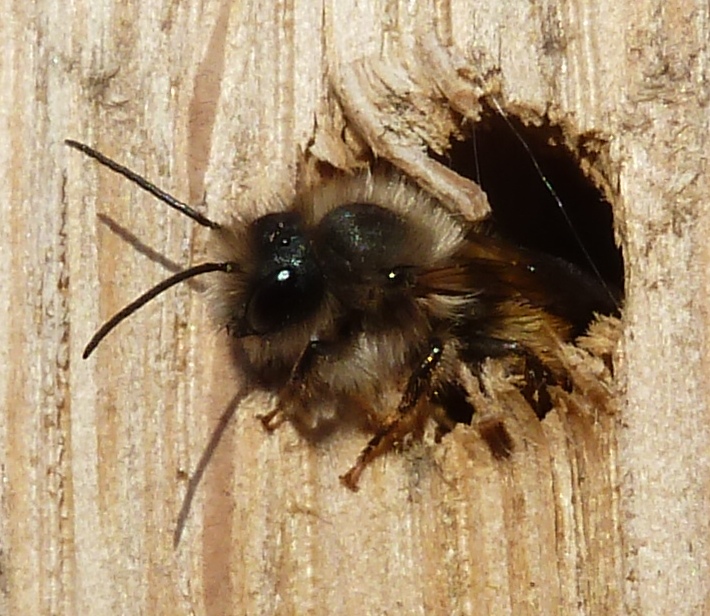
Osmia rufa exiting a tunnel in the bee-log.
O. rufa is well-known to bee-friendly gardeners as it often entirely takes over artificial bee nest-boxes in the same way as it has used the bee-log above. It occasionally causes concern due its habit of burrowing into soft mortar between bricks, but is rarely if ever a problem. If you watch carefully, you can even see the females using special prongs on their faces to tamp the mud into position after bringing it to the nest as pellets held in their mandibles.

The second is a very different species, the parasitic bee Nomada marshamella.

Nomada marshamella posing helpfully on my finger.
N. marshamella is one of the commoner species in this genus of parasitic bees, and this specimen was seen crawling in through an open window. Like other Nomada, it is an effective wasp mimic, looking more wasp-like than bee-like, and can be confused with N. goodeniana (including by me, though courtesy of Nick Owens, I now know that they can be separated by the colour of the wing-base or 'tegula' - orange here as opposed to bright yellow). It is a parasite of the common mining bee Andrena carantonica (and possibly the rarer A. trimmerana), though interestingly none of those that I have so far recorded in the garden (which doesn't mean they aren't there of course). This is also a good point to plug the excellent BWARS (Bees, Wasps and Ants Recording Society) website, including a very fine photographic gallery.

Finally (I'm being relatively brief today), I'd like to introduce my 20th garden-bee identification of the year so far, a female Osmia caerulescens (I originally thought these photos were of Lasioglossum morio which has also been recorded here - thank you again to Nick Owens for letting me know).
Osmia caerulescens female approaching Lotus corniculatus flowers, tongue at the ready...
Osmia caerulescens female on Lotus corniculatus flower - note the blue-green metallic sheen and pale hairs.
This small bee is widespread and common (I'm pretty sure it's been using the garden for a while but I hadn't managed to get a close enough look), and feeds from a wide range of flowers. Females nest in existing holes such as in dead wood, including fence posts, and masonry (we have plenty of both) where it closes the hole with a plug of chewed leaves, and is well-known from both gardens and woodland edges.

So, just three of 20, but I hope they provide a little inspiration if you are thinking about planting bee-friendly plants and other garden features - for example, we have a small patch of open sand created to encourage invertebrates that like this sort of thing; it is possible to create a diverse habitat structure even in a tiny rectangle of Britain like ours. The list so far is below and I expect to identify more, especially as I have plenty of hosts with no parasites and parasites with no hosts...
  • Bombus terrestris
  • Anthophora plumipes
  • Apis mellifera
  • Bombus lapidarius
  • Andrena haemorrhoa
  • Osmia rufa
  • Bombus hypnorum
  • Bombus pascuorum
  • Nomada flava
  • Lasioglossum calceatum
  • Lasioglossum morio
  • Bombus lucorum
  • Colletes daviesanus
  • Sphecodes monilicornis
  • Hylaeus communis
  • Andrena flavipes
  • Anthidium manicatum
  • Hylaeus confusus
  • Andrena labialis
  • Osmia caerulescens
  • Nomada marshamella

Wednesday, 4 July 2012

Wandering wool-carder?

One of Britain's most spectacular bees (in my opinion at least) is not a bumblebee, but the wool-carder bee Anthidium manicatum, one of the Megachilinae which includes the leaf-cutters. So, when I saw one basking on a Geranium leaf during a welcome burst of sunshine a few days ago (it then moved onto common bird's-foot trefoil Lotus corniculatus), I had to take a photo - however, when I looked more closely, it was almost, but not quite, as I expected.

The wool-carder bee Anthidium manicatum
At first glance, it looks much like any other individual of this species, however the yellow markings are far more strongly developed than is usual for a British specimen - they are usually spots to the sides of the abdomen with some in the midline and partially joined to form weak bands on the rear segments as shown in many books including Baldock (2008). A clearly striped individual like this is more like a continental European specimen - indeed, an experienced hymenopterist from BWARS remarked that he had never seen an individual like this in Britain. So, is this just an aberrant specimen, or - and I shall speculate a little - might something else be happening?

In Britain, A. manicatum is only locally common in the south, especially SE England, and becomes scarcer as you look further north. Until 1993 it was scarce even in the SE, after which it began to expand its range (Edwards, 1997) and become common is some southern locations. This suggests that temperature is a key factor in its distribution and to me indicates that this is one of many invertebrate species expanding it range as a result of climate change. Its common name of 'wool-carder' referes to its habit of shaving the hairs from downy plant leaves (such as Stachys) in order to line its nest - possibly a behavioural adaptation to provide insulation due to a requirement for high temperatures.

Considering the colour pattern, this specimen (like those in continental Europe) clearly seem to display wasp-mimicry, while typical British specimens do not, or at least only weakly. This would be a clear defensive adaptation, so why do British specimens tend not to show it? One possibility is that the relatively dark colouration permits more rapid warming when basking  - certainly this individual was also vibrating its wings at intervals, a typical insect behaviour used to warm the flight muscles. If, further south in Europe, this aid to warming is outweighed by the benefits from defensive mimicry, then the clearer stripes might be an advantage. This leads me to consider three possibilities:

1. This is an aberrant individual with no further significance.
2. It is a vagrant continental individual.
3. It is a British individual and increased temperatures are selecting for stronger stripes.

Of these, #3 is the most interesting but also the most speculative and there is no way of knowing from a single sighting. However, I intend to watch closely - males are highly territorial (and may kill other bees) so might use the garden regularly - and would be interested to hear from anyone else who has seen a specimen like this in Britain.

Anthidium manicatum basking on common bird's-foot trefoil Lotus corniculatus

References

Baldock, D.W. (2008). Bees of Surrey. Surrey Wildlife Trust, Woking.
Edwards, R. (ed.) (1997). Provisional Atlas of the Aculeate Hymenoptera of Britain and Ireland. Part 1. BWARS/BRC, Huntingdon.

Friday, 25 May 2012

Miniscule mummification

Following yesterday's post about aphid-feeding hoverfly larvae, I went out into the garden and found evidence of another aphid-bothering insect - the empty skin or 'mummy' of an aphid stuck to the underside of a sycamore leaf by a domed silken cocoon on which it lies. The whole arrangement is only about 2mm long so it was tricky to get good photos even under the microscope due to the white structures tending to overexpose, but this is what I managed...

Aphid 'mummy' attached to a silken cocoon
There are numerous parasites of aphids (technically 'parasitoids' as they develop inside them) and one key group is the aphidiiine wasps (subfamily Aphidiinae within the Braconidae), tiny wasps that lay eggs directly into living aphids. Some, such as the genus Aphidius, produce larvae that cut their way out of the abdomen leaving an empty aphid with a neat lid. However this arrangement - an aphid 'mummy' atop a domed silken cocoon containing pupa/e (the larvae will have fed on the aphid internally) - is typical of the genus Praon.

Aphid mummy attached to the top of a Praon cocoon - the developing Praon have left the aphid and have pupated beneath it.
When a Praon adult leaves the cocoon it cuts a small hole through which to exit, but the photo above shows the cocoon to be intact and skirt-like with the developing wasp/s inside. It is impossible to identify further at this stage, although P. volucre is a common species - however, I have retained the leaf and cocoon and hope to raise at least one adult for identification - I'll be looking out for a tiny black wasp with orange-yellow legs: another often-overlooked gardeners' friend!

Friday, 30 March 2012

Banking on bees

Much has been written about the importance of sunny banks for invertebrates - they are often included (sometimes as 'beetle banks') in habitat management plans and as sometimes appear as recommended features related to mitigation of various types of site development. There is much about this and other aspects of habitat management for invertebrates in e.g. the excellent Kirby (2001), but I want to focus on a local example of a feature that has just this function, albeit unintentionally - a south-facing bank alongside the footpath leading to the front of a nearby church in Hampshire, southern England.

The south-facing bank in a nearby churchyard
This is not a huge feature - it's around 10 metres long and no more the around a metre high at most (as the path rises, the bank gets lower until it merges with the rest of the churchyard). However, there are nearby flowers as pollen sources, plus small bare patches of light soil, just right for burrowing. It is also south-facing and hence sunny and warm - this is key as the north-facing slope on the other side of the path does not support the range of pollinators described below. A couple of days ago, these were found and photographed during less than an an hour on a sunny day in what is currently proving to be an unusually warm spring (I'll leave out discussion of climate change on this occasion). So, what did I find?

The bee-fly Bombylius major
The commonest bee-fly in the UK, B. major can be identified by its broad, dark wing-bands (not to mention the long proboscis characteristc of this gorup) and parasitises a number of solitary bee species - so, as well as being a herald of spring, it's also an indicator that there are bees around somewhere. However, in this case, a indicator of bee activity wasn't needed - I just needed to look at the grassy bank to see a flurry of activity.

Andrena cineraria - an attractive black and white ground-nesting species
The most obvious bee species was A. cineraria - I spotted around 15 at one time (it's difficult to be more precise as they rarely stop flying around), including some using entrance holes to burrows, plus brief 'tussles' between pairs of individuals. In some places, this species nests in huge aggregations of thousands of females and attendant males (Baldock, 2008) and I wonder if these 'tussles' are aggressive encounters related to access to nest-burrows, or are failed mating attempts - they are too fast to be certain about the sex of the participants. Of course, where one species is found, its parasites often follow - in this case the cleptoparasite Nomada lathburiana which can be very numerous in the large aggregations mentioned above. Cleptoparasites are also known as 'cuckoo bees' as they lay their eggs in nests of other bee species, their  larvae feeding on the food provided for the host larvae. Needless to say, I was on the lookout for N. lathburiana and it wasn't long before I saw one investigating the entrances to A. cineraria nests.

Nomada lathburiana showing the yellow spots and bands seen in several species of this genus.
However, although this was an interesting find, there were other bee species, including a small (aroung 6mm long) fairly dark bee that was extremely difficult to photograph due to its rapid darting flight and tendency to re-launch whenever I got near. However, I did manage to get a shot and it turned out to be another cleptoparasite, N. flavoguttata.

Nomada flavoguttata - note the reddish-brown bands on the abdomen, including a pair of tiny yellowish dots (the species name means 'yellow spots').
Although possibly not that familiar, this is a fairly common species which parasitises several small Andrena species. This is important because at this point I hadn't seen any small Andrena, only A. cineraria, so I continued looking. Then, among the flurry of black & white bee bodies, I noticed a likely candidate - a small bee crawling around under the leaf litter. Again, photography was tricky as, when on the ground, it crawled underneath leaves, and flew rapidly away as soon as it emerged - definitely camera-shy! However, I did get the following picture, and (from other views, including while feeding on dandelion Taraxacum flowers) enough detail to identify it as A. minutula, the commonest of several similar species and a known host of N. flavoguttata.

Andrena minutula crawling underneath leaves.
Two host-parasite pairs was good for an hour's work, but there was more bee-biodiversity to be found as I saw another Andrena species exiting a burrow.

Andrena flavipes flying away from its burrow
A. flavipes is identified by the pale abdominal hair-bands and orange-yellow pollen-hairs in the hind tibiae, and like A. cineraria, can be found in large nesting aggregations. It also has its own cleptoparasite, N. fucata although I could not find this although it is present at almost all of its host's nest sites - more hunting will be required.

So, I hope these observations have reinforced the importance of sunny banks as invertebrate habitat - including for our often-declining, yet essential, populations of pollinators. If you have a little spare space in your garden or another piece of land, why not add a little bank - even a small one will attract invertebrates.

An insect's-eye view of the bank with A. cineraria flying overhead.

References

Baldock, D.W. (2008). Bees of Surrey. Surrey Wildlife Trust, Pirbright.
Kirby, P. (2001). Habitat Management for Invertebrates: a Practical Handbook (revised reprint). RSPB, Sandy.

Monday, 5 December 2011

Circus of the Spineless #68 - gifts galore!

It's December, so it's tempting to come up with a festive theme for this edition of Circus of the Spineless. However, I'm going for a 'birthday' theme instead because it's my blog's 'official' 1st birthday - 'official' (like the Queen's) because it's about a year since it really got going though I started it a bit before that. And, my 20,000th pageview just appeared, so thanks to whoever that was! Anyhow, I digress - please do click to take a giftbox, a slice of virtual cake and/or a glass of whatever suits you...

First up, Susannah of Wanderin' Weeta fame has provided some gift-wrapped goodies found tucked away in a vacant lot ('brownfield site' in UK-speak!) which goes to show it's always worth a look. To celebrate, why not start with a slice of tasty cake...


Next, a pair of splendid parcels arrived from John at 'Carp Without Cars' - the first arrived as 'snail mail' but not really (you'll see what I mean, just drink from the glass of finest red) and the second comes in a smaller package that rarely displays its contents quite as clearly as this...


My birthday cup already runneth over, but there's more to come... Here, Daniel at 'Notes from Dreamworlds' takes a close, close look at some freshwater critters courtesy of some high-quality optics (feel free to contrast this with the microscopy efforts on my blog!) and wraps the whole thing up as an 8-minute video - a veritable treasure-chest of precious things.


And lastly, I shall give myself a small gift of shameless self-promotion... Here, I look at the shiny jewelled contents of a box that really did turn up in the mail, so why not sit back with an ice-cold beer - mmm.... foamy...


So, that's all from my birthday-themed CoS #68 - thanks for coming along to the party; the more the merrier and there's no-one on the door to check for invitations. Next month, prepare yourself for some myrmecology as CoS scuttles off to Wild About Ants. Byeeee.