Welcome

Welcome to my blog

This is where I post various musings about wildlife and ecology, observations of interesting species (often invertebrates)
and bits of research that grab my attention. As well as blogging, I undertake professional ecological & wildlife surveys
covering invertebrates, plants, birds, reptiles, amphibians and some mammals, plus habitat assessment and management
advice
. I don't work on planning applications/for developers. The pages on the right will tell you more about my work,
main interests and key projects, and you can follow my academic work here.
Showing posts with label woodland. Show all posts

Monday, 24 February 2014

The beetle is dead, long live the beetle

The decline of the leaf beetle (Chrysomelidae) Chrysomela tremula is well known (e.g. Cox, 2007; Hubble, 2012), even though the causes of its probable extinction in the UK are not understood - possibly the decline of coppicing and/or a side-effect of insecticidal spraying. The last known record was from Warwickshire in 1958, so when its rediscovery was reported relatively recently from purple willow Salix purpurea in Cambridgeshire (Mendel & Hatton, 2012), there was much rejoicing. Then, shortly afterwards, the authors realised that this had been a misidentification and they had actually found C. saliceti, a species never before found in Britain (Mendel & Hatton, 2013). So, C. tremula remains probably extinct but we do have a new species. This doesn't mean C. saliceti is non-native - it is very similar to C. tremula and may simply have been overlooked - after all, their separation was tricky enough to briefly trick some very experienced entomologists until another one noticed and the error was rectified - which is how science works...

Then after a discussion at the recent Coleopterists' Day in Oxford, Howard Mendel was kind enough to post me a couple of specimens of the new species as I had never seen one.

Chrysomela saliceti approx 9.5mm long.
Chrysomela saliceti under different lighting to more clearly show the punctures on the pronotum and elytra.
The trick is to separate the two species - especially in case C. tremula is still hiding somewhere (or re-appears from the Continent). A paper about this is planned, but until then, there are two key features:
  • The claw-bearing tarsal segment (two apical teeth on the underside in tremula, absent in saliceti).
  • Dissection of males to check the tip of the aedeagus (equivalent of a penis).
Tarsus ('foot') of C. saliceti - the claws are visible but no teeth on the underside.
The aedeagi of the two species for comparison.

References

Cox, M.L. (2007). Atlas of the Seed and Leaf Beetles of Britain and Ireland. Pisces, Newbury.
Hubble, D. (2012). Keys to the Adults of Seed and Leaf Beetles of Britain and Ireland. FSC, Telford.
Mendel, H. & Hatton, J. (2012). Chrysomela tremula Fabricius (Chrysomelidae) rediscovered in Britain. The Coleopterist 21(3): 132-135.
Mendel, H. & Hatton, J. (2013). Correction: Chrysomela saliceti Suffrian (new to Britain) not Chrysomela tremula Fabricius (Chrysomelidae) in the cambridgeshire fens. The Coleopterist 22(1): 19.
Warchałowski, A. (2003). The Leaf-beetles (Chrysomelidae) of Europe and the Mediterranean Area. Natura Optima Dux Foundation, Warsaw.

Tuesday, 23 April 2013

Pondnet diary day 1

Pondnet is a new Pond Conservation volunteer survey aiming to identify trends in pond quality and associated species. I was recently allocated a pond in Milkmead Copse in Hampshire's Itchen Valley Country Park, and now spring's arrived, I decided that today was a good opportunity to make my first visit to the site.

The pond in Milkmead Copse
It was good to see some frogspawn had survived the cold conditions as there were at least a couple of hundred recently hatched tadpoles, plus one adult newt. However, something else (yup, an invertebrate) caught my eye - a water scorpion (Nepa cinerea) that came to the surface.
Water scorpion, Nepa cinerea
This is a predatory true bug (Hemiptera) and the raptorial (hunting) front legs used to grip prey are clearly visible, plus the breathing tube at the rear. Although this appears to be a single thin tube, it is actually formed from two halves (they separate if a specimen is dried) - air flows from it along two grooves which have small water-repellent hairs and the spiracles open into these grooves (Denton, 2007). Being a bug, it has piercing/sucking mouthparts rather than the jaws/mandibles seen in beetles. It is a large insect by UK standards at around 20mm in length, excluding appendages. It is an active hunter, taking small fish and various other invertebrates. However, I was surprised to see it tackle a larger (approx 25mm) dragonfly nymph, itself an active and powerful predator.

N. cinerea attacking a dragonfly numph.
N. cinerea on the back of the dragonfly nymph
This is not behaviour I've seen before and the nymph struggled for a few minutes before managing to dislodge its attacker by dragging it against a piece of vegetation. Presumably the position of N. cinerea allowed it to pierce the nymph while remaining out of direct reach. Certainly, the water scorpion swam away after this encounter and the nymph came back to the surface. I'm not 100% sure which species it is as it is coated in silt which obscures key features. However, the size, head shape and silty coating are typical of the black-tailed skimmer (Orthetrum cancellatum) so that is my identification for now.

Dragonfly nymph, possibly Orthetrum cancellatum, the black-tailed skimmer. Note the hairs on the legs and body, coated in silt.

The same dragonfly nymph - note the protruding eyes and the 'mask' showing the mandibles.
So, an interesting start to a new survey programme. More to come from the pond!


Reference

Denton, J. (2007). Water Bugs and Water Beetles of Surrey. SWT, Pirbright.

Monday, 1 April 2013

The Lawn Shrimp cometh

I quite often receive invertebrates in the post, but they are usually leaf beetles (Chrysomelidae) sent to me for identification/verification in my capacity as organiser of the UK's Chrysomelid Recording Scheme - like here for example. However, a couple of days ago I came home to find something quite different awaiting me on the doormat - a crustacean looking like a small shrimp, or to be more precise an amphipod of the family Talitridae (a group usually associated with seashore habitats rather than inland terrestrial ones).

In this case, it had already been identified as Arcitalitrus dorrieni, the 'landhopper', 'woodhopper' or 'lawn shrimp' by the finder/sender, Dennis Trunecka of the Southampton Natural History Society. This is an interesting find as it is Australian in origin (New South Wales & Southern Queensland), with the first UK record being from the Scilly Isles in 1924. Since then, it has been found in a number of sites across southern England, and also in Ireland, the Channel Isles, west Wales and western Scotland (coastal when north of southern England). However, it is not entirely clear how widely it has established itself in the last couple of decades, although individuals can move tens of metres per day as well as being moved over longer distances by the plant trade etc. (Cowling et al. 2004).

Arcitalitrus dorrieni found in woodland leaf litter in Hampshire. The seven segments of the peraeon and the three segments of the pleon are indicated. Length (head to rear of body in this curved position) approx. 6.5mm.
It is most often found under stones and dead wood or among damp material (detritus, debris, leaf litter) in gardens, damp scrub and woodland. It most likely arrived (and to some extent spread) in the UK through the transport of plants/soil to and between plant nurseries and garden centres. It is uncertain whether this non-native species has a significant ecological impact in the UK, although it is possible that it competes with (and maybe replaces) native detritivores in woodlands. In some locations, it can be found in high densities - up to approximately 2,500 per square metre in Dicksonia antartica litter on the Scilly Isles (Richardson 1980). It certainly can be a significant detritivore, consuming 24.7% of annual litter fall in a coniferous woodland in Ireland (O'Hanlon & Bolger 1999) - more than any of the native macrofaunal species.

Identification is fairly straightforward, especially given the small number of possible confusion species. Orchestia cavimana  is an introduced semi-terrestrial Mediterranean amphipod (Konopacka et al. 2009) but much paler in colour - A. dorrieni is variably dark, and orange when dead as here, though pale if preserved). However, there is another introduced terrestrial amphipod, A. sylvaticus, although this is much rarer in the UK. Using the key in Peart & Lowry (2006), the two species can be separated by looking at the epimera (the three segments of the pleon, singular 'epimeron'). In A. dorrieni, the 2nd epimeron is longer than the 3rd while in A. sylvaticus they are more-or-less equal. In the top photo, this is unclear as the rear edge of eipermon 3 is obscured by one of the legs, but with some legs (re)moved, it is clear that this is A. dorrieni. There are other features which might be required to separate further species but these do not (yet) occur in the UK, although it is possible they could be imported with plants.

A. dorrieni - from the green lines, it is clear that epimeron 2 is longer than epimeron 3.
The head bears numerous appendages including two pairs of antennae (typical of crustaceans) and a complex array of mouthparts - I won't go into the details here but there are plenty of resources online and in print providing introductions to crustacean anatomy. The lateral compression is clear (flattened side-to-side) and is generally a good way of separating amphipods from isopods (e.g. woodlice which are flattened top-to-bottom i.e. dorso-ventrally). The antennae are inserted in front of the eye which is black and not especially well developed, being covered by a transparent plate. This is likely to be an adaptation to its life within/under leaf-litter and under damp material where vision is less likely to be useful than senses such as touch - note the long antennae and various bristles.

A. dorrieni showing its lateral compression.
Head of A. dorrieni (side view)
Mouth and mouthparts of A. dorrieni (ventral view)
So, an interesting find and thanks to Dennis for passing it on to me for closer scrutiny. As ever, finds such as this are useful in determining the distribution (and in this case, spread) of species, so it is worth keeping an eye out - especially in case a third Arcitalitrus finds its way here.

References

Cowling, J.E., Spicer, J.I., Weeks, J.M. & Gaston, K.J. (2004). Current status of an amphipod invader, Arcitalitrus dorrieni (Hunt, 1925) in Britain. Journal of Natural History 38: 1665-1675. 
Konopacka, A., Grabowski, M., Bącela-Spychalska, K. & Rewicz, T. (2009). Orchestia cavimana Heller, 1865 (Amphipoda: Talitridae) enters freshwater inland habitats in the Vistula River, Poland. Aquatic Invasions 4(4): 689-691.
O'Hanlon, R.P. & Bolger, T. (1999). The importance of Arcitalitrus dorrieni (Hunt) (Crustacea: Amphipoda: Talitridae) in coniferous litter breakdown. Applied Soil Ecology 11: 29-33.
Peart, R. & Lowry, J.K. (2006). The amphipod genus Arcitalitrus (Crustacea: Amphipoda: Talitridae) of New South Wales forests, with descriptions of six new species. Records of the Australian Museum 58: 97-118.
Richardson, A.M.M. (1980). Notes on the occurrence of Talitrus dorrieni Hunt (Crustacea: Amphipoda: Talitridae) in south-west England. Journal of Natural History 14: 751-757.


Monday, 25 February 2013

Eight spores good - a mossy mystery

Looking through moss and fragments of moist dead wood recently, I've found a range of small invertebrates such as mites, and spurred on to see what else dwells within, I've clocked up some more microscope time. Scanning a specimen of the creeping feather-moss Amblystegium serpens, a common species known from various habitats/substrates including both living and dead wood, I noticed some tiny red-brown structures underneath some of the leaves. Having a look through Atherton et al. (2010) and Watson (1981), no moss structures looked quite like it, so I started photographing and magnifying...

Structures growing from the stem of Amblystegium serpens
There's not a lot of detail here, but an idea of scale can be gained - the width of the stem (no more than about 0.2mm - the leaves are also tiny, about 0.5mm long) is clear where it reaches the left-hand side of the photo and the more-or-less rectangular (but not especially elongate) individual cells can be seen there. Just to the left of the pin, the stem is a little different however - the cells are orange-brown and a little larger. This might be of interest as many gall-causing Fungi induce changes in cell size and tissue colour. So, to see more detail in the brown masses, I made a simple 'squash' preparation for higher magnification.

Fibrous structure growing from the stem beneath a leaf of Amblystegium serpens
The fibrous structure is clearer here, including its point of attachment/outgrowth from just below the base of a leaf. The longest fibres are maybe 0.5mm long, maybe a little more, but it is still unclear exactly what they are. Mosses produce a number of structures worth considering here:

  • Paraphyses - thin sterile hairs, sometimes club-shaped, usually multicellular. A possibility.
  • Protonema - the young stage of a moss that develops when a spore germinates; generally appears as a system of green threads. Clearly not the case here.
  • Gemma - a unit of vegetative propagation, may be single-celled, two-celled or multicellular. Another possibility.
To determine whether these were parts of the moss and/or a fungus growing on it, more detail was needed.

Various structures seen attached to Amblystegium serpens
A fungal spore found with a sample of Amblystegium serpens
In the first of this pair of photos, a number of structures are visible. Those indicated by blue arrows are unidentified - the larger fragment could be a paraphysis or similar (or an equivalent fungal paraphysis) while the 4-celled structure could be gemmal or a 4-celled fungal ascus (spore-bearing 'sac') - this is largely guesswork however, partly informed by checking fungal structure using Webster (1970). The structure indicated by a red arrow is rather clearer and appears to be the ascus (spore-bearing 'sac') of a discomycete fungus, complete with the typical eight spores seen when fully developed, though the left-most one is blurred out in the photo. Other similar structures could be seen, including the spore in the lower photo - it is almost spherical and measures around 13 x 15 um, and although again blurred out here, has a surface covered in tiny 'warts' (i.e. it is 'verruculose'). Consulting Ellis & Ellis (1998), there appears to be only one contender with this host and set of characteristics - the microfungus Octospora wrightii which is associated primarily with this moss, and is found from January to March.


As ever, comments, suggestions and corrections welcome - I am, as is so often the case, writing outside my comfort zone here; how else to learn though?


References

Atherton, I., Bosnaquet, S. & Lawley, M. (eds.) (2010). Mosses and Liverworts of Britain and Ireland: A Field Guide. British Bryological Society. [If you only buy one UK bryology book, I can recommend making it this one]
Ellis, M.B. & Ellis, J.P. (1998). Microfungi on Miscellaneous Substrates: An Identification Handbook (2nd ed.). Richmond, Slough.
Watson, E.V. (1981). British Mosses and Liverworts (3rd ed.). Cambridge University Press.
Webster, J. (1970). Introduction to Fungi. Cambridge University Press.

Wednesday, 20 February 2013

Sighting the mighty tiny mite

A couple of days ago, I mentioned oribatid mites, more-or-less in passing while looking at other moss, soil and decay fauna. As they are so important in the processes of decay and decomposition, feeding on all sorts of organic matter, I decided to return to my samples and see what else I could find. Unsurprisingly I found a few more but although I can't identify them to species (yet - I'm starting to have a look at Michael (1888) which you can download for free here), I thought it would be a good opportunity to give a bit of introductory information about this often unfamiliar group. So, what are oribatids?

Taxonomically, they form the order Oribatida within the Acari (mites) which are in turn arachnids. All are small (none more than 1.4mm in length) and those that I found were between 0.5 and 1.0mm. They are largely found in soils (especially in woodlands) and decaying matter (dead wood, leaf litter etc), and are important in soil processing and formation in much the same way as earthworms. Like other arachnids they have jaws known as chelicerae, and are eight-legged, but some other features may not be familiar.

Oribatid mite, approx 0.7mm long, ventral view
The pteromorph is a wing-or cloak-like extension of the carapace which wraps partly around the mite, presumably to armour it against damage from soil particles or predators. The genital shield is a round structure formed of two semi-circular halves which covers the reproductive structures - males have a penis-like structure called an aedeagus, much like that seen in beetles. Similarly, the anal shield is paired and covers the end of the gut.

Oribatid mite, approx 0.7mm long, ventral view
Unlike the more familar red spider mites (Trombidium spp.), these are not hairy/velvety but are smooth with only fine sculpturing and sometimes larger but fewer bristles. The legs do however have long bristles which perform a sensory function, and in fact the first pair of legs of some species are purely sensory (like antennae) and are no longer used for locomotion. There is a single median eye and with vision reduced (unsurprisingly as oribatids are mainly soil-dwelling), sensory bristles have become more important, not just on the legs, but also via the development of specialised bristles to form a 'pseudostigmatic organ' which can have a variety of shapes e.g. club or drumstick.

That is all the detail I can provide at present without simply summarising Michael (1888) and covering features not visible in my photographs. However, I am sure oribatids will show up on my invertebrate radar again, and I hope to be able to delve more deeply into their ecology and taxonomy.

Reference

Michael, A.D. (1888). British Oribatidae Vol.II. Ray Society, London.

Monday, 18 February 2013

Tiny denizens of the rot-hole

What with winter keeping most invertebrates out of sight, it's been a while since I wrote much of an entomological nature, but yesterday was a fine opportunity to head up to Beacon Hill nature reserve to see what was about. As well as chalk grassland (which will be more interesting when in flower), there is an interesting stand of beech woodland and associated scrub, including an ecologically important resource of dead wood (standing and fallen) and old mossy trees.

The base of a mossy beech tree.
These features mean that there is habitat for many fungi and dead-wood invertebrates and the evidence is everywhere - beetle boreholes (some opened by woodpeckers, one of which could be heard clearly in the woodland), wood in various stages of decay, insect-feeding birds such as a treecreeper (Certhia familiaris) and an intriguing-looking rot-hole with a large fungus and a tuft of hair poking out of it...

Rot-hole with fungus and tuft of hair
Looking inside, it had been lined with moss and hair, and was clearly a nest or roost of some sort, either of a bird or small mammal, and the fungus is (I think) an oyster mushroom Pleurotus ostreatus - if any mycologists would like to correct me on this, please do!

The inside of the rot-hole; at the base of the fungus, a layer of moss-and-hair bedding.
So, sample-pot in hand (like any good ecologist!), I took a pinch of the mossy bedding, including some soil/decayed wood from directly beneath it - after all, there are plenty of under-recorded parasites that live in vertebrate nests and you never know what you'll find. Back home, it was time to check what I'd found; some of the small inveretebrates such as Collembola (springtails) hide very effectively in material like this, so I find that adding some water to the sample in a watch-glass causes them to float to the surface and become easier to see. Indeed, doing this brought up a cluster of the common springtail Ceratophysella bengtssoni which can sometimes be found in large aggregations on the surface of soil and puddles, but may well still have been hibernating given the cold night-time temperatures at present.

Several Ceratophysella bengtssoni from the nest sample
These weren't the only springtails - Lepidocyrtus cyaneus and Neanura muscorum were also present, as was Tomocerus vulgaris from mossy dead-wood of a nearby tree. The samples included quite a few empty moulted skins, suggesting that these are not solely hibernation sites, but places where active feeding and growth occur - unsurprising as they mainly feed on fungal hyphae and decaying plant material (no shortage in this sample location). They are also an excellent group to look for in the winter as they can be found throughout the year - if you are interested in the UK species, Hopkin (2007) is an excellent place to start. However, Collembola are not the only soil/leaf-litter animals to be found. Hidden among the tangle of hair (mainly sheep I think) and plant fibres were two shed skins of an oribatid soil mite.

The shed skin of an oribatid soil mite
Oribatids are beyond my identification skills (I don't even know anyone who can ID them, though I do have a go at halacarids occasionally), but the shiny bulbous shape, the pointed mouthparts and the leg attachment points are all visible here. Though poorly known outside the realm of specialists, these mites are important in the decay process, feeding on a wide range of plant, animal and fungal organic material, with a minority being predatory - in fact they break down and process soil material in a similar way to earthworms even if they aren't as familiar or well-understood/studied.

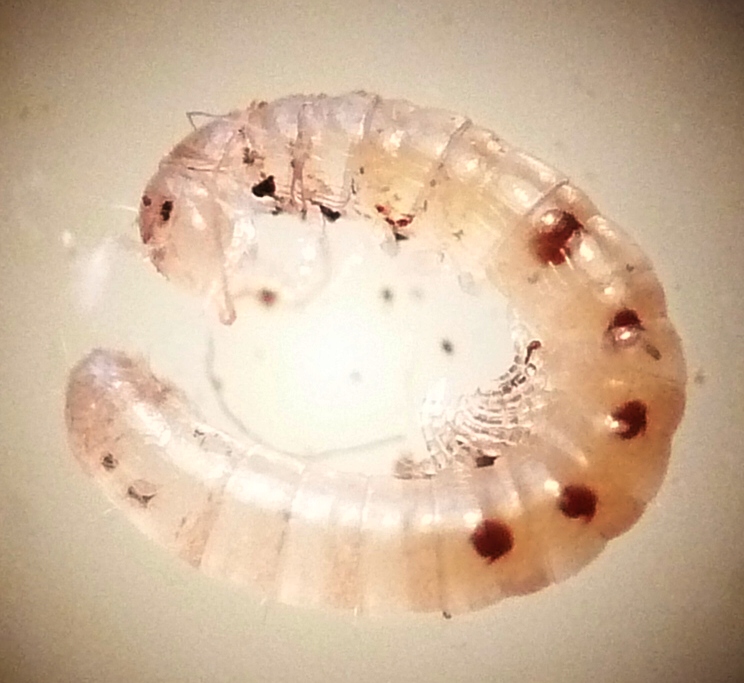
Another species, common if often over-looked, and mainly found under bark or logs in woodland is the spotted snake millipede Blaniulus guttulatus. It is often considred a pest (e.g. in allotments) but probably only enters crops when damage has already occurred, such as by a 'primary' pest or some other mechanical means. They grow to around 20mm in length and are white with rows of red spots along the sides. The specimen I found however was a juvenile no more than about 3mm long (with few segments/spots), and the first early stage I've seen of this species.

Juvenile Blaniulus guttulatus
So, a few interesting finds - common species (no idea about the oribatid) but indicative of the small and often un-noticed soil/dead-wood fauna. Interestingly there were no mammal/bird nest-dwelling species (such as ticks or fleas), and no indication of exactly what had been using the hole - however, the presence of fine hairs and small dark elongate faeces, plus a lack of even small feathers suggest a mammal, presumably a rodent, rather than a bird.

Reference

Hopkin, S.P. (2007). A Key to the Collembola (Springtails) of Britain and Ireland. FSC, Shrewsbury.

Friday, 5 October 2012

The sticky world of sap-runs

It's well known that dead and decaying wood forms essential habitat for a wide range of species invlved in decay processes, plus many more that use such sites to burrow and nest. However, there are some situations which can be looked at individually and seen as providing even more specialised conditions, sometimes relating to living tree tissue, but siimilar in concept to dead-wood habitats. These include coppice stools, old parkland pollards and deadwood (saproxylic) or epiphytic fungi themselves, plus the one I want to look at here - sap-runs.

Bracket fungi on standing deadwood
Sap runs are living areas on the trunk or branches where sap oozes out for all or part of the growing season (Fry & Lonsdale 1991). These occur on (probably) all tree species - some such as elms and horse-chestnuts more than others - and the one I saw recently was on a branch of an oak. At the time I was looking at, and taking photos of, the rarer Wild Service tree in front of it. However, I noticed a flurry of invertebrate activity on a partly dead branch and initially thought it was a hornet (Vespa carbro) nest as I could see these large, and increasingly rare, wasps darting in and out of crevices and crawling on the bark.

Wild Service tree with the oak behind. The red arrow indicates the branch with a sap-run.
There may indeed have been a hornet nest, but what held my attention further was the behaviour of not only the hornets but also a host of other insects including various flies and Red Admiral (Vanessa atalanta) butterflies. The photos below illustrate some of this (apologies for the grainy images - it was the best my zoom could manage!)

A hornet on the underside of the branch
The most striking behaviour was the amount of aggression between the different species; initially hornets chasing butterflies and flies away, but also butterflies tussling with each other. In itself, this isn't unusual - male Red Admirals are highly territorial, but this happens in spring - the behaviour seen here occurred in late summer so is clearly something else.

Three Red Admirals fighting above while one feeds on the underside. Also note the large flies on the upper surface which may be feeding or basking.
This photo shows the aggression fairly clearly, but more importantly the position of the butterfly below. This is the exact spot occupied by the hornet above and was where any insect that avoided the fighting landed. Clearly there was a valuable resource here - and the only one that seemed plausible was a small sap-run. With sap-runs an important source of nutrient-rich fluid, it is unsurprising that individual insects were competing for it, especially if the run itself was tiny as seems to be the case here. The flies were unidentifiable at a distance and smaller species may well have been present - in fact this is highly likely as sap-runs are known to support specialists such as the gnat-like flies Mycetobia spp. and Sylvicola cinctus, midges Forcipomyia spp., hoverflies Brachyopa spp. (whose males hover near sap-runs and attempt to mate with any females that land on them) and Ferdinandea cuprea, and the beetles Glischrochilus hortensis, Cryptarcha strigata and Epuraea aestiva.

These are only a few examples and there are many others, especially among the hoverflies as the numerous mentions of sap-runs by Rotheray & Gilbert (2011) can testify, including the danger of becoming trapped in sticky fluid that eventually becomes amber. As noted by Kirby (2001), this highlights the importance of sap-runs, along with many other features of trees (rot-holes, dead branches, ivy) that are sometimes removed as signs of 'ill-health', such as by being selectively removed during woodland thinning rather than being selectively retained. In fact, it seems clear that larger and longer-lasting sap-runs support more diverse species assemblages and so trees with large, deep injuries forming sap-runs should be retained just like those with large dead-wood features. It means overturning some of the received (but erroneous) wisdom ingrained in aspects of woodland management, but structural diversity is of key importance and the countryside isn't meant to be neat!

References

Fry, R. & Lonsdale, D. (eds) (1991). Habitat Conservation for Insects - A Neglected Green Issue. AES, Middlesex.
Kirby, P. (2001). Habitat Management for Invertebrates: A Practical Handbook. RSPB, Sandy.
Rotheray, G.E. & Gilbert, F. (2011). The Natural History of Hoverflies. Forrest Text, Tresaith.

Thursday, 19 July 2012

Lovely local longhorns

In Britain there are approaching 4,100 species of beetle and some of the most attractive and charismatic of these are the longhorns (Cerambycidae) known for their large size, bright patterns and long antennae. However, although some are strikingly coloured (such as the yellow and black Rutpela maculata), many are actually more sombre blacks and browns. One such species is the 'tawny longhorn' Paracorymbia fulva which I have found at three nearby locations during the last week or so, including my back garden.

Paracorymbia fulva
As you can see, it has yellow-brown elytra with black cut-off tips and is also otherwise black. It is very similar to male Anastrangalia sanguinolenta but has a pronotum wider than it is long and with rounded sides (in A. sanguinolenta the pronotum is more slender and less rounded), is 9-14mm long (excluding appendages) and is found in the adult stage between June and August. P. fulva is also interesting for a number of reasons.

Firstly, it is generally described as being associated with broadleaved woodland (e.g. Duff 2007a), but observations suggest that its habitats are more diverse than this. For example, my three recent sightings have been in a suburban garden, rough trackside vegetation and woodland edge while Michael Darby (in Wright 2011) reports that it is associated with chalk grassland in Wiltshire without any woodland or fallen timber.

Secondly, it is considered 'Rare' in the UK as it is listed as a Category 3 Red Data Book species (again e.g. Duff 2007a), but observations by mant recorders suggest that it is more common than this, even if still mainly associated with central and southern England. More widely, it is found across most of Europe, except the north and Turkey (Hoskovec & Rejzek 2007). Given that the northern limit is likely to be due to temperature, its expansion in the UK may be another example of a species spreading due to climate change.

Thirdly, no-one knows what it feeds on - or much else about it. This may seem surprising, and in some ways it is - as Martin Rejzec says in Wright (2011), P. fulva is one of the few remaining European species which has an unknown host plant, a larva that is completely undescribed, and an unknown life history. However, he goes on to explain that this may also be because, unlike most other longhorns, it does not develop in timber; instead it might do so in the underground parts of trees or shrubs, and the larvae may even be free-living in the soil, feeding for example on fungi. Whatever the case, it is clear that this is a species where there is clear opportunity for significant gains through targeted study and research, and as it is now more common in the UK, there may be a greater chance that this will happen.

If you are interested in longhorns in the UK, I strongly recommend acquiring a copy of Duff's excellent illustrated guide (2007, b) which will help you become familiar with this fascinating family of beetles.

A reminder that many longhorns are colourful, Rutpela maculata (sometimes placed in the genus Strangalia)

References

Duff, A. (2007a). Longhorn beetles: Part 1. British Wildlife 18(6): 406-414.
Duff, A. (2007b). Longhorn beetles: Part 2. British Wildlife 19(1): 35-43.
Hoskovec, M. & Rejzek, M.(2007). Paracorymbia fulva (De Geer, 1775). Cerambycidae. [accessed 19/07/2012].
Wright, R. (2011). Paracorymbia fulva - further information received. Beetle News 3(3): 6.

Friday, 29 June 2012

Lovely little loofahs

As I have a static page devoted to dead wood monitoring at habitat/woodland scale, the organisms associated with dead wood do appear on my blog from time to time. On this occasion, I'd been tidying up the 'wrecking yard' at the far end of our garden where I cut firewood and so on. Because of this, unwanted offcuts that are too decayed to be useful have been piled up to form habitat for saproxylic (dead wood) species. Often these may be small invertebrates such as beetles and barklice, but of course, Fungi are also important in the decay process, as are myxomycetes (slime moulds) which, although often included as 'honorary Fungi', are actually Protozoa. As a group, 'myxos' are widespread - everywhere which some suitable substrate, though they often remain unseen as their fruiting bodies are often very short-lived. So, I was interested to see some clusters of small loofah-shaped growths on small rotting logs.

The myxomycete Arcyria obvelata - approx 1cm tall
Having a copy of Ing (1999) made identification pretty straightforward - Arcyria obvelata is a common species on dead wood, especially beech, sometimes oak, and occasionally (as here) on conifers. It is typified by the short stalk leading to a funnel-shaped cup upon which there is the tall, pale yellow sporangium of tangled tubes bearing minute spores, the whole being up to 15mm tall. When newly grown, the sporangium is a short, smooth cylinder, but when mature it expands as seen here with the longer ones drooping.

Apparently there are some colour variations, but these have not yet been found in Britain - maybe something to look out for!

A larger clump of Arcyria obvelata

Reference

Ing, B. (1999). The Myxomycetes of Britain and Ireland: An Identification Handbook. Richmond, Slough.

Sunday, 10 June 2012

Chicks are best in a well-dressed nest

A few months ago, I built a new riddling table (essentially a mobile soil sieve on legs) for our local community farm - the soil is very stony and it's a good way of making a fine tilth or lump-free compost. It wasn't going to be needed much over winter, so was stored under some polythene sheeting and next to a thick hedgerow to keep the weather off until required. However, when the cover was removed a few weeks ago, there was a surprise - a bird's nest complete with four pale blue, slightly speckly eggs. The cover was quickly replaced and a notice sent round to let everyone know that the table couldn't used for a while. Even without looking at the eggs it was clear that it belonged to a pair of song thrushes (Turdus philomelos) as the parents could soon be seen attending it. A week or two later, I revisited the nest to check its progress.

Song thrush nest with 3 nestlings
As you can see, there were 3 nestlings - still bald with their eyes closed. The nest is on a shallowly sloping  wooden platform (used to funnel sieved soil into a wheelbarrow) underneath the sieving tray - you can see one of its wheels at the back - with the whole structure covered in polythene - an excellent hideaway. Song thrushes usually build their nests in trees and shrubs, typically near the trunk around 1-4m up, though they can sometimes be found in buildings, on the ground, on stumps and fallen branches or in hollows among creepers. Whatever the precise location, they tend to be in shady, well-hidden places in or near woodland or hedgerows, and this artificial construction suited their needs very well.

Song thrush nestlings - some downiness has already appeared with a few feather shafts just beginning to develop
These were the only photos I took as I didn't want to visit the nest for longer than required to obtain enough information to make a useful record. Such records, if obtained carefully, provide valuable information about the breeding success of many species and in the UK, the BTO's Nest Record Scheme uses volunteers to follow the progress of nests, providing training where required. With the bad old days of egg collecting largely behind us (though some illegal collecting still occurs), a Code of Conduct needs to be followed when recording nests. Much of this is common sense (don't visit more often than necessary, limit the amount of disturbance caused and try to approach the nest when it is unattended) but some aspects are less obvious.

For example, it is widely believed that visiting a nest will increase the probability of the clutch failing. However, reviews of research into nesting success (Götmark 1992, Mayer-Gross et al. 1997) indicate that this is not the case, if the Code of Conduct guidelines are followed. Examples of some other less obvious actions that need to be taken are as follows (for a full list, see the Code):

  • In case parent birds are watching, approach nests casually, as if by chance, rather than directly and deliberately - you are then likely to be seen as harmless (like a passing herbivore) rather than a potential nest predator.
  • Adults are most sensitive to disturbance at the start of the breeding attempt, during egg laying and very early in the incubation period - it these times, they have invested less energy in the nesting attempt and have more time to lay a replacement clutch.
  • Conversely, the parents become less sensitive of disturbance as the nesting attempt continues, but the chicks’ become more aware, and when partially feathered, the young of some species may instinctively scatter from the nest, a process known a ‘exploding’. This is adaptive when a real predator raids a nest is it gives a chance of survival for at least part of the brood, but once out of the nest the chicks are vulnerable to cold and to ground predators. Also, don't forget that chicks can only legally be handled by licensed bird ringers.

Here, the nest was unattended, the adults past the period of maximum senstivity and the chicks still too young to scatter - the perfect time to visit. After this, the adults could be seen bringing food to the nest and all three nestlings were seen to fledge. Once it was clear that the nest was no longer in use (young stay in the nest for 12-16 days), it was removed for closer inspection.

Song thrush nest after the chicks had fledged
The nest, built by the female (though both parents feed the young) is made of a woven circle of small twigs, leaves, grass, roots, moss and string surrounding a smooth cup of papier-mache made from rotten wood-pulp (sometimes mud is used). Close up, it really is an impressive structure - neatly woven and well camouflaged (or would be in a tree), and the inner cup thin, light and neatly smoothed. Although the young are very similar to those of the mistle thrush (T. viscivorus), as are the nests and breeding times, the nest structure is clearly different with the mistle thrush making a bulkier cup of plant material with soil mixed into it and lining it with finer grass.

If you want to know more about how to identify nests, eggs and nestlings, Harrison & Castell's 2002 guide is excellent, but do take care as noted above, and if possible join the Nest Record Scheme; information about breeding success is vital for well-informed conservation.

References

Götmark, F. (1992). The effects of investigator disturbance on nesting birds. Current Ornithology 9: 63-104.
Harrison, C. & Castell, P. (2002). Bird Nests, Eggs and Nestlings of of Britain & Europe with North Africa and the Middle East (rev. ed.). HarperCollins, London.
Mayer-Gross, H., Crick, H.Q.P. & Greenwood, J.J.D. (1997). The effect of observers visiting the nests of passerines: an experimental study. Bird Study 44: 53-65.

Tuesday, 5 June 2012

Making Solomon's mines

As it seems to be the season for finding fly larvae (for example here and here), I thought I'd continue with this theme, but move from aphid predators to a species feeding on (or rather, in) plant material, in particular, a leaf miner feeding on Solomon's-seal (Polygonatum multiflorum).

Leaf mine in Polygonatum multiflorum - the arrows indicate small groups of feeding larvae
There are few leaf miners of P. multiflorum, and it was clear that these were most likely the larvae of the fly Parallelomma paridis (Diptera: Scathophagidae). However, a closer look was needed for confirmation, and having kept the leaf in a container overnight, the larvae began to leave the mine.

Larva of Parallelomma paridis. The head is to the bottom of the photo (note the black mouthparts) and the pair of posterior respiratory processes (PRPs) can be seen at the rear. Yellow-green gut contents are also visible.
Before looking more closely at the larva and subsequent pupa, it is worth noting that there has been some taxonomic confusion regarding this species. It has been synonymised with P. vittatum, but is now (by some dipterists at least e.g. Nelson, 1990 and Chandler, 1998) considered a separate species with P. vittatum on Orchidaceae (as noted by Smith, 1989) and P. paridis on Liliaceae as here. I take the view of Nelson and Chandler that these are separate species. The genus has also been known as Americina (which, along with the required Latinisation, means that some specimens of this species may be labelled Americina vittata).

The mines of this genus start near the eggs which are laid in small groups with the larvae then feeding communally.

Empty eggs of P. paridis - note the elongate shape and longitudinal ridges. The slit to the right appears to be the entrance to the mine
A small group of P. paridis larvae feeding together in the leaf mine. The arrows indicate the small, black, hooked mouthparts.
The mouthparts are hard 'sclerotised' hooked structures (mouth-hooks) which equate to mandibles and, in some groups of flies, are useful in identification. In this species the overall form is curved with a distinct hook at the tip. They are used to scrape leaf material into the mouth - the group of larvae work more or less in unison, gradually extending the mine as seen in the short video below the next photo.

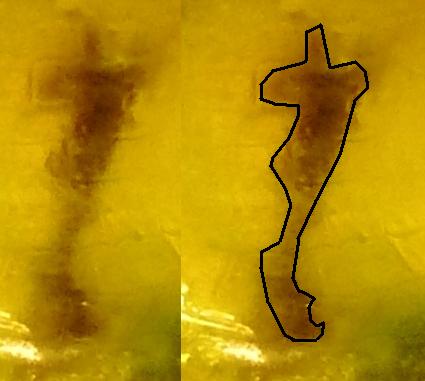
Close-up of the mouth-hook of P. paridis. As the photo was taken of a live specimen still feeding in the mine, it is a little unclear (the rectangular leaf cell walls are visible), but the approximate outline on the right shows the hooked tip at the bottom of the image.

As well as muscle contractions, movement through the narrow mine is aided by the additional grip created by rings of tiny spikes on the surface of the larva, running around the front edge of each segment.

The head of the P. paridis larva - note the rings of tiny black spikes around the front of each segment. A pair of 'eye-lash' shaped tufts (probably with a sensory function) can also be seen, if a little out of focus, on the first segment.
Pitkin et al. (2012) state that the larvae of P. vittatum (noting the taxonomic confusion mentioned above) develop rapidly, emerging from the mine and pupating outside their food-plant after only 13 days and remaining as pupae for almost a year (around 348 days), with adults emerging in May and June. In fact 5 of the 6 larvae in my sample have already pupated and the other appears to be undergoing this process (see below) and so I expect to be storing the pupae for some time before being able to see the adults.

Pupation, with the associated hardening and darkening of the cuticle, appears to begin with the PRPs and then progress inwards from both ends of the larva. So, I would like to finish with a series of images showing the progress of pupation in this species and some of the structures of the pupa itself.

Larva of P. paridis with the PRPs having darkened as pupation is about to begin.
Larva of P. paridis showing partial pupation.
Pupa of P. paridis (approx 4mm long)
Head of P. paridis pupa showing the 'eye-lash' shaped tufts also seen in the larva above
Rear of P. paridis pupa showing the pair of PRPs and several smaller spines
Rear of P. paridis pupa showing the pair of PRPs and rings of small spikes around the articulations of segments.
Rear of P. paridis pupa showing the pair of PRPs and smaller lateral spines

References

Chandler, P.J. (1998). Checklists of insects of the British Isles (new series) part 1: Diptera. Handbooks for the Identification of British Insects 12(1): i-xx; 1-234.
Nelson, M. (1990). Observations on the biology and status of British dung flies of the genus Parallelomma Becker (Dipt., Scathophagidae). Entomologist's Monthly Magazine 126: 187-189. 
Pitkin, B., Ellis, W., Plant, C. & Edmunds, R. (2012). The Leaf and Stem Mines of British Flies and Other Insects: Parallelomma vittatum (Meigen, 1826) [accessed 05/06/2012].
[Diptera: Scathophagidae]
Smith, K.G.V. (1989). An introduction to the immature stages of British flies. Handbooks for the Identification of British Insects 10(14): 1-280.