What with winter keeping most invertebrates out of sight, it's been a while since I wrote much of an entomological nature, but yesterday was a fine opportunity to head up to
Beacon Hill nature reserve to see what was about. As well as chalk grassland (which will be more interesting when in flower), there is an interesting stand of beech woodland and associated scrub, including an ecologically important resource of dead wood (standing and fallen) and old mossy trees.
 |
| The base of a mossy beech tree. |
These features mean that there is habitat for many fungi and dead-wood invertebrates and the evidence is everywhere - beetle boreholes (some opened by woodpeckers, one of which could be heard clearly in the woodland), wood in various stages of decay, insect-feeding birds such as a treecreeper (
Certhia familiaris) and an intriguing-looking rot-hole with a large fungus and a tuft of hair poking out of it...
 |
| Rot-hole with fungus and tuft of hair |
Looking inside, it had been lined with moss and hair, and was clearly a nest or roost of some sort, either of a bird or small mammal, and the fungus is (I think) an oyster mushroom
Pleurotus ostreatus - if any mycologists would like to correct me on this, please do!
 |
| The inside of the rot-hole; at the base of the fungus, a layer of moss-and-hair bedding. |
So, sample-pot in hand (like any good ecologist!), I took a pinch of the mossy bedding, including some soil/decayed wood from directly beneath it - after all, there are plenty of under-recorded parasites that live in vertebrate nests and you never know what you'll find. Back home, it was time to check what I'd found; some of the small inveretebrates such as Collembola (springtails) hide very effectively in material like this, so I find that adding some water to the sample in a watch-glass causes them to float to the surface and become easier to see. Indeed, doing this brought up a cluster of the common springtail
Ceratophysella bengtssoni which can sometimes be found in large aggregations on the surface of soil and puddles, but may well still have been hibernating given the cold night-time temperatures at present.
 |
| Several Ceratophysella bengtssoni from the nest sample |
These weren't the only springtails -
Lepidocyrtus cyaneus and
Neanura muscorum were also present, as was
Tomocerus vulgaris from mossy dead-wood of a nearby tree. The samples included quite a few empty moulted skins, suggesting that these are not solely hibernation sites, but places where active feeding and growth occur - unsurprising as they mainly feed on fungal hyphae and decaying plant material (no shortage in this sample location). They are also an excellent group to look for in the winter as they can be found throughout the year - if you are interested in the UK species,
Hopkin (2007) is an excellent place to start. However, Collembola are not the only soil/leaf-litter animals to be found. Hidden among the tangle of hair (mainly sheep I think) and plant fibres were two shed skins of an oribatid soil mite.
 |
| The shed skin of an oribatid soil mite |
Oribatids are beyond my identification skills (I don't even
know anyone who can ID them, though I do have a go at halacarids occasionally), but the shiny bulbous shape, the pointed mouthparts and the leg attachment points are all visible here. Though poorly known outside the realm of specialists, these mites are important in the decay process, feeding on a wide range of plant, animal and fungal organic material, with a minority being predatory - in fact they break down and process soil material in a similar way to earthworms even if they aren't as familiar or well-understood/studied.
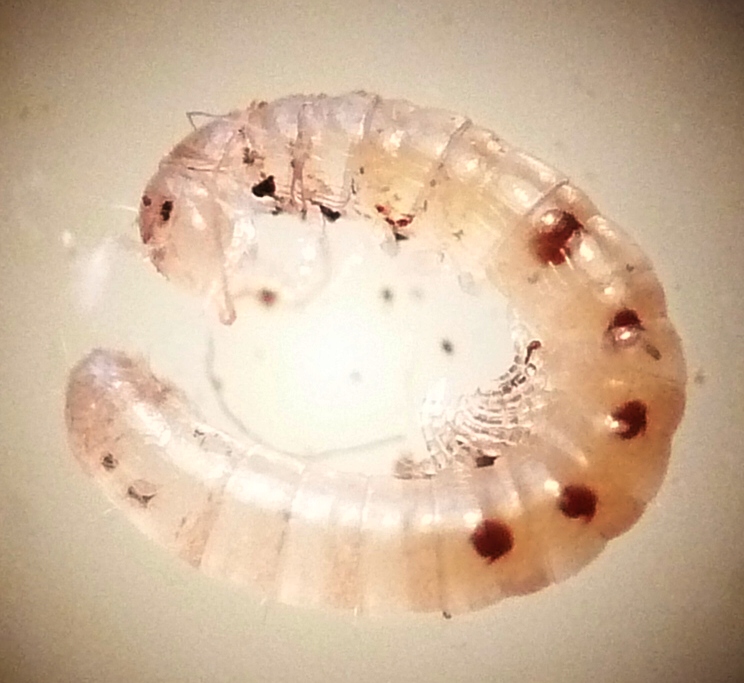
Another species, common if often over-looked, and mainly found under bark or logs in woodland is the spotted snake millipede
Blaniulus guttulatus. It is often considred a pest (e.g. in allotments) but probably only enters crops when damage has already occurred, such as by a 'primary' pest or some other mechanical means. They grow to around 20mm in length and are white with rows of red spots along the sides. The specimen I found however was a juvenile no more than about 3mm long (with few segments/spots), and the first early stage I've seen of this species.
 |
| Juvenile Blaniulus guttulatus |
So, a few interesting finds - common species (no idea about the oribatid) but indicative of the small and often un-noticed soil/dead-wood fauna. Interestingly there were no mammal/bird nest-dwelling species (such as ticks or fleas), and no indication of exactly what had been using the hole - however, the presence of fine hairs and small dark elongate faeces, plus a lack of even small feathers suggest a mammal, presumably a rodent, rather than a bird.
Reference
Hopkin, S.P. (2007).
A Key to the Collembola (Springtails) of Britain and Ireland. FSC, Shrewsbury.