Welcome

Welcome to my blog

This is where I post various musings about wildlife and ecology, observations of interesting species (often invertebrates)
and bits of research that grab my attention. As well as blogging, I undertake professional ecological & wildlife surveys
covering invertebrates, plants, birds, reptiles, amphibians and some mammals, plus habitat assessment and management
advice
. I don't work on planning applications/for developers. The pages on the right will tell you more about my work,
main interests and key projects, and you can follow my academic work here.
Showing posts with label reserves. Show all posts

Sunday, 29 December 2013

Highlights of 2013

December's been a quiet month on the blogging front - a large beetle project is ongoing (status review of the UK Chrysomelidae) and then of course the whole festive-season-thing. However, there was a proper summer this year with an extended period of hot dry weather extending into a mild autumn, and this meant some fine invertebrate (and other) sightings after some truly awful, cool, wet summers. The most spectacular (for me as they were all personal firsts) were probably three Lepidoptera finds between July and September - two butterflies, a monarch (Danaus plexippus) and long-tailed blue (Lampides boeticus) and a moth, the Clifden nonpareil (Catocala fraxini). The monarch is a North American species, and although some have been known to cross the Atlantic, it is more likely that this (and one from a nearby friend's garden) had escaped from a butterfly farm, maybe on the Isle of Wight. Certainly there was a small flurry of records of this species in southern England, aided by the fact that monarchs in the UK often visit gardens to seek their foodplant, milkweed (Asclepias syriaca) which is of course also non-native. The other two are scarce migrants seen in higher-than-usual numbers due to the favourable conditions this year. Being native to NE Europe, the Clifden nonpareil is more often seen on the eastern coasts of Britain, but my sighting was in Hampshire, about 10km inland where one large and unmistakable adult was seen basking on warm brickwork near scrub including its foodplants - aspens and other poplars (Populus spp.). Also a rare migrant, the long-tailed blue can be found on various Fabaceae such as everlasting-peas (Lathyrus spp.) and brooms (Cytisus spp.) - as a Mediterranean resident, it's not often seen in this country. I'll stop there, but if you'd like an affordable and user-friendly guide to European butterflies, one of my favourites is Haahtela et al. (2011). More to come from me in 2014, but until then, here are some pics from 2013...

A flock/mob of jackdaws in spring, as seen from my study window.
Adult female smooth newt in our garden pond.
A leaf beetle larva and its defensive shield of faeces and shed skins.
And finally, just to prove that I do go out and do ecology in the field, here I am taking great created newt eDNA samples at Claylands Nature Reserve, Hampshire.

Reference

Haahtela, T., Saarinen, K., Ojalainen, P. & Aarnio, H. (2011). Butterflies of Britain and Europe: A Photographic Guide. A & C Black, London.

Tuesday, 31 January 2012

What's in the box? No.13 - new to Nottinghamshire

The most recent coleopterous arrival by post came beautifully carded inside the lid of a screw-top plastic pot complete with a label detailing the location, collection date and name of the person recording it. It came from a reserve warden who had been in touch with me because they had identified the beetle as Longitarsus dorsalis, a species that did not appear to have been recorded before in the county in which they found it (Nottinghamshire) and wanted the identification confirmed (or otherwise).

The neatly set specimen of Longitarsus dorsalis as it arrived by post - carded inside the lid of a screw-top plastic pot.
Now onto identification. The beetle is about 2.5mm long (as ever, excluding appendages), with dark elytra bearing broad orangey side-stripes, a similarly orange pronotum and a dark head and appendages.

Dorsal view of L. dorsalis
Within the genus Longitarsus, this coloration is only known from L. dorsalis in Britain and the genus is easy to determine as the first tarsal segment is more than half the length of the tibia. So, it seems that the identification is straightforward to confirm, but it is worth looking more closely to see some other features associated with the species (some more details and further images can be found here).

Hind leg of L. dorsalis showing key features
In this photo, the long first tarsal segment is clear to see (red line) and the tibial spur (green line) is shorter than the maximum thickness of the tibia (sometimes this can be difficult to tell as the spur length may be very close to the max tibial width). The upper surface of the tibia is flat (too dark to tell here, but it is) and the outer edge of the tibia has a fringe of short flat bristles (red arrow).

Pronotum of L. dorsalis
The pronotum is orange, usually with at least a dark patch towards the front (clearly seen above). The pronotum also has a fine but distinct rim along the rear edge (also visible above) and sides. The pronotal punctures are fine and between them there is finer microsculpture. The elytral punctures are coarser than those on the pronotum and the elytra themselves have definite 'shoulders'.

Head of L. dorsalis
The head is also densely microsculptured and although this isn't visible in the photo above, you can see the coarse punctures along the edge of the eye.

Side view of L. dorsalis showing the epipleura narrowing towards the rear (red lines).
In side view, the epipleura (lower edges of the elytra) narrow towards the rear, especially behind the mid-point (approximately where the left-hand red 'I' is in the photo above). Lastly, I want to look at the aedeagus (below) which is often a useful diagnostic tool when identifying some trickier-to-separate beetles. Here, the tip unfortunately broke off during dissection (though it did have a small blunt point), but the sides clearly curve inwards and the shape matches the better specimen illustrated here. The parameres (lateral lobes) can be seen as the dark V-shaped structure near the bottom. Interestingly, the curved sides of the aedeagus, an important feature, are not clearly shown in the usually excellent (and expensive) work by Warchałowski (2003).

Aedeagus of L. dorsalis

This clearly indicates that the specimen is of L. dorsalis which is important as it is the first time it has been found in Nottinghamshire, and is nationally scarce in the UK (Notable B). It is mainly found on calcareous or sandy soils, is associated with ragworts (Senecio), and has become scarce due to the loss of its habitats (conversion of grassland to agriculture, infilling of quarries, habitat succession such as in once-open woodland rides and clearings, grassland 'improvement' through fertiliser application, herbicide use and woodland clearance). Open conditions with ragwort are required and conservation measures can be straightforward e.g. retaining some open areas in woodland through rotational cutting, or grazing is some other situations (Hyman, 1992). So, it's good to see this species in a previously unrecorded location, especially as several individuals were seen with just one sent to me for identification.

References

Hyman, P.S. (1992). A Review of the Scarce and Threatened Coleoptera of Great Britain. Part 1. JNCC, Peterborough.
Warchałowski, A. (2003). The Leaf-beetles (Chrysomelidae) of Europe and the Mediterranean Area. Natura Optima Dux Foundation, Warsaw.

Friday, 16 December 2011

Egrets, I've had a few, but then again...

OK, yes, the title is a terrible Piaf pun (je n'aigrette rien?) - maybe I'm feeling festive and frivolous... Anyhow, I've posted a lot of invertebrate taxonomic morphology lately, especially that of small beetles, so I thought I'd move up the size scale to look at a species that is probably one of Britain's most popular birds, the Little Egret (Egretta garzetta).

A little egret stalking through the water of a coastal scrape/lagoon
This is a small heron and its white plumage makes it both attractive and easily recognisable - the size and black beak separate it from other, scarcer, egrets in Britain. Although familiar to many people, its current British population size, around 1,600 wintering birds and 150 breeding pairs (RSPB, 2011) is a fairly recent phenomenon. Until the late 1980s, it was only seen occasionally, not breeding in Britain until 1996. This was  a result of natural colonisation from France where, in previous decades, it had expanded from southern Europe into western and northern France following effective legal protection which allowed its population to recover after massive declines up to the 19th century as birds were killed to provide decorative hat-feathers. In fact, the decline of this species was one of the reason the RSPB was founded back in 1889. It is now seen regularly, especially along the south coast, and in East Anglia and Wales, but is included on the Amber List as a rare breeding species as the number of breeding pairs remains fairly small.

It feeds on fish and other small animals (insects, amphibians, reptiles, crustaceans) which it hunts mainly by stalking in shallow water, sometimes also running with raised wings or shuffling its feet to disturb small fish; at other times they may simply stand still and ambush their prey. While bird-watching yesterday, I was pleased to see a little egret using the foot-shuffling method (which the other British egrets do not use) and, although I'm no wildlife film-maker, I did manage to capture this footage (on a compact, hence the graininess, but the behaviour is still visible):


You can see the shuffling, sometimes circular foot movements which, at the end, result in the rapid (blink and you'll miss it) capture of a prey item. I hope you enjoyed reading this tale of conservation success - also a departure from the usual invertebrate theme - more coming soon.

Prey detected, the beak strikes!
Reference

RSPB (2011). Little egret. [accessed 16/12/2011]

Tuesday, 21 June 2011

What's in a gall? Part 3: Secrets of the bedeguar

About a week ago, I was on top of St. Catherine's Hill nature reserve near Winchester (Hampshire, England), leading a wildlife walk entitled 'Galls and other wildlife' as the heavens opened and the rain came down... and down... However, although few invertebrates were visible, there was one aspect of entomology that was visible whatever the weather - galls. Last month, I wrote about an undescribed gall species which can be found on this chalk grassland reserve, and before that I investigated the complex inner workings and inhabitants of a common gall species, the Knopper. So, when I saw a cluster of old woody bedeguar galls (Diplolepis rosae) on a sweet-briar (Rosa rubiginosa), I had to collect one and bring it back for closer examination.

A live gall of D. rosae


Bedeguar galls (also known as Robin's Pincushion in Britain) are the galls of the cynipid wasp D. rosae and are quite familar due to their large (a few cm across) spiky shape as shown above. Bedeguar is a Persian word relating to thistles (either their spininess or being wind-blown like thistledown), and there is evidence that ancient writers such as Pliny were familiar with these structures.

Most (well over 90%) of D. rosae wasps are female and it may well be that males are redundant and disappearing. As described in, for example, Csoka et al. (1998), this appears to be due to infection by the bacterium Wolbachia which causes reproduction to occur via thelytokous parthenogenesis (i.e. production of females from unfertilised eggs). Wolbachia has various effects on its different hosts (other wasps, woodlice, gnats, fruit flies) and comes in different strains, but it can interefere with meiosis (meaning females could not produce haploid eggs), cause sexual incompatibility, prevent production of males, or even feminise males (this happens in woodlouse hosts even though they have males genes). In any case, females emerge during May and June and lay eggs in leaf buds which are beginning to swell - whatever the precise criteria for bud selection, females can investigate a bud for up to an hour before deciding on its suitability. Inserting the ovipositir under a bud scale, eggs are laid between the developing leaflets inside  without damaging the plant tissues, and 30+ eggs can be laid, each in an individual cell.

As is usual in cynipid gallers, the leaflet cells around and below the egg immediately become highly active, enlarging and producing RNA, proteins and other substances, and a small pad is formed after about two days. Cell walls break down forming a cavity in the pad, and around a week after the egg was laid, it hatches and the larva enters the cavity. As it begins to feed, nutritive cells develop near its head - these line the chamber while the outside produces cambium. The epidermis meanwhile grows bulges which develop into the familiar multicellular hairs forming the outside of the gall which is familiar to us, the whole mass containing a number of cells. Also, new vascular tissues grow inwards to supply the nutritive layer and out into the hairs as well as linking with leaf veins. The gall is fully developed by July or August and at this point the larvae feed rapidly, being fully fed by October. They overwinter in the gall, pupate there in late spring, and new adults use their jaws to tunnel out (Redfern 2011).

An old bedeguar gall c. 25mm across showing exit holes in individual cells. The gall is also covered with lichens and moss.

The gall broken open to show vascular strands and the inside of a single cell.
The pictures above, especially the lower one, show the complex structure of the vascular tissues, shown here as spaghetti-like threads having grown through the outer layers before they became woody. As shown by the colonising lichens etc., this is quite an old gall and so no D. rosae or associated parasites/inquilines are present, but the complex structure is of interest, especially given the possibility of non-galling invertebrate colonists. A variety of structures is shown in the following pictures:

Enlarged cells similar to those seen in the Knopper gall (see link at top of article)

Layering of cells in the bedeguar gall.

Spongy texture of woody cells surrounding a gall cell.

Some of the vascular tissues, now woody, linked to various parts of the gall and host plant, including the hairs - elongate plant cells are visible.

A section from around a gall cell showing the same elongate structures and their association with the spongy layer.
Looking inside an individual gall cell, it is clear that there is colonisation by, for example, lichens and fungi, but there is evidence of other biota using these ready-made structures.

The inside of a gall cell showing a white membrane suggesting a cocoon, plus black specks of 'frass' (invertebrate faeces).
Looking behind this membrane, among the green algae and black frass, there appears to be an empty skin (exuvium) - the small linear structures in the centre are probably legs.
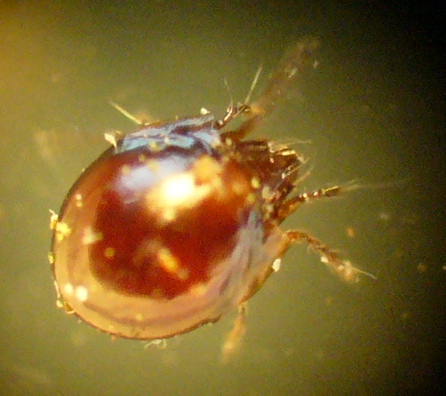
Having found an exuvium, I had to wonder what had left it there. I didn't expect to find anything, but then there was a tiny flash of reddish movement as I looked down the microscope.
In the bottom of the open cell, a small, round (and quickly moving) red shape.
After some time, I managed to capture this tiny creature (the inner chamber of the cell is only a few mm across, so this is only about 0.5mm long) and took some pictures. It turns out that unlike many invertebrates, it is unable to walk on glass, so although its limbs were moving, the organism itself stayed still on a slide...
The tiny beast in question - a mite, possibly an oribatid. Note the shiny round carapace, bristly appendages and rostrum with transverse wrinkles.

The dorsal surface of the mite showing the even sculpturing.

The best close-up I could get of the head and front appendages/bristles.
So, as always when I decide to investigate a gall in detail, I have come away finding more than expected - it has induced me to read up on the unusual bacterium-mediated reporductive strategy of D. rosae, scrutinise the fine structure of something that is familiar on a macro scale only, and find an invertebrate that I genuinely can't identify (I await a friendly acarologist - should one appear, I'll post any updates). However, with its shiny single carapace, it does look like an oribatid (moss mite, order Oribatida). These vary in their diet, but different species feed on dead plant matter, fungi, carrion or lichens, while some are predatory. Given the microhabitat here, I suspect fungal and/or lichen feeding, and after a further search of the gall cells I found four of these mites. The gall and mites are now in a tiny vivarium, so I may get to see more behaviour and maybe young. If so, pics and details will of course appear here. Thanks for reading!


References

Csoka, G., Mattson, W.J., Stone, G.N. & Price, P.W. (eds) (1998). The Biology of Gall-Inducing Arthropods. General Technical Report NC-199, Forest Service, North Central Research Station, USDA, St Paul, MN. Contains many useful papers and used as a general reference in the publication below.

Redfern, M. (2011). Plant Galls. Collins, London. The source of much of the gall biology here, and a must for gall-nerds!

Thursday, 2 June 2011

Water meadow wonders

As summer seems to have returned to southern England, I thought I'd offer something a bit lighter and essentially photographic rather than any in-depth diagnostic morphology or analyses of gall contents (though these will return...). Instead, here's a selection of splendid invertebrates from Ovington water meadows near Winchester - the site is managed for nature conservation and is a centuries-old water meadow system of sluice-controlled channels, grasslands, scrub and mill-stream. Enjoy!

Starting with the flies (Diptera):

The Noon-fly (Mesembrina meridiana) often seen basking - distinctive yellow-gold wing-bases on an otherwise black fly. This one was busily engaged in leg-cleaning behaviour.

A hoverfly of the genus Helophilus feeding from umbellifer flowers.

The stilt-legged fly Calobata petronella perched on a leaf.

 And of course some beetles (Coleoptera):


A splendid Red-headed Cardinal beetle, Pyrochroa serraticornis

An (IMO) even more splendid longhorn beetle, Agapanthia villosoviridescens

Guarding its patch of umbellifer flower, a soldier beetle of the genus Cantharis.

One of the Donacia reed beetles - in my specialist area, the family Chrysomelidae. Look out for a post on Donacia soon, including colour variants from this site.
 Now onto a possibly less familiar group, the scorpion-flies (Mecoptera):

A female of the genus Panorpa - the males have a scorpion-like tail with genital capsule raised at the end.
 And finally, I couldn't look at a wetland ecosystem without at least one specimen of Odonata:

To humans, a lovely Banded Demoiselle Calopteryx splendens; to small invertebrates, fearsome flying jaws!
I hope you enjoyed my photographic interlude - something a little more in-depth coming this way soon...

Tuesday, 1 March 2011

When conservation fragments fail - the demise of the Pashford Pot Beetle

Much is written about connecting protected areas with the aim of achieving landscape-scale nature conservation, and the problems of isolation, fragmentation, edge effects and so on in small, disconnected sites are well known, even if some of the mechanisms involved are not fully understood (e.g. Harris 1988, Murcia 1995). There are many examples of areas where species and areas of 'protected' habitat have suffered through a lack of connectivity, both in terms of the landscape itself and the policies and legislation covering them. In Britain, one particular example, the Pashford Pot Beetle Cryptocephalus exiguus, illustrates this issue especially clearly at the national (UK) level.

C. exiguus, photo © Lech Borowiec


C. exiguus is a widespread Palaearctic species (in Mongolia and Korea it is known as ssp. amiculus), but in Britain has only been recorded in few scattered sites, mainly in eastern England. Between 1898 and 1954 it was recorded from Freshney Bog, Lincolnshire, but since then it has been known only from a single site - Pashford Poors Fen, Suffolk - with the most recent record from 2000.


NBN map of C. exiguus distribution
Pashford Poors Fen is a SSSI (Site of Special Scientific Interest) and a nature reserve managed by the Suffolk Wildlife Trust. Covering 11.3 hectares, it is known for its mosaic of drier grassland and wetter fen areas, both of which support a range of interesting plant and animal species. It is however essentially an ecological island within a sea of intensive land use (mainly agriculture). C. exiguus itself is listed as 'Endangered' (RBD 1) and is covered by the UK Biodiversity Action Plan (BAP). It is a wetland species associated with mixed fen and fen meadow, and although little is known about its biology in Britain, it is believed to feed on Common Sorrel (Rumex acetosa), among other possibile host plants. Targeted survey efforts found small numbers during the 1980s and 90s and concluded that the habitat had degraded to such an extent that it could only support a small population, if any. Although the BAP set a target in 1995 of maintaining the population, and if possible enhancing it with a view to translocating it to other sites, it has not been found since 2000 and BAP reporting in 2005 simply stated 'Target not Achieved'. Given that the species was listed as Endangered in the 1980s and subsequently BAP listed, and the site is a nature reserve designated as a SSSI and managed well by a conservation body, what has happened?

Essentially, this is where the landscape issue comes in. Fojt (1994) noted that fens and their vegetation communities (many of which are localised, some of which are rare, and all of which are of high conservation value) are dependent on calcareous spring water, but that they are threatened by drainage (e.g. for agriculture). Many fens have been damaged by drainage, and although this has been occurring for a long time,  spring-dependent communities have often survived. However, more recently there has been increased abstraction of aquifer water, and this fundmentally threatens the ecological functioning of fens both directly and by worsening the effects of droughts (which may well increase in frequency and severity as a result of climate change). Fojt's report notes that changes had already occurred in the species composition of many sites, in some cases changing the type of vegetation community. This of course has knock-on effects on species, such as invertebrates, which rely on particular plant communities. Fojt also notes that groundwater abstraction directly threatens springs and their associated (and nationally important) plant communities although in most cases, the lack of intensive hydrological study makes it difficult to determine the precise impacts of groundwater abstraction on fen water tables. Looking at solutions, Fojt noted that,

"The problem of dehydration due to water abstraction needs to be tackled strategically in the long term, though action needs to be taken over currently existing licences. The alleviation of the problem will be helped if water resource plans accommodate the water demand of those fens with a high wildlife interest."

As with many sites, this true of Pashford Poors Fen which is both small and surrounded by land use which is effectively, through water abstraction and drainage, hostile to its continued well-being, even if unintentionally. In the 1990s, the Suffolk Local BAP stated that action included extension of the SSSI boundary in 1996 to improve control over adjacent drainage ditches, and the installation of additional bunds to attempt to retain higher water levels during the summer. The management plan for the site was rewritten with greater emphasis on the vegetation management of those areas where C. exiguus had been found, focusing on providing an appropriate grazing regime during autumn and early winter. A Water Level Management Plan was mooted to deal with issues relating to control of water resources on the site, but for fens in general these have tended to be inadequate as they do not cover groundwater or water quality.

So, what has happened? Well, no-one knows for certain, but it is likely that C. exiguus is at best extremely rare in Britain, possibly extinct. Of course, it might be rediscovered at Pashford Poors Fen, or indeed at another site. At the Palaearctic scale, it could be argued that this isn't too important - it was rare and localised in Britain even when land management was at least a bit more sustainable (i.e. in the 19th century), and remains widespread elsewhere. However, aside from the intrinsic value of any species as a contributor to national and local biodiversity (and I consider this important in itself), it highlights a major failing in conservation. The site and species were both listed/designated and therefore, in principle at least, protected. The problem had been identified, and required action understood - indeed, as site managers, the Suffolk Wildlife Trust did what they could. Yet, the site has still degraded and the species has probably been lost. Why? Well, it's simply because conservation requirements remain politically a lower priority than many other competing interests. In this case, water abstraction licences for agriculture were granted despite the impact on adjacent wildlife habitat, and regardless of the site's conservation designation and status. This could have been taken into account but wasn't - and so, the fate of the site and species was taken out of the hands of the Wildlife Trust: by the time favourable changes started to be made in policy etc, it was already too late. Still, hopefully the relevant lessons will have been learned...

I could go on about the Government's continued failure to protect Britain's biodiversity (Countdown 2010 anyone...), but - at least for now - I won't. However, this is hardly a unique situation - a recent post by Ted McRae at Beetles in the Bush covers a parallel issue from Missouri - and it seems that, unless conservation requirements become fully integrated and suitably weighted in decision-making and land management/planning processes, it is something that will continue to occur. Still, not all is doom and gloom - since I took over as organiser of the UK Chrysomelid Recording Scheme, two more chrysomelids have been found - Longitarsus symphyti which should be a definite addition to the list, and Smaragdina salicina which is so far known only from a single specimen.

References

Fojt, W.J. (1994). Dehydration and the threat to East Anglian fens, England. Biological Conservation 69(2): 163-175.

Harris, L.D. (1988). Edge Effects and Conservation of Biotic Diversity. Conservation Biology 2(4): 330-332.

Murcia, C. (1995). Edge effects in fragmented forests: implications for conservation. Trends in Ecology and  Evolution 10(2): 58-62.