Welcome

Welcome to my blog

This is where I post various musings about wildlife and ecology, observations of interesting species (often invertebrates)
and bits of research that grab my attention. As well as blogging, I undertake professional ecological & wildlife surveys
covering invertebrates, plants, birds, reptiles, amphibians and some mammals, plus habitat assessment and management
advice
. I don't work on planning applications/for developers. The pages on the right will tell you more about my work,
main interests and key projects, and you can follow my academic work here.
Showing posts with label Hemiptera. Show all posts

Monday, 8 June 2015

Bioblitz bits AKA things in other things

I've done a couple of bioblitzes as entomological geek-in-residence for the day, identifying things that are a little tricky, and the most recent was just a couple of days ago in Southampton, around the Southampton University campus. This involves me looking for specimens myself, but during busy periods such as when groups come back from recording sessions, I'm at a table with a microscope and a pile of books. A lot of different species passed through my hands that day, but here are a couple of less familiar one that are both endoparasites...

The species of interest here isn't the aphid, but the disc-shaped structure below it. The aphid is a mummified husk at this stage because it has been parasitised by the small wasp Discritulus planiceps. This lives inside the aphid, then exits through the body wall and develops into an adult inside the disc-like cocoon it builds beneath the host skin. Wasps of the genus Praon do something similar but their cocoons are tent-shaped.
This cluster of pupae was attached to the underside of an oak leaf. They are each a few millimetres long and have small blobs of what I assume are dried faeces at one end. A bit of research indicated that they are probably wasps of the genus Eulophus. They are now in my hatchery to see if I can confirm the species once they emerge. They will have emerged from a caterpillar host before pupating and the fragments to the left of the cluster are probably where it was attached before falling off the leaf. A more familar species is the braconid wasp Apanteles glomeratus that has a similar lifestyle, parasitising the caterpillars of white butterflies like Pieris.

A close-up of a Eulophus pupa - various structures are quite clearly visible such as eyes and mouthparts.
At the end of the day, Lizzy from HBIC announced the total number of species recorded on the day - 257, an increase of about 30 on last year's event, although more records will trickle in a specimens like the Eulophus above are identified.

Wednesday, 10 July 2013

It's OK to be takeyai

It's time to look at a family of insects I've not written about before - the Tingidae or 'lacebugs'. These are true bugs (Hemiptera) and, though small, are distinctive due to having a lace-like network of reticulation covering the pronotum and forewings. The function of this isn't immediately obvious, but as they often look like dried seeds or similar, it may be a form of camouflage. They are also flattened dorso-ventrally, with the head, in many species, hidden beneath a hood-like or bulging extension of the pronotum. Although generally unfamiliar to non-entomologists, they can be quite common and there are over 2,000 known species worldwide (25 in the UK, 8 of which are listed as scarce or rare).

All Tingidae are plant-feeders, and being mostly host-specific, some are considered pests. One of these, a Japanese species first recorded in Britain in 1998 (Halstead & Malumphy, 2003) was found in our garden yesterday - the andromeda lacebug Stephanitis takeyai. It feeds on the 'Japanese andromeda' Pieris japonica and has been introduced into the USA and Europe via the ornamental/garden plant trade. It also uses other Pieris species, as well as rhododendrons and azaleas - as such it is sometimes considered a pest in ornamental gardens, though in ours it is welcome to eat what it can find as we don't grow these!

Stephanitis takeyai, approx 4mm long (excluding appendages)
The dark reticulation is clearly visible here and, along with the dark wing markings (which break up the outline) and leaf-coloured legs/antennae I suspect provides effective camouflage. The bulbous hood of the pronotum is visible, almost entirely obscuring the head/eyes, but can been seen more clearly from different angles.

Stephanitis takeyai, side view showing the pronotal hood and, just behind it a thin longitudinal pronotal keel. The flattening of the body is also clear.
Stephanitis takeyai, front view, again showing the pronotal hood.
Although some North American tree-pest species have been well studied, there is a lack of information about the Tingidae in more general sources. There is a short section including keys in Southwood & Leston (1959) and although Ryan (2012) updated the list in this publication, adding S. takeyai and Corythucha ciliata, identification details were not included. However, S. takeyai is a distinctive species, only likely to be confused with another rhododendron-feeding introduction, S. rhododendri which is broadly similar, but has mainly pale wings with a brown band near the base.

S. rhododendri is covered briefly in Becker (1974), Buczacki & Harris (1981) and similar publications, as well as in Southwood & Leston (1959), while Alford (2011) covers the platanus lacebug C. ciliata, a North American pest of various plane trees first found in Britain in 2006, again via the plant trade. However, there is much to learn about these insects, and it seems likely that more will be accidentally imported, so definitely a group worth keeping an eye out for, including on garden/ornamental plants.

References
 
Alford, D.V. (2011). Plant Pests. Collins, London.
Becker, P. (1974). Pests of Ornamental Plants. HMSO, London.
Buczacki, S. & Harris, K. (1981). Guide to the Pests, Diseases and Disorders of Garden Plants. Collins, London.
Halstead, A.J. & Malumphy, C.P. (2003). Outbreak in Britain of Stephanitis takeyai Drake & Mao (Hemiptera: Tingidae), a pest of Pieris japonica. British Journal of Entomology & Natural History 16: 3-6.
Ryan, R. (2012). An addendum to Southwood & Leston's Land and Water Bugs of the British Isles. British Journal of Entomology & Natural History 25: 205-215.
Southwood, T.R.E. & Leston, D. (1959). Land & Water Bugs of the British Isles. Warne, London. [there is a 2005 reprint which is much cheaper, and a CD-ROM version from Pisces Conservation Ltd.]

Thursday, 9 May 2013

Peering at pond predators

As our garden pond develops, so does the community of invertebrates that live within it - and this of course means predation. Predators come in all shapes and sizes, from tiny water mites to herons. One vertebrate predator is a neighbour's cat (which does not like being sprayed with water!); another is the smooth newt Lissotriton vulgaris. Our pond currently has a pair of these, so we will be looking out for eggs - they are also voracious predators of frog tadpoles (of which there are many) and one was seen yesterday taking a tadpole as prey.

Female smooth newt Lissotriton vulgaris
Other predators are smaller (in the absence of fish which are likely to devour/reduce the biodiversity of a garden pond) in the form of various invertebrates. Some of these are familiar and commonly seen, such as the pond-skater Gerris lacustris (there are other species, but this one is often an early coloniser of newly created ponds). Being a true bug (Hemiptera), it has piercing mouthparts (which curve back under the head) and can be seen skating on the surface held up by surface tension. Pond skaters can move quickly when disturbed or darting towards prey such as smaller invertebrates that have fallen onto the water's surface. Their feet and legs dimple the surface and the large middle pair of legs push backwards, creating a pressure wave that allows the insect to glide forwards (e.g. Guthrie 1989).

Pond skater Gerris lacustris. The dimples in the water's surface are clearly visible - also note that this specimen is fully winged; spring dispersal flights are an important part of this species' life history.
Lastly, a quick look at a group well known as predators in their juvenile form - the Odonata - dragonflies and damselflies. There are several small early-instar nymphs of the Large Red Damselfly Pyrrhosoma nymphula in our pond, but also a late/final-instar nymph as shown below. Although often lurking in sediment (this one was underneath an aquatic plant pot/basket), they can swim actively, have excellent vision and of course hinged mouthparts (the 'mask') which can be quickly thrust forwards to grab prey. Nymphs of the Odonata will attack many types of prey - not only other invertebrates, but also amphibians, especially small/juvenile individuals. It is likely that our large population of frog tadpoles may start to be reduced soon...

Late-instar nymph of the Large Red Damselfly Pyrrhosoma nymphula. The partly darkened caudal lamellae at the tip of the abdomen can be seen, plus the bulges and central indent at the back of the head - these features are useful for identification.
Late-instar nymph of the Large Red Damselfly Pyrrhosoma nymphula. The large eyes, useful for locating prey, are shown - the jawed 'mask' is retracted beneath the front of the head.

Reference

Guthrie, M. (1989). Animals of the Surface Film. Richmond, Slough.

Friday, 3 May 2013

Pondnet diary day 2

Continuing the Pondnet survey that began about a week ago, having done a preliminary survey of the main environmental features and whichever species could be spotted from the side, this time a net and white tray were required.

My wife/field-assistant doing some pond-netting.
the first thing we notcied was the great increase in frog tadpoles - not only in number (from a couple of hundred to at least a thousand as a rough estimate) but in size. A week previously the ones we saw were newly hatched - these had developed their typical fat-headed shape. They hadn't all hatched in the last week, so many must have been well hidden. The net also meant that we could confirm the species of the numerous small fish seen previously - they looked like sticklebacks but it's always worth checking, and all the ones we caught (and yes re-released) were indeed three-spined sticklebacks (Gasterosteus aculeatus).

A three-spined stickleback Gasterosteus aculeatus - the dorsal spines are just visible
Of course, it wouldn't be a proper sampling day (for me) if there weren't invertebrates involved. The netting meant we could see beyond the larger surface-dwelling species and maybe find some that, even if common, are less immediately familiar.

The water-slater or hog-louse Asellus aquaticus
The water-slater or hog-louse Asellus aquaticus is an isopod crustacean i.e. related to woodlice, and is common and widespread in Britain. It can be found in a very wide range of water bodies and qualities, but especially under aquatic foliage, stones and wood (Gregory, 2009), so is rarely seen by the casual observer without a net. It can be separated from the similar Proasellus meridianus by the head pattern although the photo doesn't show it as clearly as could be seen on the live specimen.

Another common-but-overlooked species is Plea minutissima, the 'least water-boatman'. It is broadly similar to other water-boatmen seen 'rowing' beneath the water's surface, but is tiny (around 1.8 - 2.8mm long) and its domed shape means that it is initially more likely to look like a small beetle than a water bug at a glance (Denton, 2007) - it certainly did to me when seen among the debris and other small species from the net. However, under the microscope (or even a squinted eye) it is quite different and the pointed mouthparts can be seen.

The least water-boatman Plea minutissima is the sole British species in the family Pleidae.
Lastly, I'd like to keep moving down the size scale to look at the water mites - arachnids of the suborder Hydracarina. These are mostly bulbous and the body in not separated into separate sections (cephalothorax and abdomen) as would be seen in the suborder Oribatei. Identification is tricky, but Hopkins (1961) can be downloaded from free here and is very useful for those beginning to study this tricky, and again often-overlooked, group. I won't go into detail about the identification here, but the water mite I investigated was Piona coccinea - a red species around 2-3mm long, red and globose in form.

That's where I'll leave pond-related matters for today - more soon!

The water mite Piona coccinea.

References

Denton, J. (2007). Water Bugs and Water Beetles of Surrey. SWT, Woking.
Gregory, S. (2009). Woodlice and Waterlice (Isopoda: Oniscidea & Asellota) in Britain and Ireland. NERC/BRC, Wallingford.
Hopkins, C.L. (1961). A key to the water mites (Hydracarina) of the Flatford area. Field Studies 1(3): 45-64.

Tuesday, 23 April 2013

Pondnet diary day 1

Pondnet is a new Pond Conservation volunteer survey aiming to identify trends in pond quality and associated species. I was recently allocated a pond in Milkmead Copse in Hampshire's Itchen Valley Country Park, and now spring's arrived, I decided that today was a good opportunity to make my first visit to the site.

The pond in Milkmead Copse
It was good to see some frogspawn had survived the cold conditions as there were at least a couple of hundred recently hatched tadpoles, plus one adult newt. However, something else (yup, an invertebrate) caught my eye - a water scorpion (Nepa cinerea) that came to the surface.
Water scorpion, Nepa cinerea
This is a predatory true bug (Hemiptera) and the raptorial (hunting) front legs used to grip prey are clearly visible, plus the breathing tube at the rear. Although this appears to be a single thin tube, it is actually formed from two halves (they separate if a specimen is dried) - air flows from it along two grooves which have small water-repellent hairs and the spiracles open into these grooves (Denton, 2007). Being a bug, it has piercing/sucking mouthparts rather than the jaws/mandibles seen in beetles. It is a large insect by UK standards at around 20mm in length, excluding appendages. It is an active hunter, taking small fish and various other invertebrates. However, I was surprised to see it tackle a larger (approx 25mm) dragonfly nymph, itself an active and powerful predator.

N. cinerea attacking a dragonfly numph.
N. cinerea on the back of the dragonfly nymph
This is not behaviour I've seen before and the nymph struggled for a few minutes before managing to dislodge its attacker by dragging it against a piece of vegetation. Presumably the position of N. cinerea allowed it to pierce the nymph while remaining out of direct reach. Certainly, the water scorpion swam away after this encounter and the nymph came back to the surface. I'm not 100% sure which species it is as it is coated in silt which obscures key features. However, the size, head shape and silty coating are typical of the black-tailed skimmer (Orthetrum cancellatum) so that is my identification for now.

Dragonfly nymph, possibly Orthetrum cancellatum, the black-tailed skimmer. Note the hairs on the legs and body, coated in silt.

The same dragonfly nymph - note the protruding eyes and the 'mask' showing the mandibles.
So, an interesting start to a new survey programme. More to come from the pond!


Reference

Denton, J. (2007). Water Bugs and Water Beetles of Surrey. SWT, Pirbright.

Wednesday, 26 September 2012

Attack of the swimming saucers

Continuing with the theme of true bugs (Hemiptera) in ponds, not all are elongate, sluggish ambush-predators - others actively chase prey and one such species is the common Saucer Bug Ilyocoris cimicoides, the common name coming from its relatively broad, convex shape.

Saucer Bug Ilyocoris cimicoides
Unlike many aquatic bugs, the middle and hind legs are only slightly modified for swimming (there is some flattening, plus clear rows of swimming hairs), and can be used very effectively for walking on land. The front legs are however more strongly adapted, not for swimming but for seeking prey.

Ilyocoris cimicoides - ventral view showing hooked front legs
The hooked legs are used for sifting through sediment and detritus, and for grasping prey which is then pierced by the rostrum - humans should take care when looking through pond-nets as the bite can be very painful and includes toxic saliva causing a sensation equivalent to a bee or wasp sting (at up to 15mm long excluding appendages, it is moderately large insect). The front legs are shown clearly in the side view below, including the broad femur (for strong internal muscle attachments) which have long grooves on the underside which presumably help to grip prey and may form slots where the hooked tibia fits into it when the leg is folded shut.

Although it may be unfamiliar if you've never been pond-dipping, it is widespread though local in distribution and can be common in some waterbodies, especially in the weedy margins of large water-bodies such as marshy dykes, old canals and lakes/large ponds.

Ilyocoris cimicoides - side view showing hooked front legs and slightly modified mid- & hind legs
Note that there is now a second species of saucer bug of the family Naucoridae in Britain - Naucoris maculatus which has been found in England and may well spread being a strong flier (Denton 2007). Happy pond-dipping!

Reference

Denton, J. (2007). Water Bugs and Water Beetles of Surrey. Surrey Wildlife Trust, Woking. [Covers a good range of species; lots of useful info and excellent photos even if you're not in Surrey].

Friday, 21 September 2012

Pond bugs - the long and short of it

As you may have noticed if you're a regular, since building my own garden pond, I have been pretty enthusiastic about all things lentic (I like that word) and this post is no exception. During a recent Southampton Natural History Society field trip (hosted by Naomi, an ecologist from Pond Conservation) to look at invertebrates associated with New Forest ponds, numerous fine creatures were found, including a couple of spindly beasts that are probably unfamiliar to most people who don't regularly wade around in the mud and reeds, pond net in hand. The first of these is the Water Stick-insect Ranatra linearis.
Water stick-insect Ranatra linearis
The first thing to say is that this isn't a stick-insect, it's a true bug (Hemiptera) in the same family (Nepidae) as water-scorpions, and as such has piercing/sucking mouthparts. The long 'tail' is its breathing tube 15-20mm long at the end of a 30-35mm long body (not including the legs) - quite a striking creature, and though locally common in southern England and wales, rarely seen as it tends to lurk in dense pond vegetation, where it is an ambush predator (like a mantis for example) grasping prey with its raptorial front legs. If caught in a pond net, it tends to look like a bit of twiggy detritus until it moves - the occasional human has been known to jump in surprise at pond-dipping events and the like...
The raptorial front legs of Ranatra linearis
Here you can clearly see how the legs can shoot out mantis-like and grab prey (often small newts and fish) which will then be pierced by the pointed mouthparts (also visible). It is able to fly - useful if a pond dries up, and they also hunt on land - and although I have never seen one doing so, apparently it looks similar to a damselfly when in flight. The eggs are a peculiar sight too - when laid on leaves of water plants such as reedmaces and bur-reeds, breathing tube emerge into the air, and the eggs look like little rows of surgical stitches; there are good photos in Denton (2007).

Moving onto something smaller, at 9-12mm long (excluding legs and antennae), the Water-measurer (Hydrometra stagnorum) is another true bug common in much of lowland England and Wales (less so in Scotland and northern England) and is especially elongate, having the longest length-to-width ratio of any British insect - even the head is elongate, protruding well in front of the eyes which can be seen about half way between the antennae and front legs.

The Water-measurer Hydrometra stagnorum
It tends to be found around the edges of ponds and streams, including bankside vegetation as well as the water surface, and are also known from ephemeral waters where they can be found under debris during dry periods. Although they are generally unwinged, individuals with wings do occasionally occur. Attracted by ripples of movement (Savage 1989), they feed on smaller invertebrates such as water-fleas (Cladocera e.g. Daphnia) and mosquito larvae, piercing them through the water surface with their mouthparts, and sometimes pulling them up through it - Fitter & Manuel (1994) includes a photo of prey being consumed. Unlike R. linearis above, the front legs are simply used for walking and are not involved in catching prey - their very regular tip-toe gait gives them their common name as they appear to be pacing out distances. There is a second slightly smaller species, H. gracilenta, but this is very rare in Britain, known only from a handful of locations in southern and eastern England. Back in the 1950s, it was apparently found in the New Forest, but the account was never published and so the alleged location remains a mystery (Huxley 2003) - to find one there would be an entomological highlight!

Although both of these species are fairly common, this is not true of all our aquatic bugs - many (most) ponds in lowland Britain are polluted to some extent, especially by nutrients from our intensive agricultural system, and this has seriously impacted the biodiversity of pond ecosystems. With both point and diffuse sources being a problem, it can be difficult to ensure good ecologicsl water quality, but advice (on managing existing ponds or creating new ones) can be sought from organisations such as Pond Conservation. Garden pond ponds are a little different as few of us have enough room for the metres of shallow muddy margins that a really good pond needs, but some of the same advice applies and they are really important oases - and excellent fun to watch as the wildlife colonises it and does its thing!

Naomi from Pond Conservation hard at work looking for aquatic invertebrates in a shallow pond in the New Forest.

References

Denton, J. (2007). Water Bugs and Water Beetles of Surrey. Surrey Wildlife Trust, Woking. [Covers a good range of species; lots of useful info and excellent photos even if you're not in Surrey].
Fitter, R. & Manuel, R. (1994). Lakes, Rivers, Streams & Ponds of Britain & North-West Europe. HarperCollins, London. Also published in 1986 as Field Guide to the Freshwater Life of Britain and North-West Europe. [Both versions are out of print, but worth tracking either down online as they can be quite cheap.]
Huxley, T. (2003). Provisional Atlas of the British Aquatic Bugs (Hemiptera, Heteroptera). BRC, Huntingdon.
Savage, A.A. (1989). Adults of the British Aquatic Hemiptera Heteroptera: A Key with Ecological Notes. FBA, Ambleside. [The standard identification guide].

Thursday, 13 September 2012

Eyes in the back of my... back...

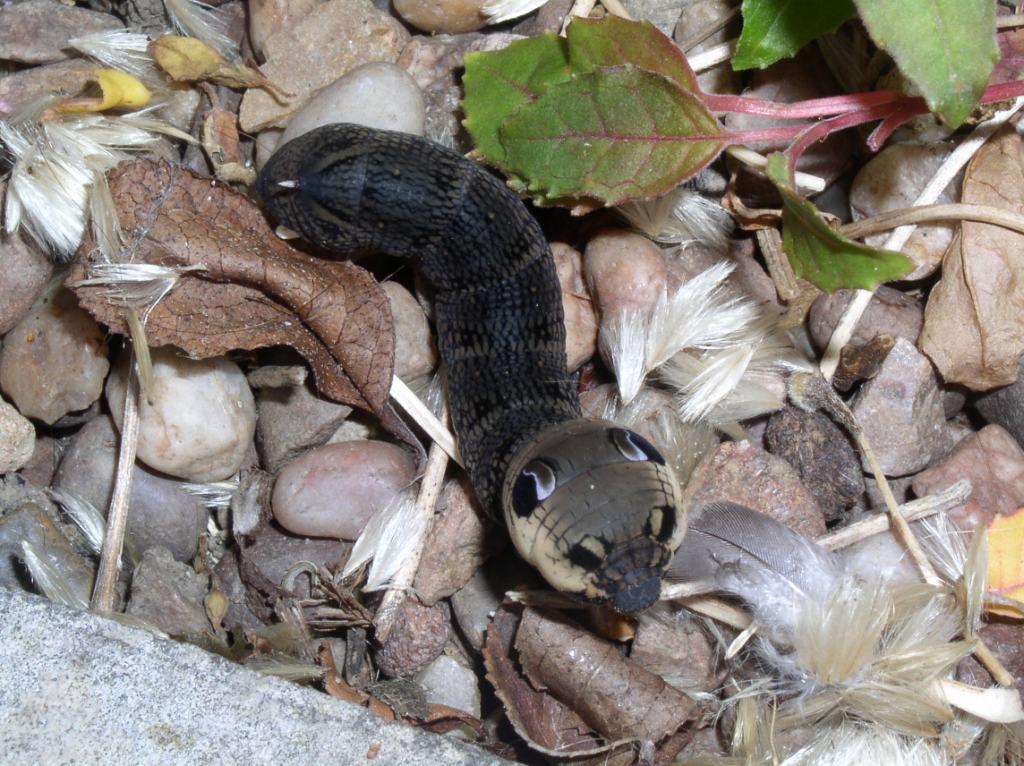
Mimicry using eyespots is widespread in nature - they are found in fish (such as the four-eyed butterflyfish Chaetodon capistratus which has them on the tail, so predators attack a non-lethal area or miss entirely), mammals (not only the 'obvious' ones such as leopards, but also the serval Leptailurus serval which has them on the backs of its ears for signalling to kittens while hunting), reptiles, birds and insects. Within the insects, butterflies and moths are probably best-known - many adult butterflies and moths have eyespots on the wings (the result of concentric pigment location around morphogenetic focus points), while the larva of the elephant hawkmoth Deilephila elpenor is famous for its conspicuous eye-like spots towards the head which are used to startle predators such as birds.

Elephant hawkmoth larva Deilephila elpenor showing eyespots
However, there are other invertebrates that show evidence of eyespots. I've previously written about bug (Hemiptera) nymphs possibly mimicing harvestmen, and today I noticed another - the common European garden spider Araneus diadematus. This is a very familiar species, often found on its orb-shaped web in gardens, and known for the pale cross-shaped marking (made from guanine which is a by-product of its protein metabolism) on the normally yellowish, orange or brown background of the top of the bulbous abdomen in females. Other common names include 'cross spider' and 'cross orbweaver', and males are smaller and less striking, though the markings are broadly similar.

Female Araneus diadematus showing the typical abdominal colour and cross-shaped marking

Male Araneus diadematus
So far, so good - but what about the eyespots I've mentioned. Well, the spiders are generally found either in the middle of their webs as shown above or tucked away in refuges at the ends of suspension silk lines. On webs they are typically head down and seen side on, either dorsally or ventrally. However, if you look stright down from the rear, a different pattern can be seen.

Female Araneus diadematus showing abdominal eyespots
To me, this is clear eyespot mimicry and makes adaptive sense - usually being head down, the rear of the abdomen is the part most likely to be presented to potential predators, namely birds, and therefore where eyespots that could startle them would be most useful. What I find more surprising is that I've never noticed this before despite having seen many specimens; more so that I can't find any other reports which suggests no-one else has either (or at least they written about it on the 'net). As ever, comments welcome!

Monday, 27 August 2012

Bubble-butts and water-walkers

It's about a month since we lined and filled our garden pond and it took less than 24 hours for the first invertebrates to find and colonise it (they were small Hydrellia flies which formed a breeding swarm within 48 hours). Since then, things have moved on - as covered in a recent post, dragonflies and damselflies have already found it, the large water mint (Mentha aquatica) is proving very popular with nectar-feeders, and a common frog (Rana temporaria) has taken up residence at one end.However, I want to look at a couple of other pond residents - beetles and bugs (that's the Hemiptera or 'true bugs' rather than bugs in the general sense...).
A water beetle Rhantus suturalis on bare new pond-liner - its breathing air-bubble is visible at its rear.
The largest beetle currently present is Rhantus suturalis (photo above) which as about 12mm long excluding appendages - note the 'smudged' dark mark on the centre of the pronotum. This is probably the most widespread water beetle worldwide, being found from northern Britain to New Zealand (Foster & Friday 2011). It tends to be associated with stagnant water in lowland areas, often in newly created or polluted situations - our pond is neither stagnant nor polluted but is certainly new and this beetle appeared within about a week, possibly transferred with water plants. This specimen seems to spend much of its time hiding under the bridge over our pond, but is also seen regularly swimming rapidly around the pond, including visits to the surface where it exposed its rear to replenish the air bubble used for breathing.There are some other small dark water beetles which I have yet to capture and identify (I'm tempted not to disturb the pond much at this early stage), but also beetle larvae.

Beetle larva in side view
Beetle larva in dorsal view

Again, I haven't identified this larva (yet) though it does look like Rhantus, maybe a smallish early stage - time will tell, but there are several which can be seen swimming actively to and from the surface. Meanwhile, up on the surface, taking advantage of surface tension to allow propulsion, pondskaters of the genus Gerris, probably the common pondskater G. lacustris, hunt for prey items that fall into (or rather, onto) the water. This species is well known as an early coloniser of new ponds (Denton 2007) and can be seen skating rapidly towards potential prey which is then pierced with the tubular mouthparts.

A pondskater Gerris lacustris, an early coloniser of new ponds
As well as predation, I have witnessed both reproduction (copulation) and aggression between Gerris. The latter appears to be as a result of encounters between males (some are territorial, actively courting approaching females) which are brief, in the form of immediate attack and retreat. Females also hold territories based on food supply. The sexes signal to each other by making ripples with the legs and abdomen, the frequency indication whether the sender is male or female. Males then judge which it is and act accordingly with 'courtship' or 'repel' signals, though they are not always correct (Savage 1989)!

So, although the pond is unlikely to mature that much more before next spring when the first full plant-growing season starts, an aquatic community is beginning to develop and will undoubtedly feature here from time to time as interesting species and behaviour catch my eye.

'Til then, if you'd like more info about creating a wildlife-friendly garden pond, why not download an advice booklet here (from the excellent Pond Conservation).

References

Denton, J. (2007). Water Bugs and Water Beetles of Surrey. Surrey Wildlife Trust, Woking.
Foster, G.N. & Friday, L.E. (2012). Keys to the adults of water beetles of Britain and Ireland (Part 1) (2nd ed.). Handbooks for the Identification of British Insects 4(5): i-iv, 1-144.
Savage, A.A. (1989). Adults of the British Aquatic Hemiptera Heteroptera. A Key with Ecological Notes. FBA, Ambleside.

Monday, 30 July 2012

Ants as farmers, aphids in the slow lane

If you grow soft fruit such as currants or gooseberries, you are probably familiar with the sight of numerous aphids densely clustered around the stems, making the leaves wrinkled and deformed. You may also be aware that some ant species 'farm' aphids in order to consume the sugar-rich 'honeydew' that they excrete. However, this is a complex behaviour and so is worth a closer look.

A colony of Aphis schneideri on black-currant Ribes nigrum, attended by black garden ants Lasius niger
First of all, there are numerous aphid species that are found on cultivated fruits, and they can be difficult to tell apart. Those in the photo above are on black-currant Ribes nigrum - within the Ribes-feeding group, only one species has long, acute, erect to semi-erect hairs on the antennae (especially near the base), and that is what is seen here, Aphis schneideri (I couldn't get a clear photo of the antennal hairs, so you'll have to trust me on that). A. schneideri is also commonly associated with R. nigrum, causing clusters of terminal leaves to fold and distort, and the aphids are grey-green, with paler legs and often with a scattered coating of small pale waxy particles.

The ants seen attending the aphids here are the common black garden ant Lasius niger. Not all colonies of L. niger do this, although when it occurs, there is mutual benefit - the ants obtain sugar-rich honeydew and in turn protect the aphids from predators. So far, all straightforward, but exactly how the ants do this was not understood until a few years ago. It has been known for some time that, in order to ensure a dense crop of aphids, ants limit their dispersal (aphids otherwise disperse to new plants when overcrowded, the production of winged forms being triggered by the frequency of contacts between individuals) by biting off their wings (Kunkel 1973) or by secretions from the ants' mandibular glands interfering with the development of winged aphids (Kleinjan & Mittler 1975). Conversely, ants have been seen carrying aphids to suitable, good-quality host plants within their nest's home range. However, aphids also disperse by wandering (which may be more prevalent than dispersal by flying) and some decades ago, both Banks & Nixon (1958) and El Ziady (1960) noticed that the presence of ants seemed to slow aphids down, but no further research was undertaken until Oliver et al. (2007).

Ants are known to lay 'semiochemical' trails by touching glands onto the surface of their substrate, and these chemical marks can lead others from their nest sources of food (Hölldobler & Wilson 1990). Such chemicals can also be applied passively through shedding of cuticular hydrocarbons and this is important recognising nest-mates and, possibly, home-range territories (Devigne & Detrain 2002). Moreover, other insects, including herbivores and aphid predators, have  been found to respond to chemicals that indicate the presence of ants (Offenberg 2004). However, Oliver et al. (2007) found that these ant chemicals had a tranquilising effect on aphids, causing them to walk more slowly and thus - as with the other effects noted above - maintain higher densities which provide the ants with more honeydew.

Although ants have been seen deterring aphid predators such as ladybirds, this does not mean that the mutualistic arrangement is entirely positive for the aphids. Their manipulation by ants means that their dispersal is reduced (or at least delayed) which may have impacts on the wider population (or 'metapopulation') and increase competition between closely packed individuals. Also, dense aggregations may be repeatedly attacked, and sometimes wiped out, by specialist parasitoids which are able to evade ants, such as the small parasitic wasp Lysiphlebus cardui (Weisser & Völkl 1997). Lastly, ants are occasionally seen eating aphids and it appears that this primarily occurs when individual aphids are encountered away from the aggregation. Not only would this prevent aphids being used for the benefit of rival neighbouring ant nests, but presumably produces an evolutionary pressure to 'obey' ant chemical cues rather than be able to avoid the tranquilising effect.

A Lasius niger individual at a colony of Aphis schneideri

So, definitely a more complex story than it initially seemed (isn't it always!), but also a more interesting one, and something you may be able to witness in your own garden. If you are interested in identifying aphids, a standard work covering British Aphidini (the 'tribe' including the genus Aphis) is Stroyan (1984), but be warned - this is not an easy group to identify to species level, and the separation of some species can be uncertain.

References

Banks, C.J. & Nixon, H.L. (1958). Effects of the ant, Lasius niger L., on the feeding and excretion of the bean aphid, Aphis fabae Scop. Journal of Experimental Biology 35: 703-711.
Collins, C.M. & Leather, S.R. (200). Ant-mediated dispersal of the black willow aphid Pterocomma salicis L.; does the ant Lasius niger L. judge aphid-host quality? Ecological Entomology 27: 238-241.  
Devigne, C. & Detrain, C. (2002). Collective exploration and area marking in the ant Lasius niger. Insectes Sociaux 49: 357-362.
El Ziady, S. (1960). Further effects of Lasius niger L. on Aphis fabae Scopoli. Proceedings of the Royal Entomological Society A 35: 30-38.
Hölldobler, B. & Wilson, E.O. (1990). The Ants. Harvard University Press, Cambridge, MA.
Kleinjan, J.E. & Mittler, T.E. (1975). A chemical influence of ants in wing development in aphids. Entomologia Experimentalis et Applicata 18: 384-388. 
Kunkel, H. (1973). Die Kotagabe der Aphiden (Aphidina, Hemiptera) unter Einfluss von Ameisen. Bonner Zoologische Beiträge 24: 105-121.
Offenberg, J. (2004). Evidence that insect herbivores are deterred by ant pheromones. Proceedings of the Royal Society B 271: S433-S435.
Oliver, T.H., Mashanova, A., Cook, J.M., Leather, S.R & Jansen, V.A.A. (2007). Ant semiochemicals limit apterous aphid dispersal. Proceedings of the Royal Society B: Biological Sciences 274: 3127-3131.
Stroyan, H.L.G. (1984). Aphids - Pterocommatinae and Aphidinae (Aphidini). Homoptera, Aphididae. Handbooks for the Identification of British Insects 2(6): 1-232.
Weisser, W.W. & Völkl, W. (1997). Dispersal in the aphid parasitoid, Lysiphlebus cardui (Marshall) (Hym., Aphidiidae). Journal of Applied Entomology 121: 23-28.

Monday, 28 May 2012

Small, spiny and very very hungry

It must be the time of year, but after writing about a Platycheirus hoverfly larva, I found another one - a different genus, but the overall form and fused posterior respiratory processes (PRPs) make it clearly a hoverfly (Syrphidae); larvae of some other fly families such as the Pipunculidae have PRPs that appear fused, but a close look reveals they are not.

Dorsal view of the hoverfly larva - about 10mm long and the head end is bottom left.
This is quite different to the smooth, 'maggoty' Platycheirus larva with its yellow-green lines of fat. Here, small bumps and spines can be seen on the top and sides plus lots of little black speckles (see below). The PRPs are a pale brown colour and the dark line down the middle is the long thin 'heart' which could be clearly seen pumping while I took this shot. Referring as ever to Rotheray (1993), the features soon brough me to two possible genera, either Scaeva or Eupeodes (previously known at Metasyrphus). Let's look a little more closely...

PRPs and posterior clasper of Eupeodes luniger

Close-up of PRPs and posterior clasper of E. luniger. The green polygon outlines the clasper and the red lines follow the directions of the lower pair of spiracles, showing that they diverge strongly.

The photo legends give the game away - it's Eupeodes luniger - but let's consider why. Firstly, the top photo of the PRPs (themselves within a roughtly triangular surround) shows that the black patches are made of tiny dark spines or 'spicules' - something that separates Eupeodes from Scaeva. Most Eupeodes are found on conifers, but two are commonly associated with ground layer vegetation - E. corollae and E. luniger. The larvae of these (as with Platycheirus they are aphid predators) are fairly similar, but can be separated by looking carefully at the spiracles - the slit-like openings of the PRPs. In corollae the lower pair are almost parallel, but in luniger, as here in the lower photo, they diverge strongly. The clasper is also typical of Eupeodes and, as shown clearly in Rotheray (2003), is used to grip the edges of leaves or thin stems (here it is gripping a thin wooden spatula being used to position it under the microscope). This is a surprisingly unusual adaptation in hoverfly larvae many of which do sometimes fall off leaves as they can not easily grip them and have to rely on the surface tension created by moisture on leaves; some exude saliva just ahead of themselves and use this to grip (Rotheray & Gilbert 2011). The locomotory structures of Eupeodes are also known to be complex (besides the presence of a clasper) and the photo below hopefully gives some indication of the folding and creasing that forms the prolegs and associated structures on the underside of the larva. Though migratory, both E. luniger and corollae are common in a range of habitats in Britain, and their similarity to Scaeva remains when adult. This specimen, as before, has now been released into our garden to feed on aphids. More soon!

The complex prolegs and locomotory growths on the underside of Eupeodes

References

Rotheray, G.E. (1993). Colour guide to hoverfly larvae (Diptera, Syrphidae). Dipterists Digest 9: 1-156.
Rotheray, G.E. (2003). Aphid Predators. Richmond, Slough.
Rotheray, G.E. & Gilbert, F. (2011). The Natural History of Hoverflies. Forrest Text, Tresaith.

Friday, 25 May 2012

Miniscule mummification

Following yesterday's post about aphid-feeding hoverfly larvae, I went out into the garden and found evidence of another aphid-bothering insect - the empty skin or 'mummy' of an aphid stuck to the underside of a sycamore leaf by a domed silken cocoon on which it lies. The whole arrangement is only about 2mm long so it was tricky to get good photos even under the microscope due to the white structures tending to overexpose, but this is what I managed...

Aphid 'mummy' attached to a silken cocoon
There are numerous parasites of aphids (technically 'parasitoids' as they develop inside them) and one key group is the aphidiiine wasps (subfamily Aphidiinae within the Braconidae), tiny wasps that lay eggs directly into living aphids. Some, such as the genus Aphidius, produce larvae that cut their way out of the abdomen leaving an empty aphid with a neat lid. However this arrangement - an aphid 'mummy' atop a domed silken cocoon containing pupa/e (the larvae will have fed on the aphid internally) - is typical of the genus Praon.

Aphid mummy attached to the top of a Praon cocoon - the developing Praon have left the aphid and have pupated beneath it.
When a Praon adult leaves the cocoon it cuts a small hole through which to exit, but the photo above shows the cocoon to be intact and skirt-like with the developing wasp/s inside. It is impossible to identify further at this stage, although P. volucre is a common species - however, I have retained the leaf and cocoon and hope to raise at least one adult for identification - I'll be looking out for a tiny black wasp with orange-yellow legs: another often-overlooked gardeners' friend!

Thursday, 24 May 2012

Great hovering maggots

When collecting brambles to feed our stick-insects, small invertebrates on them often end up indoors as stowaways. As the bramble leaves are destined to be rapidly eaten, I tend to put the invertebrates back outside - recently I've unexpectedly found moths, aphids, a parasitic bee, small spiders, barklice and others. Some of these get out of the stick-insects' containers and wander about the place. So, I wasn't too surprised this morning when I saw something wiggling its way across the lid. The pointed head end with a dark point and pulsing legless 'maggoty' movement made it clear this was a fly larva - in particular a hoverfly (Syrphidae).

Hoverfly larva, the head end is at the bottom of the photo
Being a bug-nerd, before putting it back outdoors, I decided to take a closer look to see if I could identify it. Using the standard work by Rotheray (1993), it is clearly not Microdon (which is domed in shape and has a band of bristles aruond the edge of the body), but does have a colour pattern. It's not green (though the fat deposits are a yellow-green colour), nor does it have dorsal projections, although there is some dorsal striping. The next step is to look at the 'posterior respiratory projections' (PRPs) at the rear end.

Rear end of the hoverfly larva showing PRPs with pale bases and about as wide as long.
The larva is somewhat flat and so 'subrectangular' rather than square-ish in cross-section, and has dorsal stripes merged smoothly at the head end - these features indicate that it is in the genus Platycheirus.

Head end of Platycheirus larva showing the point where dorsal stripes meet smoothly
Platycheirus larvae are associated broadly with low or ground-layer vegetation and feed on aphids - definitely popular with knowledgeable gardeners! However, the ecological and biological details of Platycheirus larvae, including differences in feeding strategies between species, are poorly understood. This does not have clear chevrons of fat so is probably in the fulviventris group, although not P. fulviventris itself as this is associated with wetland monocots rather than hedgerow brambles. Consulting Stubbs & Falk (2002), fulviventris is in the clypeatus group and it may well be the common and widespread P. clypeatus although the only way to be certain would be to raise it to adulthood and the habitat is more suited to another common species P. albimanus although this falls outside the fulviventris and clypeatus groups. Fortunately for the larva, it is back outside on aphid-laden bramble in our garden.

Dorsal view of the Platycheirus larva showing the dark gut between patches of fat

References

Rotheray, G.E. (1993). Colour guide to hoverfly larvae (Diptera, Syrphidae). Dipterists Digest 9: 1-156.
Stubbs, A.E. & Falk, S.J. (2002). British Hoverflies. BENHS, Reading.

Friday, 27 April 2012

Who you gonna gall?

If you are interested in plant galls, you'll know how important it is to correctly identify the host plant as there is often a high degree of specificity between the gall host and the gall causer which makes identification a lot easier. It's not always that straightforward however, as I discovered when I found galls on the leaves of a Mountain (or Alpine) Currant Ribes alpinum.

Galls on a leaf of Ribes alpinum
These are clearly true galls as the red patches are swollen rather than simply being discoloured, and looking Redfern & Shirley (2011) - the standard work on British galls - there are few options on Ribes. In fact, the key quickly moves to an answer, both caused by aphids of the genus Cryptomyzus:

  • On redcurrant R. rubrum, galls caused by C. ribis which are yellow-green in colour.
  • On R. alpinum, galls caused by C. korschelti which are pink, orange or reddish.
The plant ID is definitely correct (a known specimen confirmed by an experienced botanist), so it looks like C. korschelti, but it's important to check carefully, so let's see the aphids themselves.

Aphids on the underside of an R. alpinum leaf

Close-up of an aphid on the underside of an R. alpinum leaf
By now you should have seen the difficulty - this is a yellow-green aphid, but this implies the aphids are C. ribis which are not, according to Redfern & Shirley (2011), found on R. alpinum. However, rather than having found a new species, I thought it was more likely that this is R. ribis on an unusual (for the UK) host. However, having consulted with an aphid specialist (thanks Fiona!), not only is it unusual to find Cryptomyzus on the underside of the leaf rather than inside the galls, but the galls themselves are too swollen. So, let's look even more closely...

Siphons (or 'cornicles') at the rear of the aphid's abdomen
Cornicles are an important way to separate some aphid species, and these are broadly swollen with a slightly widened rim at the end (this isn't very clear in the photo, but it is there), the whole being approximately bottle-shaped. In Cryptomyzus, the cornicles are narrower - this is a different genus. Without going into too much detail here, it turns out that (thanks again Fiona) it is in the genus Hyperomyzus, specifically H. lactucae. This is rarely recorded in Britain (though this doesn't necessarily mean it is rare, just that not many people look or can identify them), but it has been found here before and is known from Ribes in continental Europe.

Many galls are not well understood and minor discoveries like this can be made quite readily if care is taken to look, especially given that R. alpinum is not especially common in the UK and probably poorly studied. The lack of readily accessible/affordable identification guides (Blackman & Eastop's 2006 2-volume opus was needed for this species, but is not cheap) makes aphid study more difficult (plus some genera are taxonomically confusing and really require genetic analysis and/or research), but as I found, there are specialists who are ready to help and it's always worth asking. Now to let the authors of the gall key know what I've found, then check whether H. lactucae has been recorded in Hampshire before...

References

Blackman, R.L. & Eastop, V.F. (2006). Aphids on the World's Herbaceous Plants and Shrubs. (2 vols.). Wiley, Chichester.
Redfern, M. & Shirley, P. (2011). British Plant Galls (2nd ed.). FSC, Shrewsbury.