Welcome

Welcome to my blog

This is where I post various musings about wildlife and ecology, observations of interesting species (often invertebrates)
and bits of research that grab my attention. As well as blogging, I undertake professional ecological & wildlife surveys
covering invertebrates, plants, birds, reptiles, amphibians and some mammals, plus habitat assessment and management
advice
. I don't work on planning applications/for developers. The pages on the right will tell you more about my work,
main interests and key projects, and you can follow my academic work here.
Showing posts with label birds. Show all posts

Monday, 29 September 2014

Floodplain meadows are the new amenity

Our local playing fields are, ecologically speaking, not much more than a green desert - heavily 'improved' amenity grassland with barely a 'weed' in sight. Or at least they were until last winter's ongoing storms caused a local river to burst its banks.

February 2014 - playing fields underwater.
The fields are part of a floodplain and are below the level of the surrounding river channels, some of which have been built up and were used as canals decades ago. The floods seem to have surprised a lot of people, though I'm never really sure why the term 'floodplain' isn't seen as self-explanatory. Anyhow, not all the local residents minded...

A colony of black-headed gulls soon moved in to use the unplanned wetland - other species such as mute swans were also regularly seen.
The fields are also a popular dog-walking location - the shallow 'lagoon' soon became a well-used destination for humans-and-canines as well as avians.
The water persisted for some months but of course dried up when warm weather came. After a hot summer, the ground flora was looking very different to the near-monoculture present only a year ago.

Tall herbs such as fleabanes competing with the grasses.
Meadow plants such as butterbur are already abundant.
Now, I appreciate that leisure is a valid use for playing fields, but this wetted area covers a minority of the total area and the site's use for football and rugby continues unaffected. The newly floral patch is not only popular with invertebrates, but also with walkers (with or without dogs) as a path has been mown around the edge. I hope that it will be left to develop as a 'wild' patch rather than being mown back to amenity grassland status as the leisure-wildlife balance seems excellent currently, but time will tell.

Monday, 28 July 2014

Nest of tiny delights

Wow - a month since my last post - there has been no shortage of wildlife to write about, just no 'spare' time to do the writing. However, the paid stuff is quiet for a few days at least, so I thought I'd share some observations of the small and hidden, to be precise what I found lurking within a used-and-the-young-fledged robin's nest.

The robin's nest before dismantling.
You never know what'll be hiding in a nest (whether bird or mammal) - there's always the possibility of some under-recorded parasites, plus the array of small invertebrates that simply use the structure as their own. So, a white tray, various tweezers and pins and some time later, this is what I found, along with quite a few Collembola (springtails) and Psocoptera (barklice) which I didn't collect on this occasion as I knew I would have time to work through the identification.

One of three similar pupae a few mm long, currently in my hatchery.
Another pupa, also a few mm long.
A very young spiderling, highly active and I think one of the wolf spiders (Lycosidae)
A tiny dead wasp, probably one of the Pteromalidae, possibly predated by a spider.
The exuvia (skin) of, well, I'm not sure...

Alive and active, the larva of what is probably a 'carpet beetle' (Dermestidae).
So, not much in the way of definite identifications - with juvenile stages, that tends to be difficult, though if any are successfully raised to adulthood, I will as ever update the post. Also, no parasites, but there was good evidence of a thriving community of small invertebrates potentially living out their whole life cycle in the structure of the nest with larvae, pupae, evidence of emergence, predators and prey.

Sunday, 29 December 2013

Highlights of 2013

December's been a quiet month on the blogging front - a large beetle project is ongoing (status review of the UK Chrysomelidae) and then of course the whole festive-season-thing. However, there was a proper summer this year with an extended period of hot dry weather extending into a mild autumn, and this meant some fine invertebrate (and other) sightings after some truly awful, cool, wet summers. The most spectacular (for me as they were all personal firsts) were probably three Lepidoptera finds between July and September - two butterflies, a monarch (Danaus plexippus) and long-tailed blue (Lampides boeticus) and a moth, the Clifden nonpareil (Catocala fraxini). The monarch is a North American species, and although some have been known to cross the Atlantic, it is more likely that this (and one from a nearby friend's garden) had escaped from a butterfly farm, maybe on the Isle of Wight. Certainly there was a small flurry of records of this species in southern England, aided by the fact that monarchs in the UK often visit gardens to seek their foodplant, milkweed (Asclepias syriaca) which is of course also non-native. The other two are scarce migrants seen in higher-than-usual numbers due to the favourable conditions this year. Being native to NE Europe, the Clifden nonpareil is more often seen on the eastern coasts of Britain, but my sighting was in Hampshire, about 10km inland where one large and unmistakable adult was seen basking on warm brickwork near scrub including its foodplants - aspens and other poplars (Populus spp.). Also a rare migrant, the long-tailed blue can be found on various Fabaceae such as everlasting-peas (Lathyrus spp.) and brooms (Cytisus spp.) - as a Mediterranean resident, it's not often seen in this country. I'll stop there, but if you'd like an affordable and user-friendly guide to European butterflies, one of my favourites is Haahtela et al. (2011). More to come from me in 2014, but until then, here are some pics from 2013...

A flock/mob of jackdaws in spring, as seen from my study window.
Adult female smooth newt in our garden pond.
A leaf beetle larva and its defensive shield of faeces and shed skins.
And finally, just to prove that I do go out and do ecology in the field, here I am taking great created newt eDNA samples at Claylands Nature Reserve, Hampshire.

Reference

Haahtela, T., Saarinen, K., Ojalainen, P. & Aarnio, H. (2011). Butterflies of Britain and Europe: A Photographic Guide. A & C Black, London.

Monday, 4 November 2013

No clouds, no rain, no cold, November

This title of this post may well be inaccurate by tomorrow, but for now - in this part of Britain at least - it is warm, dry and sunny. More importantly, it has remained warm apart from a couple of cold nights and dry apart from a few days of stormy rain for much of the autumn. This of course affects our wildlife. For example, a 'proper' hot, dry summer after several cool, wet ones has seen butterfly populations bounce back to some extent, and this is likely to be helped by a long warm autumn. Undoubtedly, migratory birds will have done better than in previous years, being able to find more food for there long autumn flight, and hibernating species will have a better chance of storing enough energy for the winter. Personal observations also bear this out - garden birds are not using our feeders so much as they have been (though I have seen plenty of birds around) - presumably there is still plenty of wild food available.

This year our strawberry plants have fruited into November - some wild plants will be doing the same
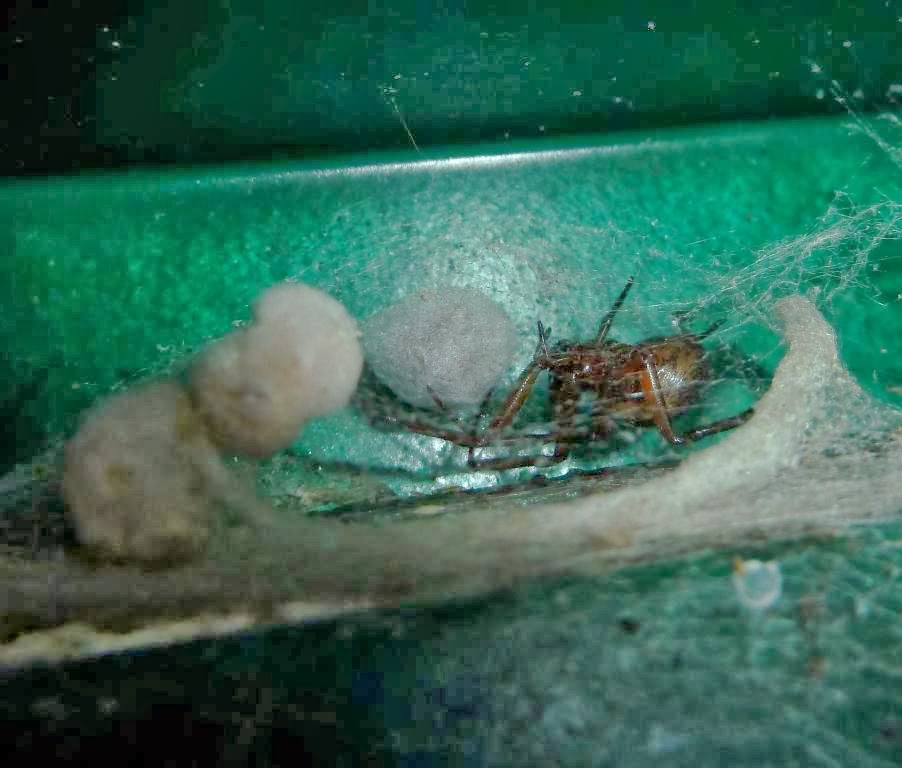
A long season of favourable conditions means that breeding/reproduction can go on for longer with 'extra' broods possibly being squeezed in before winter. I have seen late jackdaw broods in chimney-pots nearby, but on a smaller scale, the female Steatoda nobilis false widow spider (one of the species associated with tabloids' recent scaremongering) that lives in our garden storage box has another brood which she guards closely.

Female Steatoda nobilis guarding her egg-sac - two old sacs remain showing that this is the third brood in this sheltered location.


 Of course, it is autumn - leaves are turning yellow and falling - and it has been damp recently, so Fungi are also appearing to remind us that this is not simply an extension of summer. There are 'toadstool' or mushroom-types of Fungi, but personally I am drawn to the smaller species (as I am with invertebrates), some of which have appeared, almost overnight, on some of our garden woodwork...
 
The common species Coral Spot Nectria cinnabarina - associated with dead wood, here it is on a batten forming part of a garden shed
A small species on hardwood garden shelving - I haven't yet identified it but it look a little like an oysterling (Crepidotus sp.)
So, just a few observations about this autumn, but they do give a flavour of how the current and recent conditions affect the wildlife we see - hope you enjoy whatever you are watching out for!

Tuesday, 2 July 2013

Robins good

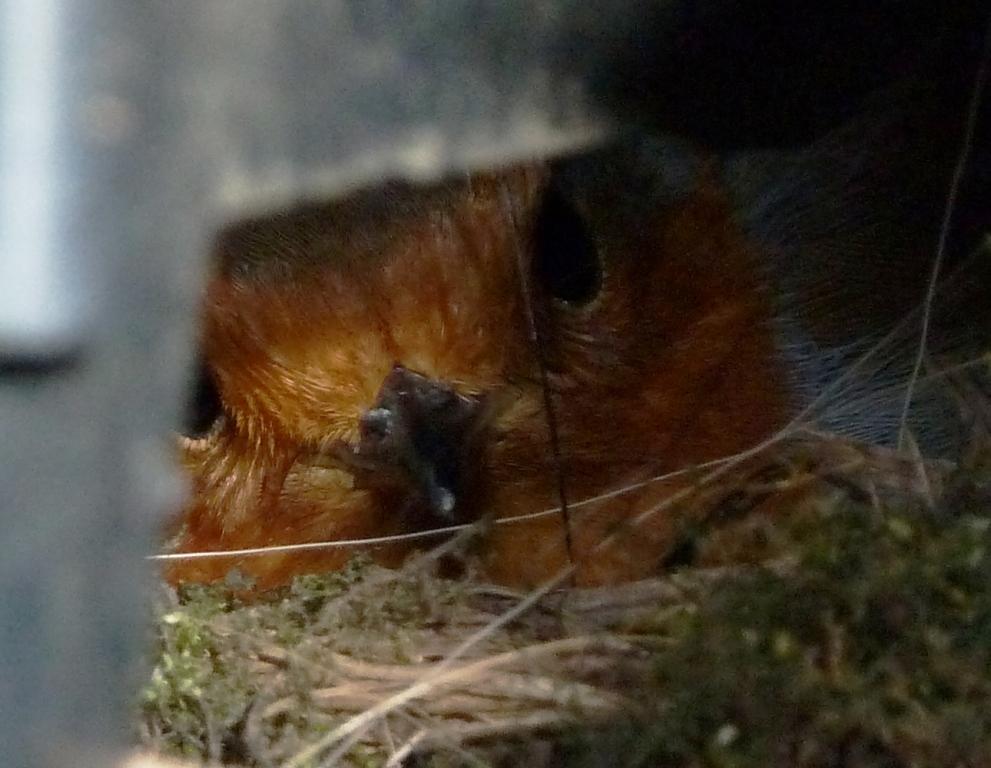
About a year ago, I wrote about a thrush nest hidden away on our community farm. As it is a wildlife-friendly enterprise, it wasn't too surprising when we found another nest recently - this time a robin (Erithacus rubecula) tucked away in our plant-pot storage area. Obviously, disturbance is a sensitive issue (I covered this in my previous post) and although the birds had chosen to nest in a location with a lot of human activity, we wanted them to experience as little stress as possible. So, a few photos were taken quickly, then a sign erected to ensure no-one tried to take pots from that part of the store. This was the outcome.

Robin nestlings, one gaping to elicit feeding.
An adult robin incubating the hatched brood.

After fledging, one infertile/addled egg remains unhatched.
Although there was concern that the nest had been abandoned, this seems unlikely. There was no evidence of dead young, nor of the nest having been disturbed by a predator. Also, a couple of young robins have been noted nearby, so the evidence is strong that this was a successful nest, hopefully helped by a little care from the surrounding humans!

Monday, 18 February 2013

Tiny denizens of the rot-hole

What with winter keeping most invertebrates out of sight, it's been a while since I wrote much of an entomological nature, but yesterday was a fine opportunity to head up to Beacon Hill nature reserve to see what was about. As well as chalk grassland (which will be more interesting when in flower), there is an interesting stand of beech woodland and associated scrub, including an ecologically important resource of dead wood (standing and fallen) and old mossy trees.

The base of a mossy beech tree.
These features mean that there is habitat for many fungi and dead-wood invertebrates and the evidence is everywhere - beetle boreholes (some opened by woodpeckers, one of which could be heard clearly in the woodland), wood in various stages of decay, insect-feeding birds such as a treecreeper (Certhia familiaris) and an intriguing-looking rot-hole with a large fungus and a tuft of hair poking out of it...

Rot-hole with fungus and tuft of hair
Looking inside, it had been lined with moss and hair, and was clearly a nest or roost of some sort, either of a bird or small mammal, and the fungus is (I think) an oyster mushroom Pleurotus ostreatus - if any mycologists would like to correct me on this, please do!

The inside of the rot-hole; at the base of the fungus, a layer of moss-and-hair bedding.
So, sample-pot in hand (like any good ecologist!), I took a pinch of the mossy bedding, including some soil/decayed wood from directly beneath it - after all, there are plenty of under-recorded parasites that live in vertebrate nests and you never know what you'll find. Back home, it was time to check what I'd found; some of the small inveretebrates such as Collembola (springtails) hide very effectively in material like this, so I find that adding some water to the sample in a watch-glass causes them to float to the surface and become easier to see. Indeed, doing this brought up a cluster of the common springtail Ceratophysella bengtssoni which can sometimes be found in large aggregations on the surface of soil and puddles, but may well still have been hibernating given the cold night-time temperatures at present.

Several Ceratophysella bengtssoni from the nest sample
These weren't the only springtails - Lepidocyrtus cyaneus and Neanura muscorum were also present, as was Tomocerus vulgaris from mossy dead-wood of a nearby tree. The samples included quite a few empty moulted skins, suggesting that these are not solely hibernation sites, but places where active feeding and growth occur - unsurprising as they mainly feed on fungal hyphae and decaying plant material (no shortage in this sample location). They are also an excellent group to look for in the winter as they can be found throughout the year - if you are interested in the UK species, Hopkin (2007) is an excellent place to start. However, Collembola are not the only soil/leaf-litter animals to be found. Hidden among the tangle of hair (mainly sheep I think) and plant fibres were two shed skins of an oribatid soil mite.

The shed skin of an oribatid soil mite
Oribatids are beyond my identification skills (I don't even know anyone who can ID them, though I do have a go at halacarids occasionally), but the shiny bulbous shape, the pointed mouthparts and the leg attachment points are all visible here. Though poorly known outside the realm of specialists, these mites are important in the decay process, feeding on a wide range of plant, animal and fungal organic material, with a minority being predatory - in fact they break down and process soil material in a similar way to earthworms even if they aren't as familiar or well-understood/studied.

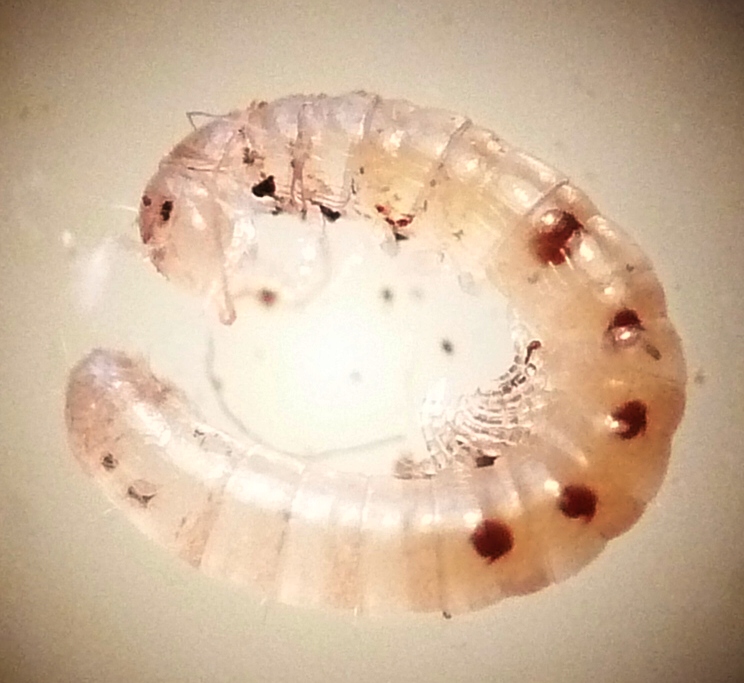
Another species, common if often over-looked, and mainly found under bark or logs in woodland is the spotted snake millipede Blaniulus guttulatus. It is often considred a pest (e.g. in allotments) but probably only enters crops when damage has already occurred, such as by a 'primary' pest or some other mechanical means. They grow to around 20mm in length and are white with rows of red spots along the sides. The specimen I found however was a juvenile no more than about 3mm long (with few segments/spots), and the first early stage I've seen of this species.

Juvenile Blaniulus guttulatus
So, a few interesting finds - common species (no idea about the oribatid) but indicative of the small and often un-noticed soil/dead-wood fauna. Interestingly there were no mammal/bird nest-dwelling species (such as ticks or fleas), and no indication of exactly what had been using the hole - however, the presence of fine hairs and small dark elongate faeces, plus a lack of even small feathers suggest a mammal, presumably a rodent, rather than a bird.

Reference

Hopkin, S.P. (2007). A Key to the Collembola (Springtails) of Britain and Ireland. FSC, Shrewsbury.

Saturday, 9 February 2013

Flit, flutter and flirt

Today it may be cold, grey and sleeting, but yesterday was clear and sunny, and provided me with the opportunity to watch the 'spring-is-coming' behaviour of a pair of familiar garden birds - blue tits (Parus caeruleus, sometimes put in the genus Cyanistes). There have been blue tits around throughout the winter, making good use of feeding opportunities (I am their 'food monkey'), but they have been doing little more (as far as I can tell) than feeding, hiding/roosting and basically surviving.

A pair of blue tits investigating our garden
A small, charismatic species, blue tits are well known for their acrobatic feeding habits, but what was particularly noticeable yesterday were bursts of frantic darting and chasing, barely stopping for a second.

After a brief pause, back to darting about...
This is, I can only imagine, mating/flirting behaviour - plenty of species engage in some sort of chasing, and spring is soon due to, well, spring. Also, there were other behaviours, including female fluttering which echoes the food-soliciting movements of juveniles, and male calling which seems likely to be a precursor to more strictly territorial singing.

A fluttering female
A calling/singing male
Punctuating the more obvious flirting there were periods of feeding which may be somewhat ritualised, where one or both would pick at parts of the fence and perform various feats of acrobatics. Maybe I'm anthropomorphising a bit, but at times it did look as if one was hiding while the other fed (or pretended to) and then chased it - repeat until pair-bonded?

Busy feeding (or feeding-like) behaviour
That's all from me for now - less technical, more illustrated than my usual posts, but all kinds of topics are in the pipeline...

Thursday, 3 January 2013

Get some nyger inside ya

It's time for the first post of the new year, and my attention was grabbed this morning by the activity on our garden nyger seed feeder. It sees a lot of goldfinch activity most days, but among the colourful flits and flights were a couple of less brightly plumaged finches - redpolls.

Goldfinches on the nyger seed feeder, plus a redpoll (arrowed) nearby.
Redpoll taxonomy has changed over the last few years, but this is a common redpoll (Carduelis flammea) and not a species I've seen in our garden before. Redpolls tend to move around a lot, rarely staying in one place for long, so I was lucky to spot them (there were two but they were never close enough to appear in the same photo). This is also true of another recent 'garden first', a brambling seen a few weeks ago.

A brambling on nyger seed.
These are all species known to favour small seed such as nyger (or without kindly humans, teasels and the like) - however redpoll and brambling are not common visitors to urban gardens, so I have to wonder if the poor, very wet summer conditions have led to a low yield of seed in their native foodplants. If so, they may rely on feeders more than usual and be back, and I'll also keep an eye out for another potential visitor - the siskin.

Tuesday, 20 November 2012

No seeds, no fruit, no fungi - November!

It's been an odd year in the UK (and elsewhere) - an unusually warm early spring, then a cold, wet early spring and summer and a very variable autumn with frosts and warm periods. Unsurprisingly, this has seriously impacted some of the UK's wildlife negatively. For example, the Big Butterfly Count found declines in many common species, with 11 of the 21 target species decreasing in abundance by more than a third since 2011. There are a number of reasons - low temperatures clearly affect cold-blooded groups such as insects, which in turn reduces the food available for insectivores such as birds and bats. Plant growth is also affected by cold and water-logging, so less sugar is produced, fruit growth is reduced (and what does grow may be affected by moulds and blights and fall early or rot on the plant), leading to less seed production - bad for plant reproduction and seed-feeders such as many winter birds. This is already having visible effects as more unusual species appear in gardens - so, it is even more important to keep bird-feeders full. Poor fruit/seed growth in Scandinavia has already meant that at least a couple of thousand waxwings have flow across the North Sea to NE Britain. There are also less obvious effects. For example, the reduced sugar production means that ectomycorrhizal (externally root-associated) fungi grow poorly despite the damp conditions.

However, not all is doom and gloom. Some species have taken advantage of warm late summer and autumn temperatures to grow and breed - I have certainly seen late bird-nesting activity, and while in south Devon last week (the SW is the warmest part of the country), while some trees were losing their leaves, others were budding as seen here.

Hazel coming into bud in mid-November in south Devon
Late flowering has provided at least some extended nectar availability (apart from ivy which is always a winter source) as seen here where a small Panurgus calcaratus bee is feeding on a yellow composite flower, again in mid-November. Found in a band across SE England it is also known all round the SW coast as you can see on the map here; clearly a species needing warm temperatures as it is absent further north.

Panurgus calcaratus feeding on a yellow composite flower in warm sunny mid-November conditions in south Devon
Warm damp autumn weather has meant that some fungi have done well eventually, such as those living on damp deadwood and leaf-litter, while in our new garden pond, the pond-skaters have bred very successfully and are highly active. Slugs and snails have also had an excellent year, though this is not popular with gardeners and allotment-holders, not to mention those of us with old houses that have little holes where slugs can gain access in the middkle of the night...

Overall, there are sadly probably more wildlife losers than winners, but what does the future hold? Well, nothing is certain, but an important study by Overland et al. (2012) does give some indications. Firstly, as many people have suggested, it isn't just 2012 when the summer has been cold and wet - this is a pattern that seems to have begun in 2007 when there was what appears to be a sustained shift in early summer Arctic winds. This change is linked to increased North American atmospheric blocking which ultimately leads to the southward movement of the jet stream that has been mentioned in TV weather forecasts. The study also looked at why this has happened and has unsurprisingly concluded that climate change is a likely candidate - in particular the melting of Arctic ice (particularly around Greenland, remembering that Greenland is politically European but geographically North American) which highlights the potential connectivity between Arctic climate and mid-latitude weather i.e. the Arctic heats up, the UK gets bad summers.

This is of course an ongoing story - research is undoubtedly ongoing to finesse some of the findings and explanations. As an academic, I find this fascinating but as someone interested in wildlife and environmental issues, I also find it deeply troubling, especially when the UK government seems to be trying to pull back from its low-carbon committments. However, I'll stop there lest the Ecology Spot becomes my political ranting zone!

Reference

Overland, J. E., Francis, J. A., Hanna, E. & Wang, M. (2012). The recent shift in early summer Arctic atmospheric circulation, Geophysical Research Letters 39, L19804 (6pp.)

Friday, 19 October 2012

Teaching the peanut pirate

A fairly quick observation today... as a wildlife-friendly gardener, I put out bird-food, including peanuts for blue tits and other species. However, birds don't read the labels explaining which food is allocated to which group of species and hence piracy is rife - not that I might - they all have to eat... Anyhow, this morning, I couldn't help notice even more jackdaw (Corvus monedula) activity than usual - given the large jackdaw roosts near here, there's almost always some - in particular a group on our garden fence. Among the usual bickering and squabbling, there was a calmer group of three which appeared to be a pair of adults (black, glossy) with a fledged youngster (some pale feather edges, scruffy neck, less assured behaviour).

A probable family group of jackdaws using a peanut feeder
The adults were feeding - and ejecting other birds that tried to do so - while the youngster watched (or in the above photo got distracted by something off to the right...). In any case, the lesson seemed to work because a couple of minutes later, the adults were perched nearby and the youngster was feeding.

Young jackdaw feeding on peanuts
A simple behavioural observation, but interesting to see in action - so, before I get carried away by the urge to anthropomorphise, I'll stop there - there's much written about the adaptability and learning abilities of corvids, including in one of my early posts here. Enjoy!

A beady-eyed jackdaw in our garden

Wednesday, 20 June 2012

Uninvited guests in the nest

Having recently described the unexpected discovery of an occupied song thrush nest and the subsequent successful fledging of the chicks, being a bug-nerd at heart, I felt the need to have a closer look at the nest itself once it was no longer in use to see if any small invertebrates lay within... However, this isn't just random nosiness - there are many parasites that live in the nests of birds and mammals, and it's also the type of place where overlooked species may be found - after all, not that many people are likely to check. So, white tray in hand I began to sift...

The first species to popout was a barklouse or psocid (Psocoptera). This group contains many small species that are associated with bark, dry plant material and so on. I won't go into too much detail here, but the specimen was about 1.5 - 2mm long, variably brown with yellow and brown markings on the head, and the wings held like a shallow roof over the abdomen. Helpfully (as these tiny creatures can be tricky), the forewings also had a pattern of spots that indicated the genus Ectopsocus. As it happens, this pattern is quite strongly diagnostic and as you can see below, the spots are at the end of the wing veins and extend along them so are about twice as long as wide. This provides an identification as E. petersi - an interesting find as it is probably under-recorded, having previously been placed in the 'E. briggsi' group of similar species. However, if any psocid specialists are aware of further taxonomic changes, please do let me know.

Forewing of Ectopsocus petersi
The second species was about the same size (1.5 - 2mm), but quite different in structure - as well as the prominent bristles, it also had a relatively large ventral spring joined to the rear of the abdomen - clearly a springtail (Collembola).The blue-grey colour, which I admit was clearer in the specimen than the photos below), and other features of the ocelli, bristles and spring, plus a dark spot between the antennal bases, suggest that it is Entomobrya lanuginosa (E. myrmecophilus is associated with ants, rare and with longer bristles, while Willowsia have leaf-shaped scales rather than the covering of bristles). This is usually coastal, but inland sites are known, and a bird nest seems perfectly reasonable for a species that can be found in dry, sheltered locations.

Entomobrya lanuginosa
Close-up of Entomobrya lanuginosa
So, an urge to investigate, and a bit of work, turned up a couple of unexpected species. Possibly not as immediately engaging as nestlings becoming fledgelings (though, my bug-nerdiness means I do like them pretty much equally), but as always, species records are valuable, especially for under-recorded taxa.

References

Hopkin, S.P. (2007). A Key to the Collembola (Springtails) of Britain and Ireland. FSC, Shrewsbury. The current standard work for UK species - excellent.
New, T.R. (2005). Psocids: Psocoptera (booklice and barklice) (2nd ed.). Handbooks for the Identification of British Insects 1(7): i-iv, 1-146. Also the current standard work for UK species - also excellent.

Sunday, 10 June 2012

Chicks are best in a well-dressed nest

A few months ago, I built a new riddling table (essentially a mobile soil sieve on legs) for our local community farm - the soil is very stony and it's a good way of making a fine tilth or lump-free compost. It wasn't going to be needed much over winter, so was stored under some polythene sheeting and next to a thick hedgerow to keep the weather off until required. However, when the cover was removed a few weeks ago, there was a surprise - a bird's nest complete with four pale blue, slightly speckly eggs. The cover was quickly replaced and a notice sent round to let everyone know that the table couldn't used for a while. Even without looking at the eggs it was clear that it belonged to a pair of song thrushes (Turdus philomelos) as the parents could soon be seen attending it. A week or two later, I revisited the nest to check its progress.

Song thrush nest with 3 nestlings
As you can see, there were 3 nestlings - still bald with their eyes closed. The nest is on a shallowly sloping  wooden platform (used to funnel sieved soil into a wheelbarrow) underneath the sieving tray - you can see one of its wheels at the back - with the whole structure covered in polythene - an excellent hideaway. Song thrushes usually build their nests in trees and shrubs, typically near the trunk around 1-4m up, though they can sometimes be found in buildings, on the ground, on stumps and fallen branches or in hollows among creepers. Whatever the precise location, they tend to be in shady, well-hidden places in or near woodland or hedgerows, and this artificial construction suited their needs very well.

Song thrush nestlings - some downiness has already appeared with a few feather shafts just beginning to develop
These were the only photos I took as I didn't want to visit the nest for longer than required to obtain enough information to make a useful record. Such records, if obtained carefully, provide valuable information about the breeding success of many species and in the UK, the BTO's Nest Record Scheme uses volunteers to follow the progress of nests, providing training where required. With the bad old days of egg collecting largely behind us (though some illegal collecting still occurs), a Code of Conduct needs to be followed when recording nests. Much of this is common sense (don't visit more often than necessary, limit the amount of disturbance caused and try to approach the nest when it is unattended) but some aspects are less obvious.

For example, it is widely believed that visiting a nest will increase the probability of the clutch failing. However, reviews of research into nesting success (Götmark 1992, Mayer-Gross et al. 1997) indicate that this is not the case, if the Code of Conduct guidelines are followed. Examples of some other less obvious actions that need to be taken are as follows (for a full list, see the Code):

  • In case parent birds are watching, approach nests casually, as if by chance, rather than directly and deliberately - you are then likely to be seen as harmless (like a passing herbivore) rather than a potential nest predator.
  • Adults are most sensitive to disturbance at the start of the breeding attempt, during egg laying and very early in the incubation period - it these times, they have invested less energy in the nesting attempt and have more time to lay a replacement clutch.
  • Conversely, the parents become less sensitive of disturbance as the nesting attempt continues, but the chicks’ become more aware, and when partially feathered, the young of some species may instinctively scatter from the nest, a process known a ‘exploding’. This is adaptive when a real predator raids a nest is it gives a chance of survival for at least part of the brood, but once out of the nest the chicks are vulnerable to cold and to ground predators. Also, don't forget that chicks can only legally be handled by licensed bird ringers.

Here, the nest was unattended, the adults past the period of maximum senstivity and the chicks still too young to scatter - the perfect time to visit. After this, the adults could be seen bringing food to the nest and all three nestlings were seen to fledge. Once it was clear that the nest was no longer in use (young stay in the nest for 12-16 days), it was removed for closer inspection.

Song thrush nest after the chicks had fledged
The nest, built by the female (though both parents feed the young) is made of a woven circle of small twigs, leaves, grass, roots, moss and string surrounding a smooth cup of papier-mache made from rotten wood-pulp (sometimes mud is used). Close up, it really is an impressive structure - neatly woven and well camouflaged (or would be in a tree), and the inner cup thin, light and neatly smoothed. Although the young are very similar to those of the mistle thrush (T. viscivorus), as are the nests and breeding times, the nest structure is clearly different with the mistle thrush making a bulkier cup of plant material with soil mixed into it and lining it with finer grass.

If you want to know more about how to identify nests, eggs and nestlings, Harrison & Castell's 2002 guide is excellent, but do take care as noted above, and if possible join the Nest Record Scheme; information about breeding success is vital for well-informed conservation.

References

Götmark, F. (1992). The effects of investigator disturbance on nesting birds. Current Ornithology 9: 63-104.
Harrison, C. & Castell, P. (2002). Bird Nests, Eggs and Nestlings of of Britain & Europe with North Africa and the Middle East (rev. ed.). HarperCollins, London.
Mayer-Gross, H., Crick, H.Q.P. & Greenwood, J.J.D. (1997). The effect of observers visiting the nests of passerines: an experimental study. Bird Study 44: 53-65.

Wednesday, 9 May 2012

Making the summer

You may have heard the old adage, 'one swallow doesn't make a summer', but what about 300 or more? Given the exceptionally wet weather recently (following a dry winter and an unusually hot early spring leading to drought), the feeling that summer might be coming is certainly a pleasant one, even though objectively the rain is welcome in farms and gardens. So, while spending the weekend at Downton for the Cuckoo Fair, although I'd been seeing small numbers for a few weeks, it was good to see a more sizeable flock of swallows (Hirundo rustica) that had just arrived...


There were about 300 in total and as you can see, when this video was taken (at about 11:00) they were mostly feeding low over the River Avon with some skimming low over the fields - traditional grazed pastures favoured by swallows. By the afternoon and evening, their feeding behaviour had changed - they were flying higher and were not following the river; instead they were moving more widely over the fields, occasionally shifting en masse as a loose flock, presumably following the patterns of movement of their insect prey.

Filming these birds with their rapid, darting flight isn't too difficult (as long as it's just a broad view that you want), but photography is another matter - group shots aren't too tricky, but focusing on individuals is another matter, hence the blurriness, though it is possible to pick out the blue head and the white flashes on the underside of the tail.

Swallows feeding over the River Avon, Downton, Wiltshire
Swallows performing close aerial passes...
Within this flock of swallows, there were a few other birds that looked different - one (black rather than blue, with a white rump-patch) was the house martin (Delichon urbicum) several of which could be found away from the main swallow flock in a nearby field. Another was smaller, fairly uniform on top, with a pale underside and dark throat-collar - the sand martin (Riparia riparia) which is also associated with this low-over-water feeding behaviour.
Among the chaos of the swallow flock, one of the three sand martins seen - and the best photo I could manage!
As well as heralding summer in the UK, migratory species such as these can be excelllent (if sometimes worrying) indicators of environmental conditions. Wintering in southern Africa, Britain's swallows face a long and hazardous journey, with perils including starvation, exhaustion and death in storms. The precise routes have not always been clear, but tracking technology has provided useful data and we now know that some cross the Sahara while others follow the west coast or fly up the Nile Valley. Rather than gaining much weight prior to migration, swallows find food en route (they fly by day and at low altitude), progressing around 200 miles (320km) each day.

It's long been known that annual weather fluctuations affect swallow populations - a cold, wet breeding season reduces insect numbers and hence chicks starve - but there are longer-term trends with populations having fallen across Europe since around 1970. Although the precise causes are uncertain, there are a number of likely reasons for this:

  • The effects of climate change on swallows' African wintering grounds and migration routes. Certainly,  swallows are returning to their breeding grounds in poorer condition and laying fewer eggs than was previously the case. One factor seems likely to be the expansion of the Sahara desert,  making this already major barrier increasingly difficult to cross.
  • The effects of climate change in Europe. Cold springs (including late frosts) reduce insect numbers. Similarly, very hot, dry summers cause pools to dry out, also reducing insect numbers, and as well as the risk of starvation, chicks die from heat exhaustion and dehydration.
  • Land use changes across Europe may be reducing the numbers of nest sites and flying insects. Swallows tend to forage over grazed pastures (as seen at Downton), and the loss of cattle grazing has impacted on swallows in some areas.
So, there are clear concerns about swallow populations (as there are about many other migratory species) and solid evidence for population declines even if some of the causes are not fully understood. It is also a good example of the difference between 'weather' and 'climate' - in very simple terms, climate can be seen as 'average weather'. However, if you have outbuildings (garage, barn, workshop etc), there are some things you can do to encourage swallows to nest - they like to nest on dark ledges and in nooks and crannies, as these stay warm in cold weather and cool in hot weather. They can enter buildings via surprisinly small holes and need very little light (dark areas are at less risk from predators) - my favourite swallow nesting site is at Monkey World Ape Rescue Centre in Dorset where swallows nest high up inside one of the Chimpanzee viewing galleries, darting between visitors as they fly to and from the nest. To encourage swallows to nest in an outbuilding, the following should help:
  • Make a small opening (minimum 50 mm high & 70 mm wide), under the eaves or simply leave a window or door open if security is not an issue
  • Attach a nest platform where you would like them to be - high up, out of the reach of cats. Use flat pieces of wood to make an open-fronted box (the front should be tilted slightly upwards or have a low lip to stop the nest falling out - robin nest-box designs are sometimes used), or if you are feeling more creative, attach a sawdust-and-cement or papier-mache cup to a wooden backing plate. Block off places where you don't want the birds to nest.
  • Put a plastic bag below the nest to catch droppings 
  • If the weather is very hot, put an old carpet or blanket on the outside of the roof above the nest and soak it regularly with water. A couple of buckets of bathwater on such material takes several hours to dry and helps keep the temperature down inside the outbuilding.
Now, I think I've spotted a suitable nesting spot, so I'm off to rummage through my timber store to make a box. If it works, watch this space for nest photos! Until then...

Even swallows have to rest sometimes..