Welcome

Welcome to my blog

This is where I post various musings about wildlife and ecology, observations of interesting species (often invertebrates)
and bits of research that grab my attention. As well as blogging, I undertake professional ecological & wildlife surveys
covering invertebrates, plants, birds, reptiles, amphibians and some mammals, plus habitat assessment and management
advice
. I don't work on planning applications/for developers. The pages on the right will tell you more about my work,
main interests and key projects, and you can follow my academic work here.
Showing posts with label Odonata. Show all posts

Saturday, 25 April 2015

In spring the pond goes sproing

After a long, cold early spring, the last couple of weeks have been warm, dry and sunny - and the season has leapt at the opportunity. Butterflies are flying, birds are nest-building, bees are pollinating. All good things. As a microcosm of this rapid seasonal burst of activity the denizens of our garden pond have been distracting me from computer-based tapping and drawing me out to sit by and watch, camera in hand. Our pond's not huge, but a lot of care was taken to ensure variety of structure (and thus habitat) - here are a few of the occupants taking advantage of it.

The fly Elgiva cucularia. It is a member of the family Sciomyzidae that specialise in hunting snails - of which we have plenty. This species is associated with boggy conditions and I have recorded it several times on our pond vegetation, so the shallow, algae filled section is clearly doing its job.
A Large Red Damselfly Pyrrhosoma nymphula posing obligingly on my finger.
One of at least six smooth newts living in our pond. This shot was taken with a waterproof endoscope which I'm still new at using.
Some of this year's batch of frogspawn.
Two pond snails busily engaged in making more snails. The whitish structure top-right is indeed a snail penis AKA 'love-dart'.

Thursday, 26 June 2014

Little soft machine

It's been hot and sunny lately and lots of people have been watching damselflies and dragonflies, including the species that visit garden ponds. One of these is the large red damselfly Pyrrhosoma nymphula and I'd recently seen nymphs, adults and exuviae (empty skins) in and around our pond. However, I hadn't expected to see this when inspecting an exuvium attached to the emergent leaf of a water-soldier plant - a very freshly emerged, pale and soft ('teneral') adult.

Teneral P. nymphula with its exuvium
Teneral P. nymphula showing the pale colour and hardening wings.
 This is a risky time for the damselfly - it is soft, unable to fly and prone to predation. The legs will have hardened first to allow it to grip the plant and leave the evuvium (you can see they are already patterned). Body fluids are then pumped into the wings to expand them from their crumpled wing-bud shape. As you can see, that has happened here and the fluid's colour is the reason for the faint greenish tinge they have. The fluids are them pumped into the abdomen to expand it and give the body its shape. If the wings or body are impeded they may harden in the wrong shape, meaning the damselfly either dies or is unable to fly (and so starves and/or can't find a mate). Even a heavy (relatively speaking) insect can make holes in the wing membrane, as can raindrops. The damselfly's only real defence is to stay hidden - when I got close it quickly flipped behind the leaf to hide itself. As the leaf is spiny and I didn't want it to damage itself, I kept out of the way after these couple of photos were taken.

If all goes well, within an hour, the adult has dried and is likely to disperse once the flight muscles are warm. Sexual maturity may take a few days during which they stay away from aggressive mature males. After this, they join the great mating game!

Portrait of a mature P. nymphula

Sunday, 11 August 2013

Dead dragons

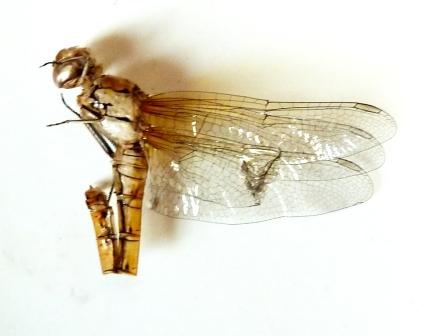
After a bit of a break, time to return to the Spot, and with another garden pond update... So far this year, I have counted 11 skins (exuviae) of common darter dragonflies (Sympetrum striolatum) that have emerged from our pond. I've only seen a few of the resulting adults, most appear to have left, presumably to find mates, but one did not get far and was found dead in the water. I don't know what happened (it appears to be hollow so scavengers were there before me I imagine), but it does provide an opportunity to look at some fine structure without killing a specimen.

The dead Sympetrum striolatum - note the fully extended wings and broken abdomen. Also, the colour has either faded aftre death, or was not fully developed.

A close-up of the abdominal segments - the last few are missing, exposing internal structures. Note the tiny teeth around the rear edge of each segment which presumably aid closure against the adjacent segment and/or membrane.

Wings clearly showing the veins and pleating, as well as basal structure and the small amount of basal yellowing/darkening.

The head showing the large compound eyes and small antennae (bottom-right, jutting forwards).

Side view of the thorax - when alive, the large white patches are yellow. Spiracles are visible, such as the elongate hole by the base of the wing.
I have not gone into much detail here - it should however provide a starting point for investigating your own specimens (after all, by far the best way!) - also, as with exuviae, specimens like this can be kept as long as needed and then passed onto others interested in investigating insect anatomy (which is what has happened to the exuviae I collected).

Finally, here are my personal 'top three' useful (and not too expensive) books covering identification of British and continental European dragonflies:

Brooks, S. (2004). Field Guide to the Dragonflies and Damselflies of Great Britain and Ireland (4th ed.). BWP, Gillingham.
Dijkstra, K.-D. B. (2006). Field Guide to the Dragonflies of Britain and Europe. BWP, Gillingham.
Smallshire, D. & Swash, A. (2004). Britain's Dragonflies. WILDGuides, Old Basing

Friday, 19 July 2013

Counting skins

As stated in Corbet & Brooks (2008), when looking at Odonata (dragonflies and damselflies), the 'value of the exuvia as a tool for quantitative ecological studies cannot be overstated'. This is because, in Britain at least, most species can be identified from their exuviae (moulted skins) which show where and, depending on the fequency of recorder visits, when an adult emerged, even if the adult is never seen. This is how, despite only seeing single adults, I know that 11 common darters (Sympetrum striolatum) have emerged from our garden pond even though it is only a year old and around 3m x 1.5m in size. The exuviae are easy to find and count - as the photo here shows, they can be clustered closely together and may be on even very short emergent vegetation.

6 of the 11 Sympetrum striolatum exuviae found in our garden pond (red rings) plus one more nymph just below the surface (blue ring)

Exuviae also provide an excellent way of investigating juvenile Odonata morphology as the key nymphal features can be readily seen without needing to capture a specimen. Several dragonfly identification guides include sections on exuviae, but if you want to look at this aspect in detail, I recommend Cham (2007 & 2009) which are not expensive (and are now available as a single volume).

References


Cham, S. (2007). Field Guide to the Larvae and Exuviae of British Dragonflies. Volume 1: Dragonflies (Anisoptera). BDS, Peterborough.
Cham, S. (2009). Field Guide to the Larvae and Exuviae of British Dragonflies. Volume 2: Damselflies (Zygoptera). BDS, Peterborough.
Corbet, P. & Brooks, S. (2008). Dragonflies. Collins, London.

Thursday, 9 May 2013

Peering at pond predators

As our garden pond develops, so does the community of invertebrates that live within it - and this of course means predation. Predators come in all shapes and sizes, from tiny water mites to herons. One vertebrate predator is a neighbour's cat (which does not like being sprayed with water!); another is the smooth newt Lissotriton vulgaris. Our pond currently has a pair of these, so we will be looking out for eggs - they are also voracious predators of frog tadpoles (of which there are many) and one was seen yesterday taking a tadpole as prey.

Female smooth newt Lissotriton vulgaris
Other predators are smaller (in the absence of fish which are likely to devour/reduce the biodiversity of a garden pond) in the form of various invertebrates. Some of these are familiar and commonly seen, such as the pond-skater Gerris lacustris (there are other species, but this one is often an early coloniser of newly created ponds). Being a true bug (Hemiptera), it has piercing mouthparts (which curve back under the head) and can be seen skating on the surface held up by surface tension. Pond skaters can move quickly when disturbed or darting towards prey such as smaller invertebrates that have fallen onto the water's surface. Their feet and legs dimple the surface and the large middle pair of legs push backwards, creating a pressure wave that allows the insect to glide forwards (e.g. Guthrie 1989).

Pond skater Gerris lacustris. The dimples in the water's surface are clearly visible - also note that this specimen is fully winged; spring dispersal flights are an important part of this species' life history.
Lastly, a quick look at a group well known as predators in their juvenile form - the Odonata - dragonflies and damselflies. There are several small early-instar nymphs of the Large Red Damselfly Pyrrhosoma nymphula in our pond, but also a late/final-instar nymph as shown below. Although often lurking in sediment (this one was underneath an aquatic plant pot/basket), they can swim actively, have excellent vision and of course hinged mouthparts (the 'mask') which can be quickly thrust forwards to grab prey. Nymphs of the Odonata will attack many types of prey - not only other invertebrates, but also amphibians, especially small/juvenile individuals. It is likely that our large population of frog tadpoles may start to be reduced soon...

Late-instar nymph of the Large Red Damselfly Pyrrhosoma nymphula. The partly darkened caudal lamellae at the tip of the abdomen can be seen, plus the bulges and central indent at the back of the head - these features are useful for identification.
Late-instar nymph of the Large Red Damselfly Pyrrhosoma nymphula. The large eyes, useful for locating prey, are shown - the jawed 'mask' is retracted beneath the front of the head.

Reference

Guthrie, M. (1989). Animals of the Surface Film. Richmond, Slough.

Tuesday, 23 April 2013

Pondnet diary day 1

Pondnet is a new Pond Conservation volunteer survey aiming to identify trends in pond quality and associated species. I was recently allocated a pond in Milkmead Copse in Hampshire's Itchen Valley Country Park, and now spring's arrived, I decided that today was a good opportunity to make my first visit to the site.

The pond in Milkmead Copse
It was good to see some frogspawn had survived the cold conditions as there were at least a couple of hundred recently hatched tadpoles, plus one adult newt. However, something else (yup, an invertebrate) caught my eye - a water scorpion (Nepa cinerea) that came to the surface.
Water scorpion, Nepa cinerea
This is a predatory true bug (Hemiptera) and the raptorial (hunting) front legs used to grip prey are clearly visible, plus the breathing tube at the rear. Although this appears to be a single thin tube, it is actually formed from two halves (they separate if a specimen is dried) - air flows from it along two grooves which have small water-repellent hairs and the spiracles open into these grooves (Denton, 2007). Being a bug, it has piercing/sucking mouthparts rather than the jaws/mandibles seen in beetles. It is a large insect by UK standards at around 20mm in length, excluding appendages. It is an active hunter, taking small fish and various other invertebrates. However, I was surprised to see it tackle a larger (approx 25mm) dragonfly nymph, itself an active and powerful predator.

N. cinerea attacking a dragonfly numph.
N. cinerea on the back of the dragonfly nymph
This is not behaviour I've seen before and the nymph struggled for a few minutes before managing to dislodge its attacker by dragging it against a piece of vegetation. Presumably the position of N. cinerea allowed it to pierce the nymph while remaining out of direct reach. Certainly, the water scorpion swam away after this encounter and the nymph came back to the surface. I'm not 100% sure which species it is as it is coated in silt which obscures key features. However, the size, head shape and silty coating are typical of the black-tailed skimmer (Orthetrum cancellatum) so that is my identification for now.

Dragonfly nymph, possibly Orthetrum cancellatum, the black-tailed skimmer. Note the hairs on the legs and body, coated in silt.

The same dragonfly nymph - note the protruding eyes and the 'mask' showing the mandibles.
So, an interesting start to a new survey programme. More to come from the pond!


Reference

Denton, J. (2007). Water Bugs and Water Beetles of Surrey. SWT, Pirbright.

Monday, 27 August 2012

Bubble-butts and water-walkers

It's about a month since we lined and filled our garden pond and it took less than 24 hours for the first invertebrates to find and colonise it (they were small Hydrellia flies which formed a breeding swarm within 48 hours). Since then, things have moved on - as covered in a recent post, dragonflies and damselflies have already found it, the large water mint (Mentha aquatica) is proving very popular with nectar-feeders, and a common frog (Rana temporaria) has taken up residence at one end.However, I want to look at a couple of other pond residents - beetles and bugs (that's the Hemiptera or 'true bugs' rather than bugs in the general sense...).
A water beetle Rhantus suturalis on bare new pond-liner - its breathing air-bubble is visible at its rear.
The largest beetle currently present is Rhantus suturalis (photo above) which as about 12mm long excluding appendages - note the 'smudged' dark mark on the centre of the pronotum. This is probably the most widespread water beetle worldwide, being found from northern Britain to New Zealand (Foster & Friday 2011). It tends to be associated with stagnant water in lowland areas, often in newly created or polluted situations - our pond is neither stagnant nor polluted but is certainly new and this beetle appeared within about a week, possibly transferred with water plants. This specimen seems to spend much of its time hiding under the bridge over our pond, but is also seen regularly swimming rapidly around the pond, including visits to the surface where it exposed its rear to replenish the air bubble used for breathing.There are some other small dark water beetles which I have yet to capture and identify (I'm tempted not to disturb the pond much at this early stage), but also beetle larvae.

Beetle larva in side view
Beetle larva in dorsal view

Again, I haven't identified this larva (yet) though it does look like Rhantus, maybe a smallish early stage - time will tell, but there are several which can be seen swimming actively to and from the surface. Meanwhile, up on the surface, taking advantage of surface tension to allow propulsion, pondskaters of the genus Gerris, probably the common pondskater G. lacustris, hunt for prey items that fall into (or rather, onto) the water. This species is well known as an early coloniser of new ponds (Denton 2007) and can be seen skating rapidly towards potential prey which is then pierced with the tubular mouthparts.

A pondskater Gerris lacustris, an early coloniser of new ponds
As well as predation, I have witnessed both reproduction (copulation) and aggression between Gerris. The latter appears to be as a result of encounters between males (some are territorial, actively courting approaching females) which are brief, in the form of immediate attack and retreat. Females also hold territories based on food supply. The sexes signal to each other by making ripples with the legs and abdomen, the frequency indication whether the sender is male or female. Males then judge which it is and act accordingly with 'courtship' or 'repel' signals, though they are not always correct (Savage 1989)!

So, although the pond is unlikely to mature that much more before next spring when the first full plant-growing season starts, an aquatic community is beginning to develop and will undoubtedly feature here from time to time as interesting species and behaviour catch my eye.

'Til then, if you'd like more info about creating a wildlife-friendly garden pond, why not download an advice booklet here (from the excellent Pond Conservation).

References

Denton, J. (2007). Water Bugs and Water Beetles of Surrey. Surrey Wildlife Trust, Woking.
Foster, G.N. & Friday, L.E. (2012). Keys to the adults of water beetles of Britain and Ireland (Part 1) (2nd ed.). Handbooks for the Identification of British Insects 4(5): i-iv, 1-144.
Savage, A.A. (1989). Adults of the British Aquatic Hemiptera Heteroptera. A Key with Ecological Notes. FBA, Ambleside.

Monday, 20 August 2012

Focusing on the familiar V: dragonflies part I

A few months ago, a reader suggested I took an occasional look at some more familiar species. As my chosen remit is to popularise and familiarise less well-known species, I mused for a bit and then thought 'OK, why not?' which led to a short series on ladybirds. Now I have a garden pond, created and filled just a few weeks ago, and already interesting species are starting to appear, something I've been nattering about on facebook quite a bit. So, it seemed a good time to have a close look at one species in a generally popular group - the dragonflies - in particular the Common Darter Sympetrum striolatum. In Britain, this is probably the most commonly seen smallish red dragonfly (not to be confused with damselflies which are much more spindly), and is one of a number of species in a genus known in North America as 'meadowhawks'.

Male common darter Sympetrum striolatum on water mint.
First of all, its range is huge - from Ireland, Iberia and parts of North Africa eastwards through Europe as far as Japan, with migrations seen which can be huge in number. Like other Sympetrum, only mature males are red and it is these which I will focus on here. Females and immature males are yellowish as is typical for this genus.

The abdomen is almost parallel-sided (just a weak constriction in the front half) unlike others such as the ruddy darter S. sanguineum which has a more distinctively 'club-like' appearance. The abdomen is an orangey rather than deep red, while the sides of the thorax also have clearly yellowish patches (visible in the photo below).

Male common darter Sympetrum striolatum on Buddleia davidii.
As dragonflies can be variable in terms of depth of colour and other abdominal features, it is sometimes necessary to look more closely at the head to separate species in this genus. In S. striolatum, there is a black area above the 'face' running between the eyes, but this does not extend down the inside edge of the eyes (as shown in the photo below), unlike in, for example, S. sanguineum and S. vulgatum (which although common in continental Europe, is only found in southern Britain as a scarce vagrant).

Head of male common darter Sympetrum sanguineum showing limited extent of black facial mark.
So, if you are in Britain and see a red dragonfly of this shape and colour, there's a good chance it will be a male S. striolatum, but do take care as there are other options, and more so if you are on the continent. If you would like to find out more about this and other British and European dragonfly species, I've included a reading list at the bottom of this page - and if you'd like more info about creating a wildlife-friendly garden pond, why not download an advice booklet here (from the excellent Pond Conservation). Enjoy!

Male common darter Sympetrum striolatum surveying our new pond from his perch on water mint

Tuesday, 7 August 2012

Dragon Hunt 2012

Nope, this is not about Harry Potter or video-gaming, so if that's what brought you here, sorry - but do feel free to stay and read on... instead, it's about Hampshire Conservation Volunteers' annual pilgrimage to see the dragonflies in one of the most Odonata-friendly parts of the New Forest.

This year's event which took place last Sunday was of particular interest as it follows an exceptionally wet early to mid-summer in Britain which has led to dire predictions about the fate of many invertebrate species, a topic I've looked at briefly here. Of course, the Odonata (damselflies, demoiselles and dragonflies - all of which are illustrated below) are aquatic as juveniles, and require water to breed as adults, so it is less clear what effect wet conditions might have than, for example, on butterflies. However, with heavy rains come lower-than-average temperatures, so some of the same impacts might be seen in the adults, such as difficulties finding food and mates.

For those not familiar with Odonata, the damselflies and demoiselles (suborder Zygoptera) are slender-bodied and hold their wings closed lengthways at rest, while the dragonflies (infraorder Anisoptera) are more robust 'typical' Odonata and hold their wings open at rest. There is another infraorder of dragonflies, the Epiophlebioptera, but most of these are extinct with just three Asian species currently known (the third was discovered recently in China by Li et al., 2012) - I won't worry about these here, so back to the Dragon Hunt...

Our first stop was Hatchet Pond, a well-known Odonata-watching spot where it is possible to track down some botanical rarities too (more on that another time) and which provided us with good views of familiar species such as Common blue damselfly (with various female colour forms, and both pale-immature and blue-mature males, plus egg-laying behaviour seen) and an Emperor dragonfly patrolling a section of the large pond (it's the largest in the New Forest). However, although we visited a couple of the small nearby ponds as well, the best views of the day - and the most interesting records - were around the nearby stream at Crockford, where one of the first things we noticed (and we were helped by the sunnier-than-forecast conditions) was a number of very active Beautiful demoiselles, including males trying to entice females with a fluttering wing display.

A male (note the claspers at the tip of the abdomen) Beautiful demoiselle Calopteryx virgo.
We also couldn't help but notice a much larger species flying rapidly back and forth along a section of stream, the typical male territorial behaviour of the Golden-ringed dragonfly. The length of stream patrolled depends on the density of males present as they turn back to fly the other way when another male is encountered. Although territories are generally not guarded very vigorously, aggressive encounters between males will sometimes occur when they meet - there were 3 males along this stretch and they did encounter each other more than once. They are especially active during this period of territorial behaviour and hence can be difficult to photograph, but as they occasionally pause on vegetation, patience is generally rewarded.
Golden-ringed dragonfly Cordulegaster boltonii hanging from a twig.
Of the 14 species recorded (the list, including scientific names, is below), one is a rarity in Britain, associated largely with central southern England (though it is widespread in continental Europe), and that is the Southern damselfly. It is found mainly in slow-flowing base-rich ditches and streams in acid heathlands (and also in some of Hampshire's chalk streams, one of which is about 500m from where I live despite being urban-based, lucky me!), and seems to be limited by needing water which is stable in temperature, rarely dropping below 10oC, clearly a potential limitation during winter. However, at Crockford, numerous individuals were seen, including (again, a little patience was required) some that would tolerate a human presence near enough to see the 'mercury' mark that distinguishes it from other blue damselfly species.

Southern damselfly Coenagrion mercuriale showing the identifying 'mercury' mark near the front of the abdomen.
More importantly, active breeding behaviour could be seen - I have witnessed this before in the Southern damselfly, but never in quite such large numbers. The photograph below shows three pairs at different stages of mating. On the left, a pair which is unattached (and may simply be resting on vegetation), on the right, a male has gripped a paler female with his claspers, and at the top, the typical 'mating wheel' arrangement seen during copulation. It's not often an opportunity for a shot like this comes around...

Three pairs of Southern damselfly Coenagrion mercuriale
Of course, it's easy to get a little spoiled and forget that despite the numbers seen during the Dragon Hunt, this is actually a rare species in Britain and is covered by a UK Biodiversity Action Plan as well as being listed in Schedule 5 of the Wildlife & Countryside Act 1991 which prohibits handling without a licence.

Looking at the day's records as a whole, what does it say about the Odonata community in the area we visited? Well, it's only a snapshot, but a fair number of species were seen even though a few that I expected to see were not noted (this doesn't mean they weren't there of course) such as Emerald damselfly (Lestes sponsa) and Red-eyed damselfly (Erythromma najas). On the whole, the blue damselfly species were reasonably abundant along with the darters and skimmers (Libellulidae), but the red damselflies were sparse, as were the large hawker dragonflies (Aeshnidae) with just two Emperor dragonflies and a single Migrant hawker seen. Is this a real effect of poor weather? Well, without a more systematic study, it is of course impossible to tell for certain, but as Corbet & Brooks (2008) note using various examples (and noting the need for targeted study), Odonata are temperature-limited, so it seems likely that some impact might occur. However, volunteer records such as those here can only help to build up a picture of the current status of Britain's Odonata populations.

The day's Dragon List

Azure damselfly (Coenagrion puella)
Beautiful demoiselle (Calopteryx virgo)
Black-tailed skimmer (Orthetrum cancellatum)
Blue-tailed damselfly (Ischnura elegans)
Common blue damselfly (Enallagma cyathigerum)
Common darter (Sympetrum striolatum)
Emperor dragonfly (Anax imperator)
Golden-ringed dragonfly (Cordulegaster boltonii)
Keeled skimmer (Orthetrum coerulescens)
Large red damselfly (Pyrrhosoma nymphula)
Migrant hawker (Aeshna mixta)
Ruddy darter (Sympetrum sanguineum)
Small red damselfly (Ceriagrion tenellum)
Southern damselfly (Coenagrion mercuriale)

More about dragonflies...

If you are interested in identifying the Odonata of Britain and Europe, the following books are all excellent (there are others, but these are my personal favourites):

Brooks, S. (2004). Field Guide to the Dragonflies and Damselflies of Great Britain and Ireland (revised edition). British Wildlife Publishing, Gillingham.
Cham, S. (2007). Field Guide to the Larvae and Exuviae of British Dragonflies. Volume 1: Dragonflies (Anisoptera). British Dragonfly Society, Peterborough.
Cham, S. (2009). Field Guide to the Larvae and Exuviae of British Dragonflies. Volume 2: Damselflies (Zygoptera). British Dragonfly Society, Peterborough.
Dijkstra, K.D. (2006). Field Guide to the Dragonflies of Britain and Europe. British Wildlife Publishing, Gillingham.
Smallshire, D. & Swash, A. (2004). Britain's Dragonflies. WildGuides, Old Basing.

...and the New Forest

Brock, P.D. (2011). A Photographic Guide to Insects of the New Forest and Surrounding Area. Pisces, Newbury.
Tubbs, C.R.. (2001). The New Forest: History, Ecology & Conservation. (2nd ed.). New Forest Ninth Centenary Trust, Lyndhurst.

References

Corbet, P. & Brooks, S. (2008). Dragonflies. HarperCollins, London.
Li, J.-K., Nel, A., Zhang, X.-P., Fleck, G., Gao, M.-X., Lin, L. & Zhou, J. (2012). A third species of the relict family Epiophlebiidae discovered in China (Odonata: Epiproctophora). Systematic Entomology 37(2): 408-412.

Sunday, 25 March 2012

Diary of a farm pond: March 2012

It's been a while since I posted an update about the development of the farm pond at our local community farm project at Highbridge in Hampshire, southern England. Originally a left-over from gravel extraction, the pond has been extended and serves a dual purpose as both wildlife habitat and a source of water for irrigation. As southern England is currently experiencing a period of drought, balancing these functions will be an ongoing concern...

As a 'working pond', one key characteristic has been disturbance, especially recently as part sof the banks have been re-profiled and landscaped to prevent the sides collapsing (there's a track running along one edge), and to make it easier to access the pump when water is needed for irrigation. So, at first glance, the pond currently looks a bit sparse.


The farm pond following re-landscaping. The irrigation pump and piping can be seen to the left.
However, there's more going on than this first picture suggests. The foreground is the area that has been re-landscaped and has therefore been largely returned to 'stage one' as far as species colonisation goes. However, in the background you can see the small reedbed which has not been affected by recent works.

A slightly different viewing angle reveals more marginal vegetation.
As well as the reedbed, this photo shows that there is still marginal vegetation - this extends up the bank to the right which is gravelly and has a variety of common wildflower species along with some rough grassland and small fruit and nut trees planted as part of the community farm. Last summer this showed considerable invertebrate activity, and I expect it will be the same this year. The pond itself supported various species including several dragonflies and damselflies, plus several fly species, whirligig beetles (Gyrinus) and frogs. It is inevitable that some overwintering larvae, pupae or adults will have been affected by pond works, but hopefully this will be minimal. Despite the unusually warm weather (around 20degC for the last couple of days), it is still very early for most invertebrates to be active, although there were numerous Gyrinus, plus the spring cranefly Tipula vernalis. I shall of course be looking out for the appearance of other species, including some of the less popular groups I began searching for at the site last year (such as springtails AKA Collenbola) and updates will appear here.

Pied Wagtail Motacilla alba, one of a pair using the margins of the pond in warm weather.

Thursday, 18 August 2011

I've got my hooks in you: damselflies and the wheel of life

Instead of one of my usual forays into the morphology and taxonomy of some of our more obscure invertebrate friends, today I've decided to look at the reproduction of a species in one of the more popular and familiar groups, the damselflies (Odonata: Zygoptera), namely the Blue-tailed Damselfly Ischnura elegans, often known as the Common Bluetail outside the UK.

A typical I. elegans showing the black abdomen with blue 'tail-light'
This is one of the commonest damselfly species in Britain and can be found throughout the mainland. It tends to colonise new ponds quickly and is tolerant of pollution and brackish conditions to some extent. Given how some of our freshwater habitats are treated, this may be one reason why it is doing well. However, the identification, distribution and ecology of this species are well documented in the references given below as well as online. Instead, I would like to focus on just one aspect of this species' biology, namely reproduction, and in particular the behaviour and reproductive structures of the adults.

In both males and females, the primary genitalia are located beneath the 8th abdominal segment (near the end of the abdomen). However, males are unique among insect groups in also having secondary genitalia - these are found under the 2nd abdominal segment and consist of a pair of lateral hooks (called 'hamules') plus, usually hidden away in an opening, a flexible penis - more of that later. The presence of these secondary genitalia is the reason why the Odonata are the only insect group to adopt the characteristic 'wheel' position during copulation.

A pair of I. elegans in the wheel position - the male is on top.
Before mating, the male passes a spermatophore (sperm-packet) from his primary to his secondary genitalia. Once this is done, and a suitable female has been located, he grasps her on the pronotum (the top of the thorax just behind the head) using claspers at the end of his abdomen. These claspers have tiny teeth to ensure a tight grip and are shaped to fit onto contours, grooves and notches on the female's head and pronotum. This is not always a gentle process as the hooked appendages have been known to leave females with scarred eyes (Brooks 2004). Once the female has been grasped, the male tries to induce copulation by swinging his abdomen (with the female) forwards to bring her genitalia in contact with his secondary set where the spermatophore is now located. Once this occurs, the wheel position is formed.

This is the starting point for what can be a long copulation - an average of 324 minutes according to a study of I. elegans in southern France (Miller 1987) which is much longer than for most other Odonata. It is unclear exactly why this is the case, although it may be a form of mate-guarding, preventing other males from mating with the same female (Corbet & Brooks 2008).This is important because there is another form of competition between males - sperm competition. This occurs when, during much of the early part of copulation, the penis (which is flexible and tipped with hooked appendages) is used to remove sperm from any male that previously mated with the same female. Only then does the male introduce his own spermatophore. I have seen mating wheels on may occasions in a range of species, however I have not often seen the structures involved in any detail.
The same pair immediately post-copulation - note the male's white secondary genitalia near the base of his abdomen.
The secondary genitalia in close-up. Although rather blurred at this magnification, the hooked appendages are visible.
In the above photo, little detail can be seen, although it is still a rarely captured view. However, for some amazing hi-res detail in a Scanning Electron Microscope image, have a look at the picture in the Science Photo Library here. This is also of I. elegans and clearly shows the hooks used in sperm competition. It also makes me jealous of their microscope.

And so, as far as copulation goes, that's about it... except of course there is a lot more to damselfly reproduction than simply the wheel position. Males have to recognise females even though some have a male (andromorph) colouration which may be a male-mimicing strategy to reduce interference from other males during egg-laying (oviposition), although it risks failure to reproduce as recognition is visual (and not fully understood) and males may not find such females, and may also lead to greater predation risk due to the bright colour. Afterwards there is of course oviposition itself with eggs being laid in a slit cut into aquatic vegetation - unlike most species, this is done by lone females late in the day once male activity has ceased (Brooks 2004). Then, once the eggs hatch, there is the development of the predatory nymphs prior to emergence as a new generation of adults. The flight season ranges from May (sometimes April) to September, peaking between June and August in the UK.

Lastly, these photos were all taken at Highbridge Farm in Hampshire, site of our community farm project, and the location of a new but rapidly developing farm pond - just the sort of habitat favoured by I. elegans!


References

Brooks, S. (2004). Field Guide to the Dragonflies and Damselflies of Great Britain and Ireland. (revised ed.). BWP, Gillingham.
Corbet, P. & Brooks, S. (2008). Dragonflies. Collins (New Naturalist), London.
Dijkstra, K.-D. B. (2006). Field Guide to the Dragonflies of Britain and Europe. BWP, Gillingham.
Miller, P.L. (1987). An examination of the prolonged copulations of Ischnura elegans (Vander Londen) (Zygoptera: Coenagrionidae). Odonatologica 16: 37-56.

Tuesday, 9 August 2011

Just skimming the surface: dragonflies of the genus Orthetrum

Following my post about the Hornet Robberfly, I thought I'd focus on one of the groups that Hatchet Pond is justly famous for - dragonflies and damselflies (Odonata). The site consists of a large central pond surrounded by grassland, scrub and heathland, plus a series of much smaller ponds scattered around the area. Although there was an unseasonally stiff, cool breeze, the scrub does provide some shelter and a range of species were seen, especially in the afternoon when the sun came out and the breeze subsided a little (it's true, we British do talk about the weather a lot...). Anyhow, to the insects - here I will focus on the genus Orthetrum (skimmers), starting with one individual that was particularly obliging - a male Black-tailed Skimmer Orthetrum cancellatum.

O. cancellatum - a male basking
This male clearly had a favourite basking spot - a small curved indent in the pond edge which presumably formed an effective heat-trap. The green eyes, brownish thorax and blue abdomen with a black tip are unmistakeable even though the yellow spots on the abdomen of mature males have not developed in this specimen. Aside from being an impressive beast (the abdomen here is about 30-35mm long), it's a good indication of how important habitat (and micro-habitat) structural diversity is when trying to ensure species diversity. Males of this species (as is often the case with Odonata) are highly territorial and patrol regularly, sometimes occupying 50m or more of bank, while females spend most of their time feeding away from water. They hunt from perches and often prefer larger prey such as butterflies, grasshoppers and damselflies - they are able to swivel their head to fix on targets visually, and often return to the same perch to feed.

A male O. coerulescens
Superficially similar, but smaller with darker eyes and thorax, and less black at the tip of the abdomen, the Keeled Skimmer Orthetrum coerulescens maintains a smaller territory - around 5m diameter - and there may be about 15 territories along a 100m stretch of bank.

In both species, females entering a male's territory may be quickly seized - in O. cancellatum, mating usually takes no more than 30 seconds (and may occur without landing), while in O. coerulescens, the process (involving a mating wheel) may take anywhere from a few minutes to over an hour. In both species, egg-laying (oviposition) behaviour depends to some extent on the density of males and the resulting levels of 'harassment' the female may experience (females can be seen waiting for an opportunity to lay eggs unmolested!).

O. cancellatum is found throughout much of the southern half of England and has extended its range northwards in recent decades (at least as far as Durham) following creation of wetlands from flooded mineral and peat extraction sites. O. coerulescens has a more south-westerly distribution being most widespread in Ireland, west Wales and Cornwall/Devon, but is found at a scattered range of sites elsewhere in the country and can colonise new sites quickly - a useful ability given the losses of some areas of its wet heathland habitat due to development and peat extraction.

So, only a brief taster of the species found at Hatchet Pond - more to come, including patrolling Emperors and a few rather more uncommon species...


References

Brooks, S. (2004). Field Guide to the Dragonflies and Damselflies of Great Britain and Ireland (revised edition). BWP, Gillingham.

Smallshire, D. & Swash, A. (2004). Britain's Dragonflies. WILDGuides, Old Basing.

Friday, 8 July 2011

Diary of a farm pond: July 2011

If you are a regular here, you'll know that I'm writing a range of occasional series - 'what's in a gall', 'wildlife-friendly gardening' and so on. One of these is the diary of the pond at Highbridge Farm (Hampshire, southern England) - for pictures of the pond itself, see the April diary entry.

Events have moved on - from a summery spring to an autumnal summer, and the combination of rain and warmth has produced a lot of plant growth, plus of course the change of species with the seasons and the development of a seeded meadow around one side of the pond. It's also important to remember that this is a 'working' pond i.e. it is used for small-scale irrigation. So, what has changed recently?

Well, as expected there are more dragonflies and damselflies (Odonata) such as the blue-tailed damselfly (Ischnura elegans) below with its bright blue 'tail-light' - plus some large nymphs which must be close to emergence. Fingers crossed for some good photos of these, including some exuviae (shed skins).

Blue-tailed damselfly Ischnura elegans
Within the water itself, a number of molluscs have appeared, including the impressive (by British standards) Great Pond Snail Lymnaea stagnalis - this one is around 4cm long...

Lymnaea stagnalis feeding on algae and plant material.
Personally, I hope the mollusc community develops a taste for the algae in the pond - with warm temperatures comes blanketing algal growth; last year this was removed by hand (aided by rakes, grapples and a small boat) and I suspect this will need to be again soon. A small amount is not a problem - in fact many invertebrates seem to use it as an important moist substrate - but for the development of aquatic plants, light penetration is required which the algal can block out. Back to the aquatic molluscs - I did notice that they have an important role in the terrestrial food chain; where stranded on land, they appear to form a source of small-scale carrion, used by invertebrates that like that sort of thing...

A fly (with the silvery jowls, I think it's the common Greenbottle Lucilia caesar) guarding a dead water-snail. It almost appears to be challenging me to try and take the snail, and certainly didn't want to abandon its prize.

Once I was no longer considered a threat, the fly resumed its business - presumably feeding as I saw no evidence of egg-laying behaviour.
Staying at the pond edge, the marginal vegetation (reeds etc) is gradually developing and the structure is clearly important with a range of invertebrates using it in different ways - hunting, mating, egg-laying, pupation and emergence, feeding and so on.

A pair of 2-spot ladybirds Adalia bipunctata busily making more ladybirds on the head of a reedmace plant - important given the threat posed by the invasive Harlequin ladybird Harmonia axyridis.

Following the ladybirds' example (no, I'm not obsessed, honest - they just don't move much when mating, and so are easier to photograph), a pair of Donacia reed beetles.

Moving onto spiders, ventral view of a female Tetragnatha extensa - note the large divergent jaws.

Cautiously approaching (remember the female's jaws), a male T. extensa - as well as his own large jaws, he has two swollen palps at the front - modified structures used for sperm transfer. Onward brave spider!
I'll be following the development of the pond and its inhabitants - after all, many ponds have been lost from the British landscape and they are of key importance for nature conservation - for example, see Pond Conservation, the British Dragonfly Society, Froglife and the Freshwater Biological Association. More soon!