Welcome

Welcome to my blog

This is where I post various musings about wildlife and ecology, observations of interesting species (often invertebrates)
and bits of research that grab my attention. As well as blogging, I undertake professional ecological & wildlife surveys
covering invertebrates, plants, birds, reptiles, amphibians and some mammals, plus habitat assessment and management
advice
. I don't work on planning applications/for developers. The pages on the right will tell you more about my work,
main interests and key projects, and you can follow my academic work here.
Showing posts with label fish. Show all posts

Friday, 31 May 2013

Hey hey, it's the end of May

After a long, cold spring, I've been watching all kinds of habitats and species wake up and get 2013 moving, including our garden pond. To celebrate this, I'm going with a non-technical post today, just enjoying what can be seen with a bit of careful design and construction, and a bit of patience in a small-to-medium urban back garden...

A portrait of the hoverfly Heliophilus pendulus basking on a pond plant
A small hoverfly (I haven't identified it yet) feeding on a buttercup (Rancunculus repens) by the pond edge.
A smooth newt gulping air.
Nymph of large red damselfly.
And that's it for me today - enjoy the sunshine, enjoy the wildlife and happy ecology! Back with something more technical in a few days...

Friday, 3 May 2013

Pondnet diary day 2

Continuing the Pondnet survey that began about a week ago, having done a preliminary survey of the main environmental features and whichever species could be spotted from the side, this time a net and white tray were required.

My wife/field-assistant doing some pond-netting.
the first thing we notcied was the great increase in frog tadpoles - not only in number (from a couple of hundred to at least a thousand as a rough estimate) but in size. A week previously the ones we saw were newly hatched - these had developed their typical fat-headed shape. They hadn't all hatched in the last week, so many must have been well hidden. The net also meant that we could confirm the species of the numerous small fish seen previously - they looked like sticklebacks but it's always worth checking, and all the ones we caught (and yes re-released) were indeed three-spined sticklebacks (Gasterosteus aculeatus).

A three-spined stickleback Gasterosteus aculeatus - the dorsal spines are just visible
Of course, it wouldn't be a proper sampling day (for me) if there weren't invertebrates involved. The netting meant we could see beyond the larger surface-dwelling species and maybe find some that, even if common, are less immediately familiar.

The water-slater or hog-louse Asellus aquaticus
The water-slater or hog-louse Asellus aquaticus is an isopod crustacean i.e. related to woodlice, and is common and widespread in Britain. It can be found in a very wide range of water bodies and qualities, but especially under aquatic foliage, stones and wood (Gregory, 2009), so is rarely seen by the casual observer without a net. It can be separated from the similar Proasellus meridianus by the head pattern although the photo doesn't show it as clearly as could be seen on the live specimen.

Another common-but-overlooked species is Plea minutissima, the 'least water-boatman'. It is broadly similar to other water-boatmen seen 'rowing' beneath the water's surface, but is tiny (around 1.8 - 2.8mm long) and its domed shape means that it is initially more likely to look like a small beetle than a water bug at a glance (Denton, 2007) - it certainly did to me when seen among the debris and other small species from the net. However, under the microscope (or even a squinted eye) it is quite different and the pointed mouthparts can be seen.

The least water-boatman Plea minutissima is the sole British species in the family Pleidae.
Lastly, I'd like to keep moving down the size scale to look at the water mites - arachnids of the suborder Hydracarina. These are mostly bulbous and the body in not separated into separate sections (cephalothorax and abdomen) as would be seen in the suborder Oribatei. Identification is tricky, but Hopkins (1961) can be downloaded from free here and is very useful for those beginning to study this tricky, and again often-overlooked, group. I won't go into detail about the identification here, but the water mite I investigated was Piona coccinea - a red species around 2-3mm long, red and globose in form.

That's where I'll leave pond-related matters for today - more soon!

The water mite Piona coccinea.

References

Denton, J. (2007). Water Bugs and Water Beetles of Surrey. SWT, Woking.
Gregory, S. (2009). Woodlice and Waterlice (Isopoda: Oniscidea & Asellota) in Britain and Ireland. NERC/BRC, Wallingford.
Hopkins, C.L. (1961). A key to the water mites (Hydracarina) of the Flatford area. Field Studies 1(3): 45-64.

Sunday, 20 January 2013

Deadly crystals: keeping the ice at bay

Looking at our frozen-solid garden pond, I couldn't help notice how healthy the water plants looked - they might be encased in ice in sub-zero temperatures, but they clearly hadn't been destroyed (just think of the soggy green mush that's left if you freeze lettuce). This got me thinking - it isn't the temperature per se that causes damage, it's the formation of ice crystals in cells and tissues.

Water mint (Mentha aquatica) in our frozen pond.

Many animals have antifreeze chemicals in their blood and tissues e.g. cold-water fish such as the largely Antarctic notothenioids and the unrelated Arctic cod (Boreogadus saida). These have various types of glycoproteins that bind to small ice crystals, preventing them from growing and/or recrystallising (and in some cases there are systems allowing resistance to the damage caused by ice crystal formation). The precise mechanisms of the various classes of antifreeze protein aren't fully understood, but research has continued (e.g. Wierzbicki et al. 2007), with the shapes and orientations of the proteins being clearly important (as in enzymes) with effects seen at the ice-water interface where ice has many different faces for potential binding. So, what's the situation in plants? In broad terms it's quite similar - many overwintering plants produce antifreeze proteins that work in a similar way to those of fish, but there are some differences.

The first of these relates to the concept of 'thermal hysteresis'. This is the difference that antifreeze proteins create between the melting and freezing points, thus inhibiting ice formation and crystal growth. In fish this effect can reduce the freezing point by up to 1.5°C, but in plants the effect is weaker. Insect antifreeze proteins, by the way, have a much stronger hysteresis effect and are not all proteins (e.g. Walters et al. 2009 who report one comprised of saccharides and fatty acids, found in an Alaskan beetle) - maybe something for a future post...

Secondly, their function appears to be more to do with inhibiting the recrystallization of ice rather than  preventing its formation (Griffith & Yaish 2004). They also have a different evolutionary origin, mostly having developed from proteins involved in tackling pathogens - indeed, some retain antifungal properties. In hindsight, maybe this isn't so surprising as a protein that can bind to a pathogen might plausably have a straightforward evolutionary path to be able to bind to somthing else.

Lastly, unlike the equivalent proteins found in fish and insects, plant antifreeze proteins have multiple ice-binding points (Griffith & Yaish 2004), though it is unknown (as far as I am aware) whether this is directly adaptive or simply a left-over from its pathogen-fighting evolutionary history.

So, next time you see a healthy looking plant in wintry conditions, these are the sorts of biochemical shenanigans going on inside - and a subject where a bit of extra biophysical amd molecular research could yield genuine breakthroughs.

References

Griffith, M. & Yaish, M.W. (2004). Antifreeze proteins in overwintering plants: a tale of two activities. Trends in Plant Science 9(8): 399–405.
Walters, K.R., Serianni, A.S., Sformo, T., Barnes, B.M. & Duman, J.G. (2009). A nonprotein thermal hysteresis-producing xylomannan antifreeze in the freeze-tolerant Alaskan beetle Upis ceramboides. Proceedings of the National Academy of Sciences of the USA 106(48): 20210–20215.
Wierzbicki, A., Dalal, P., Cheatham, T.E., Knickelbein, J.E., Haymet, A.D.J. & Madura, J.D. (2007). Antifreeze proteins at the ice/water interface: three calculated discriminating properties for orientation of Type I proteins. Biophysical Journal 93(5): 1442–1451.

Thursday, 13 September 2012

Eyes in the back of my... back...

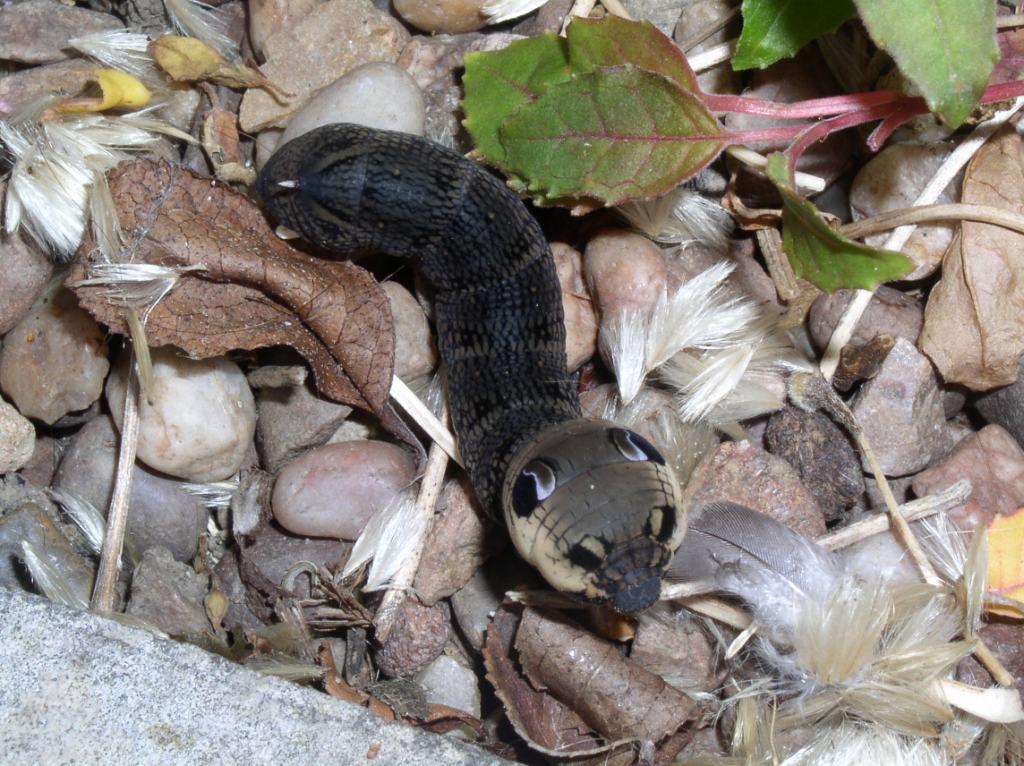
Mimicry using eyespots is widespread in nature - they are found in fish (such as the four-eyed butterflyfish Chaetodon capistratus which has them on the tail, so predators attack a non-lethal area or miss entirely), mammals (not only the 'obvious' ones such as leopards, but also the serval Leptailurus serval which has them on the backs of its ears for signalling to kittens while hunting), reptiles, birds and insects. Within the insects, butterflies and moths are probably best-known - many adult butterflies and moths have eyespots on the wings (the result of concentric pigment location around morphogenetic focus points), while the larva of the elephant hawkmoth Deilephila elpenor is famous for its conspicuous eye-like spots towards the head which are used to startle predators such as birds.

Elephant hawkmoth larva Deilephila elpenor showing eyespots
However, there are other invertebrates that show evidence of eyespots. I've previously written about bug (Hemiptera) nymphs possibly mimicing harvestmen, and today I noticed another - the common European garden spider Araneus diadematus. This is a very familiar species, often found on its orb-shaped web in gardens, and known for the pale cross-shaped marking (made from guanine which is a by-product of its protein metabolism) on the normally yellowish, orange or brown background of the top of the bulbous abdomen in females. Other common names include 'cross spider' and 'cross orbweaver', and males are smaller and less striking, though the markings are broadly similar.

Female Araneus diadematus showing the typical abdominal colour and cross-shaped marking

Male Araneus diadematus
So far, so good - but what about the eyespots I've mentioned. Well, the spiders are generally found either in the middle of their webs as shown above or tucked away in refuges at the ends of suspension silk lines. On webs they are typically head down and seen side on, either dorsally or ventrally. However, if you look stright down from the rear, a different pattern can be seen.

Female Araneus diadematus showing abdominal eyespots
To me, this is clear eyespot mimicry and makes adaptive sense - usually being head down, the rear of the abdomen is the part most likely to be presented to potential predators, namely birds, and therefore where eyespots that could startle them would be most useful. What I find more surprising is that I've never noticed this before despite having seen many specimens; more so that I can't find any other reports which suggests no-one else has either (or at least they written about it on the 'net). As ever, comments welcome!

Saturday, 19 February 2011

Entomology of Star Wars. Episode II: Metallic snails and vent mussels

As Episode I proved so popular, I've been thinking about extending the 'Entomology of Star Wars' into an occasional series - not easy as I don't go in for a lot of 'speculative biology', but I'm up for a challenge and do have a penchant for Science Fiction. So, time for a bit of a nerd-fest...

One beast that I have wondered about is the big asteroid-dwelling worm that the Millenium Falcon encounters in 'The Empire Strikes Back' - what it's made of, what it lives on, how it survives in space and so on. A little online digging soon told me that it's called a 'space slug' or 'exogorth' and that it's a silicon-based gastropod (I'm pleading poetic license and sticking with 'entomology' rather than 'conchology' though), feeding mainly by metabolising asteroid minerals through its root-like tail and absorbing stellar energy, though not averse to eating the occasional spacecraft or other unwary space-dwelling creatures. Also, it apparently reproduces by fission, moulting as it grows, then simply splitting in two when large enough.

The exogorth - in space, no-one can hear you roar!
Now, I don't intend to get into the whole hypothetical silicon-based life/alternative biochemistry thing - there are plenty of people doing that already, and there's even a Wikipedia page about it here. Instead I'd like to see if there are any parallels between this fictional beastie and real-world organisms.

Firstly, the metabolising of rocks and their constituent minerals. It's well known that some bacteria (lithoautotrophs) can metabolise a variety of minerals such as sulphur, iron and manganese and are involved in both the creation of limestone cave systems (speleogenesis), and the phenomenon of acid mine drainage (AMD), the outflow of acidic water from metal and coal mines. The biochemistry of such acidophilic bacteria can be complex, but in the case of cave systems such as Carlsbad and Lechuguilla in the US, rocks have been attacked microbially in three ways:
  • Oil-metabolisers - their biochemistry produces hydrogen sulphide which in turn produces sulphuric acid.
  • Rock-eating bacteria - the lithoautotrophs directly metabolising minerals.
  • 'Snotites' - large bacterial colonies which are primary producers in such ecosystems and drip sulphuric acid.
So, maybe the exogorth has lithoautotrophic gut flora - it has a mouth and dentition, so a gut seems likely. Thinking of a worm-like creature with symbiotic bactera does lead neatly onto the annelid tube worms such as Riftia associated with hydrothermal vents. These have become familiar creatures over the last decade or so through various TV programmes, and although they do not have a mouth or gut, they do contain symbiotic bacteria. These live within a specialised organ (the trophosome) in the worm and metabolise compounds such as carbon dioxide and hydrogen sulphide which are absorbed by the worm's plume. In turn they provide carbon compounds which nourish the worms. Similarly - and providing a handy molluscan parallel with the exogorth - vent mussels (Bathymodiolus thermophilus) are almost entirely dependent on symbiotic bacteria in their gills. Not only that, but in 2001, the Scaly-foot Gastropod (Crysomallon squamiferum) was discovered associated with hydrothermal vents in the Indian Ocean. What is unusual about this species is that its foot is armoured with 'scales' (technically 'sclerites') of iron sulphides (greigite and pyrite) and that its shell has a third layer also containing iron sulphide - it is the only animal known to use this mineral skeletally in this way. This means we do have molluscs with mineral-metabolising symbiotic bacteria, and that at least one can incorporate what we consider 'unusual' compounds into its anatomy. But, what about reproduction?

A heap of chemosynthetic vent mussels.
This seems fairly straighforward - all molluscs reproduce sexually (most gastropods are hermaphroditic), so definitely no fission. Still, although asexual reproduction is rare in higher animals, they are not unknown. For example, in Mexico, there are Topminnows of the genus Poeciliopsis where it is seen. Two species, P. monacha and P. lucida, reproduce sexually with their own species members when separate, but where they co-exist, they hybridise to produce all-female forms that reproduce by cloning (hybridogenesis and gynogenesis). In hybridogenesis, the female mates with a male, producing female offspring with both the maternal and paternal genomes. When that female produces eggs, the male genome is discarded, leading to the all-female form. In gynogenesis, females are triploid and also mate with males, but the male genome does not contribute to the offspring. There's also a good diagram explaining the process of hybridogenesis in water frogs here and there's plenty of research into gynogenesis in the African Clawed Frog (Xenopus laevis) - certainly, amphibians do seem to have a flexible approach to reproduction...

So, parallels between exogorths and real-world organisms? For molluscs, nutritionally yes but reproductively no - but what about the whole 'surviving in a vacuum' issue? Well, I think I'll leave that for Episode III...

Thursday, 6 January 2011

Britain's jawless wonders: brook lamprey ecology and taxonomic status.

Lampreys (family Petromyzonidae, ‘stone-suckers’) belong to the Agnatha, (‘jawless’), the most primitive of all living vertebrates. They have no lower jaws and the mouth is surrounded by a round sucker bearing circles of rasping teeth. They are eel-like in shape but have neither paired fins nor scales and their skeletons are entirely cartilaginous. There are three species of lamprey in Britain: brook (Lampetra planeri), river (Lampetra fluviatilis) and sea (Petromyzon marinus), but having seen L. planeri nest-building in a nearby river (the R. Itchen in Hampshire), it is this species that I want to focus on here.


Brook lamprey (Lampetra planeri) nest-building in the River Itchen, Hampshire, UK.

L. planeri  is the smallest of the three British species at 13–15 cm long. The teeth are blunt and less developed than in the other more predacious species, and it does not feed as an adult. Larvae (‘ammocoetes’), are semi-translucent and dull grey-brown in colour, though a 'golden' form does exist with reduced pigmentation. Larvae occur in suitable silt beds, mainly in running water but sometimes in large numbers in silt banks in lakes. Although not common, it is the most abundant and widespread British lamprey and its distribution can be seen in the maps below for the National Biodiversity Network (NBN); the larger-scale map shows Hampshire and surrounding areas. However, due to a decline in several parts of Europe, it has some legal protection including being long-listed in the UK Biodiversity Action Plan.


British distribution of L. planeri (from NBN as of 6th Jan 2011)

Distribution of L. planeri in and around Hampshire (from NBN as of 6th Jan 2011)

Usually cryptic and nocturnal, L. planeri (like most lampreys) are rarely seen except at spawning time (April & May) when they move into shallow, clear water during daylight to start their complex, communal nest-building activities - the photo above was taken in April 2009. As spawning approaches, adults move from silts and migrate upstream at night, often in large numbers, until they reach suitable spawning grounds. These are areas of small stones and gravel in flowing water where the current is present but not too strong. When the water reaches 10–11ºC they tend to spawn at the lower ends of pools, just where the water is starting to break into a riffle. The nest may be constructed by a dozen or more adults moving stones with their suckers and is normally an oval depression 20–40 cm across and 2–10 cm deep. Females produce about 1,500 eggs each and hatched larvae (3–5 mm long and blind) drift downstream to burrow in suitable areas of silty sand. The adults die soon after spawning. Larvae live for around 6½ years in Britain, filtering fine organic particles from the silt. Metamorphosis occurs during July to September, after which they are more silvery, though the back remains dark. They also develop teeth and full vision, though adults do not feed.

Upstream migration can only occur in the absence of barriers, either natural (e.g. waterfalls) or man-made (e.g. dams, weirs or polluted areas). Little is known about their requirements in terms of water quality and quantity, though some limited pollution appears to be tolerated if it does not lead to substrates being smothered. They need suitable conditions (e.g. substrate type) in spawning areas and nursery habitat, and rivers should not be changed to produce excessive cover or fast flow. Channelisation and some aspects of management for angling (e.g. dredging of pools and construction of weirs) has been damaging to lampreys, mainly through habitat destruction, with potential impacts from use as bait. The removal of riffles and associated spawning gravels, and the dredging of silt beds can entirely eliminate lampreys from a river. Similarly, water abstraction and land drainage can produce unstable habitats with variable water levels which flood and disturb spawning gravels and nursery silts at some times and dry out at others. Climate change is likely to produce similar problems, with heavy rain in the autumn and winter, and drought in the summer.

Also, although L. planeri and L. fluviatilis are generally treated as separate species, there is some genetic evidence that this might not be the case. Schreiber and Engelhorn (1998) found very little difference in the DNA content between both species suggesting L. fluviatilis may just be an anadromous form of the relatively 'stationary' L. planeri, with gene flow inferred between them. Their taxonomic relationship and status is still a matter for debate although further research continues to suggest that they may not be truly separate species. For example, Lesne et al. (2010) show a high incidence of communal spawning of the two species in a French river, suggesting that they are less reproductively isolated than previously believed.


From a practical conservation perspective, L. planeri (whether or not it is a species separate from L. fluviatilis) does have some key requirements, but nothing that a little more considerate and thoughtful river/habitat management shouldn't be able to provide in abundance, and which would in turn help mitigate the likely effects of climate change.

References

Lasne, E., Sabatié, M., & Evanno, G. (2010). Communal spawning of brook and river lampreys (Lampetra planeri and L. fluviatilis) is common in the Oir River (France) Ecology of Freshwater Fish, 19 (3), 323-325 DOI: 10.1111/j.1600-0633.2010.00428.x

Schreiber, A., & Engelhorn, R. (1998). Population genetics of a cyclostome species pair, river lamprey (Lampetra fluviatilis L.) and brook lamprey (Lampetra planeri Bloch) Journal of Zoological Systematics and Evolutionary Research, 36 (1-2), 85-99 : 10.1111/j.1439-0469.1998.tb00781.x

Further reading


  • More on lamprey ecology can be found here.
  • An identification guide to British lampreys can be found here.
  • A guide to monitoring lamprey can be found here.